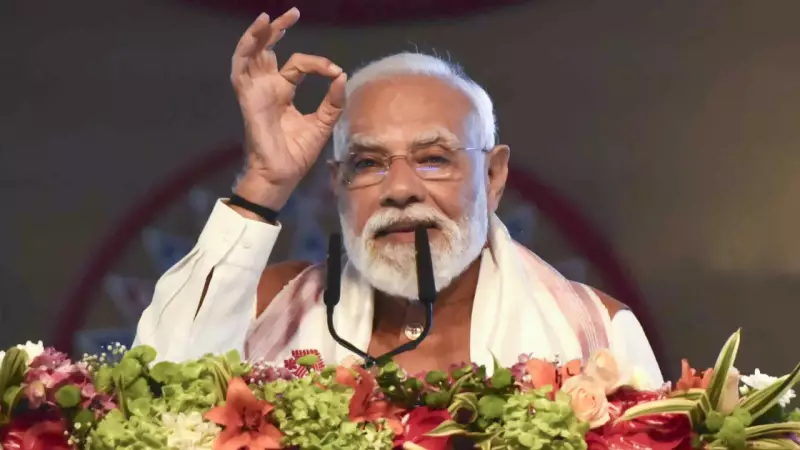
Prime Minister Narendra Modi was forced to pivot to a virtual address in West Bengal on Saturday after heavy fog prevented his helicopter from landing in Nadia district. The 18-minute speech from Kolkata airport became a platform for two crucial political maneuvers: reassuring the pivotal Matua community and countering criticism over his recent reference to Bankimchandra Chattopadhyay.
Navigating Matua Anxieties and Cultural Politics
The Prime Minister's scheduled public meeting at Taherpur in Nadia was scrapped due to weather, but the political agenda remained clear. The Matua community, a key voting bloc in districts like Nadia and North 24 Parganas, has shown growing unease over the Election Commission's Special Intensive Revision (SIR) of electoral rolls. Modi paid rich tribute to Matua icons Harichand Thakur, Guruchand Thakur, and Baroma, crediting them with advancing social development and teaching the "virtue of karma."
However, the speech did not directly address the community's specific fears linked to the revision. In Nadia, over 2.7 lakh voters (6%) are flagged as "unmapped," lacking linkage to the 2002 list. In North 24 Parganas, that number exceeds 7 lakh voters (8.8%). Matua elders believe a significant portion of these are from their community. BJP functionaries privately acknowledged the importance of Matua support for their past electoral successes and expressed surprise the issue wasn't engaged with more directly.

Linking SIR to Infiltration and Attacking Trinamool
Prime Minister Modi strategically connected the SIR exercise to the emotive issue of infiltration in border districts adjoining Bangladesh. He accused the Trinamool Congress (TMC) of being soft on the matter. "I can see them shouting 'go back Modi' slogans," he said, referring to TMC supporters. "But they are tight-lipped when it comes to saying 'go back' to infiltrators. The infiltrators, who are trying to control Bengal, are close to Trinamool's heart."
He asserted that this alleged proximity was why the ruling party in Bengal was "trying to save infiltrators and opposing SIR." This direct linkage aimed to frame the electoral roll cleanup as a national security imperative, a classic BJP plank.
Countering the 'Bankim Da' Controversy
The second front of damage control involved recent cultural criticism. After Modi referred to the 19th-century Bengali icon Bankimchandra Chattopadhyay as "Bankim da" in Parliament, the TMC had pounced, calling it proof of the BJP's cultural alienation from Bengal. In his virtual address, Modi carefully referred to the author as "Rishi Bankim babu," praising him as a sage who sowed seeds of emancipation in British-ruled India.
He highlighted Bengal's contribution to Indian history and culture, specifically noting the 150th-anniversary celebrations of 'Vande Mataram,' penned by Bankimchandra in his novel 'Anandamath.' Modi also invoked Sri Chaitanya, describing him as an icon of love and compassion, in a broader effort to reclaim the Bengali cultural narrative.
Pitching BJP as Bengal's Development Alternative
Beyond immediate controversies, Modi used the platform to position the BJP as the only viable alternative for Bengal's progress. After virtually inaugurating a four-lane highway project, he contrasted the NDA's landslide victory in Bihar with what he termed "mahajangalraj" (jungle rule) in Bengal, blaming the Trinamool government for stalled growth and lack of development.
The event, though unplanned in its virtual format, underscored the high-stakes political battle in Bengal, where the BJP is working to consolidate its gains, manage discontent among key allies like the Matuas, and wage a cultural war to shed the "outsider" tag ahead of future electoral contests.