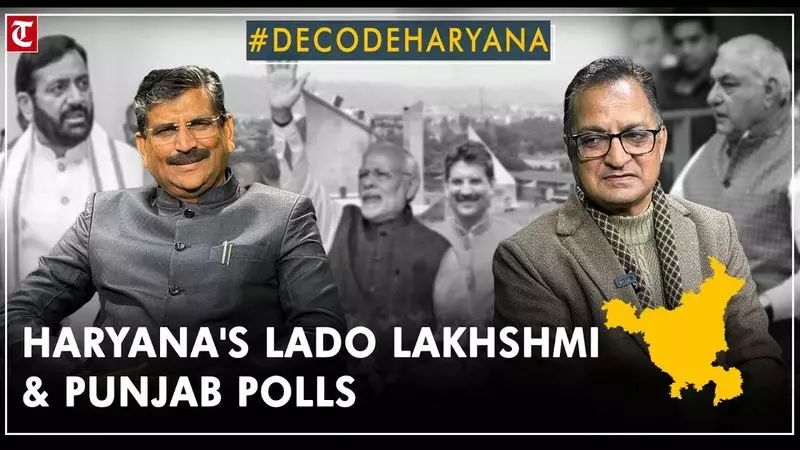
Haryana's Minister of State for Cooperation, Krishan Bedi, has made a significant claim that developments in his state, particularly concerning the Lado and Lakshmi issues and the Dalit community, are poised to dramatically influence the political landscape in neighboring Punjab ahead of its assembly elections. Bedi asserts that these factors will act as a decisive "game-changer," potentially reshaping voter sentiment and electoral outcomes.
The Catalysts from Haryana: Lado and Lakshmi
Minister Krishan Bedi highlighted two specific cases from Haryana that he believes will resonate powerfully with voters across the border in Punjab. The first is the case of Lado, a woman from Jind district. The second is the case of Lakshmi, a woman from Kaithal district. While the minister did not elaborate on the intricate details of each case in his public statement, he emphasized that both have become symbolic of broader social and justice issues.
These incidents, according to Bedi, have sparked widespread discussion and concern, transcending state boundaries. The implication is that the handling of these cases by authorities and the subsequent public reaction in Haryana are being closely watched by communities in Punjab, particularly those who share similar socio-economic backgrounds or have faced analogous challenges.

The Potent Dalit Factor in Punjab's Electoral Math
Central to Bedi's analysis is the mobilization of the Dalit community. He directly stated that the "Dalit factor" will play a pivotal role in the upcoming Punjab polls. This community constitutes a significant portion of the electorate in Punjab, and their political alignment can determine the fate of political parties in numerous constituencies.
Bedi suggests that the sentiments stirred by the Lado and Lakshmi issues in Haryana are finding a strong echo among Dalit voters in Punjab. The perception of justice, administrative response, and social dignity surrounding these cases is likely to influence how this key demographic exercises its franchise. Political observers note that parties are increasingly vying for the Dalit vote bank, making Bedi's comments particularly timely and strategic.
Inter-State Political Ripples and Implications
The assertion by a senior Haryana Bharatiya Janata Party (BJP) leader about Punjab's elections underscores the interconnected nature of regional politics in North India. It suggests that socio-political movements and public grievances are not confined by state lines, especially among culturally and linguistically contiguous regions.
Krishan Bedi's statement can be seen as an attempt to frame a narrative that connects the governance and social justice record of the BJP-led government in Haryana with the political choices facing Punjab's electorate. By positioning these issues as potential game-changers, he is indirectly highlighting themes that his party and its allies might seek to leverage in the political discourse leading up to the election campaign.
The upcoming Punjab assembly elections are already a keenly contested affair, and Bedi's intervention adds a new dimension to the pre-poll analysis. It remains to be seen how political parties in Punjab respond to this external commentary and whether the "Lado-Lakshmi-Dalit factor" indeed translates into a tangible electoral wave as predicted by the Haryana minister. The coming weeks will reveal the impact of these inter-state political ripples on the ground.