

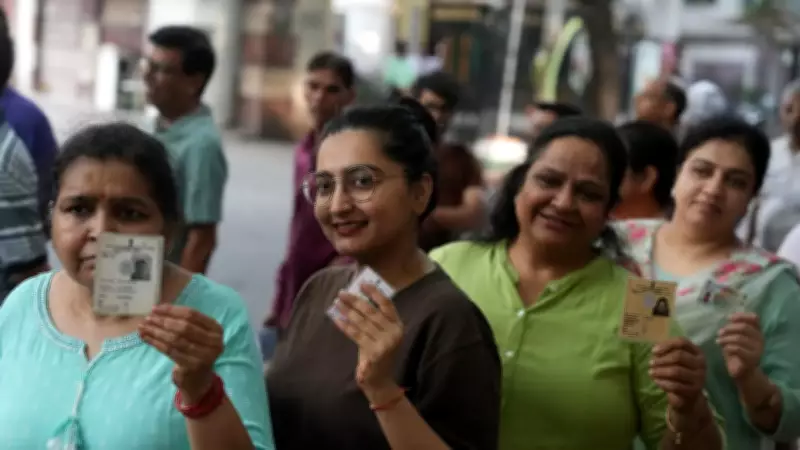
With the high-stakes second and final phase of the West Bengal assembly elections 2026 concluding on Wednesday, all eyes are now on exit poll projections that are expected to be released after 6.30 pm tomorrow, in line with Election Commission rules.
Phase 2 Voting in West Bengal
Voting in Phase 2 will cover the remaining constituencies of the 294-seat Assembly, and is up for an intense political activity across districts, with both the ruling Trinamool Congress (TMC) and the Bharatiya Janata Party (BJP) making last-minute appeals to voters amid a closely watched contest. According to Election Commission guidelines, exit polls are strictly prohibited until 30 minutes after polling ends in the final phase. ECI will allow 2026 exit poll results after 6.30 pm on April 29. You can track exit polls for West Bengal, Tamil Nadu, Kerala, Assam, and Puducherry here.
In West Bengal, voting was held in 152 constituencies on April 23 during the first phase of the elections, registering a record turnout of nearly 93% in several regions. The high participation levels have added to the anticipation surrounding final results. Bengal recorded a historic 93.2% turnout in the first phase of assembly elections, while Tamil Nadu's final provisional figure settled at 85.1% after a marginal revision, EC data showed on Saturday.

In Assam, polling for all 126 seats concluded with a final and historic turnout of 85.5%, reflecting strong voter participation across rural and urban belts.
PM Modi on Women's Voting
Prime Minister Narendra Modi said on Tuesday that women came out in large numbers to vote in the assembly elections in five states/UTs to teach a lesson to “pariwarvaadi” (dynastic) opposition parties, which were against the entry of more women into legislative bodies.
Addressing an all-woman convention, ‘Nari Shakti Vandan’, in his parliamentary constituency, he said: “We have seen in Assam, Kerala, Puducherry, West Bengal and Tamil Nadu that sisters have cast record votes. The parties opposing women’s reservation have no idea that this vote of the sisters was to punish these anti-women parties.”
The PM assured women that he will leave no stone unturned to ensure that their right to reservation in legislative bodies is implemented, as he slammed the opposition parties for joining hands to defeat the Constitution amendment bill on women’s reservation.
Parties rooted in dynastic politics feared losing their grip on power if more women from the grassroots entered electoral politics, he said, adding: “Parties doing politics of ‘pariwarvaad’ and appeasement consider the rise of women in law-making bodies in greater numbers as the biggest threat to their existence.”
Citing the construction of the new Parliament building as proof of his govt’s intention “to fulfil our commitment” to giving a 33% quota to women in Lok Sabha and state assemblies, Modi said, “The first bill we tabled in the new Parliament building was also the same, and it was passed.”
When the time came to execute that, family-centric parties like Congress, Samajwadi Party, Trinamool Congress and DMK, “like the past 40 years”, came together to prevent women from emerging as decisionmakers, the PM said.
Mixing Bhojpuri with Hindi, Modi said, “Women are the keys in making a family, society and country, but they are still told — ‘tu ka karbu, tu chup raha, tose na ho payi, ka jaroorat hao’ (What will you do? You sit silently, you will not be able to do, what is the need?).”
West Bengal: Mamata vs BJP in Final Phase
West Bengal, the largest among the five poll-bound states and the only one yet to complete voting, is drawing intense attention as counting is set for May 4. Even before that, focus has shifted to exit polls, which will begin coming in from the evening of April 29, after 6.30 pm as per Election Commission rules.
After a record turnout of nearly 93% in Phase 1, the state has moved into Phase 2, the final and decisive round, with voting underway in 142 constituencies. This phase covers the remaining seats of the 294-member Assembly, making it critical in shaping the final outcome.

Polling began at 7 am amid unprecedented security arrangements, with voters lining up across key districts including Kolkata, Howrah, North and South 24 Parganas, Nadia, Hooghly and Purba Bardhaman, regions that form the political core of the state. Voting will continue till 6 pm.
Most of the constituencies in this phase are considered strongholds of chief minister Mamata Banerjee, but the Bharatiya Janata Party is making an aggressive push to expand its presence in these areas.
One of the most closely watched contests is in Bhabanipur, Mamata Banerjee’s bastion, where she faces a strong challenge from BJP leader Suvendu Adhikari.
Other prominent candidates in the fray include Chandrima Bhattacharya, Shashi Panja and Aroop Biswas from the Trinamool Congress, while the BJP has fielded leaders such as Swapan Dasgupta and Rupa Ganguly.
Tamil Nadu: Tight Contest Expected
The stage is set for a high-stakes verdict in the Tamil Nadu Assembly elections, with results for all 234 constituencies to be announced on May 4 following polling on April 23.
With counting yet to begin, attention has now turned to exit polls, which are expected to give early signals of voter preferences in what is shaping up to be a closely fought election.
The main contest is between the DMK-led alliance and the AIADMK-led front. Chief Minister M. K. Stalin is seeking a second consecutive term, while Edappadi K. Palaniswami is aiming to bring the AIADMK back to power after five years.
Tamil Nadu’s political landscape continues to be dominated by Dravidian parties, with national players in supporting roles. The Bharatiya Janata Party is contesting in alliance with the AIADMK, while the Indian National Congress remains aligned with the ruling Dravida Munnetra Kazhagam.
The AIADMK, which last won the state in 2016 under J. Jayalalithaa, has struggled to regain its footing after her death, with leadership shifts involving O. Panneerselvam and Palaniswami reshaping the party’s direction.
Adding a new dimension to the contest is actor-turned-politician Vijay, whose party, Tamilaga Vettri Kazhagam, has drawn large crowds and heightened interest in the election.
Tamil Nadu recorded around 4.87 crore votes, reflecting strong voter participation across the state. The turnout could prove decisive, especially in closely contested seats.
EC Ban on Exit Polls Until April 29
The Election Commission had earlier said that exit polls for the assembly elections of five states can neither be held nor disseminated from 7 am on April 9 till 6:30 pm on April 29. The poll body said that conducting or broadcasting exit polls in the period is violative of section 126A of the Representation of People Act, 1951 and is punishable with imprisonment up to a period of two years, or with a fine or both.
This is a standard measure aimed at ensuring free and fair elections and preventing exit poll data from influencing voters while polling is still underway.
What Are Exit Polls?
Exit polls for the Tamil Nadu, Kerala, Assam and Puducherry assembly elections will be released after 6:30 pm on April 29, in line with guidelines set by the Election Commission of India. The poll panel mandates that exit poll results can only be published 30 minutes after voting ends in the final phase.
These projections will be broadcast across major TV news channels and digital platforms soon after the embargo is lifted.
Exit polls are surveys conducted with voters immediately after they cast their ballots. Unlike opinion polls, which measure voter mood before elections, exit polls are based on actual responses from voters about whom they voted for, offering an early indication of possible results.





