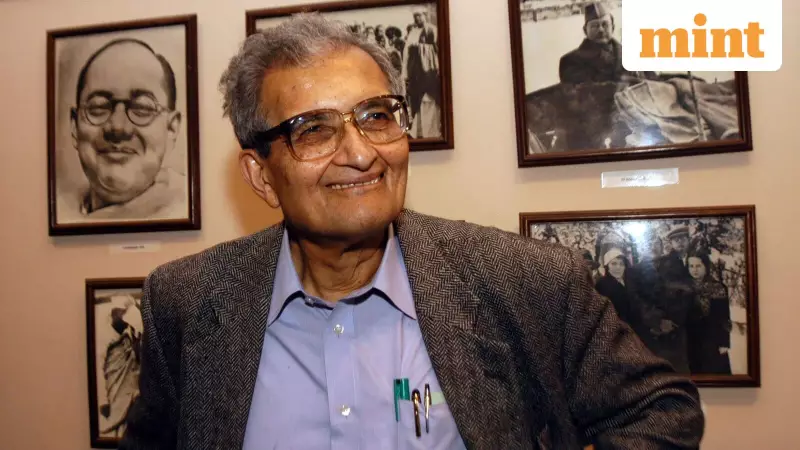
The Election Commission of India (EC) on Tuesday moved swiftly to clear the air, stating that Nobel laureate Amartya Sen is not required to appear for any hearing concerning discrepancies in the spelling of his name in the electoral roll. This official clarification came after reports and political claims suggested the eminent economist had been summoned.
Clarification Follows TMC Leader's Claim
The Commission's statement was issued following assertions made by Trinamool Congress (TMC) leader Abhishek Banerjee earlier in the day. Banerjee had claimed that Professor Sen, along with other notable personalities like actor Dev and cricketer Mohammed Shami, had been served with a hearing notice under the ongoing Special Intensive Revision (SIR) of voter lists.
"On my way here, I was told that Professor Amartya Sen, the Nobel laureate who brought global recognition to our country, has been served with an SIR hearing notice," Banerjee had stated. However, a family member of Sen later told PTI that they had not yet received any such formal notice from the poll body.

EC Calls It a "Purely Technical" Matter
An EC official, cited by PTI, explained that the confusion was minor and procedural. "The confusion over the spelling is purely technical and has no bearing on the voter's eligibility," the official said. The Commission emphasised that such minor errors in voters' names do not impact the hearing process or a citizen's voting rights.
To prevent unnecessary controversies, officials have been instructed to resolve these matters at the administrative level itself. The EC also warned its field authorities against creating public disputes over such technicalities.
Background on the Special Intensive Revision (SIR)
The clarification comes amid a large-scale voter list revision exercise in West Bengal. The first phase of the SIR identified around 1.36 crore voters with data inconsistencies. Following this phase, the draft electoral roll published on December 16 showed the state's electorate dropping from 7.66 crore to 7.08 crore after the deletion of over 58 lakh names.
The second phase, which began on December 27, involves hearings for a total of 1.67 crore electors under scrutiny. This includes the 1.36 crore flagged for logical discrepancies and another 31 lakh voters whose records lack proper mapping.
In a related directive, the EC has issued strict instructions to ensure all notices concerning discrepancies are downloaded and delivered to voters within four to five days, with no lapses tolerated. The state Chief Electoral Officer's office is now requiring daily constituency-wise reports on the number of notices served.
Political Reactions and Broader Context
The SIR process has become a point of political contention. Earlier, on Sunday, West Bengal Chief Minister Mamata Banerjee had written to Chief Election Commissioner Gyanesh Kumar, urging him to halt what she called an "arbitrary and flawed" revision. She warned that continuing the process in its present form could lead to mass disenfranchisement and undermine democracy.
Banerjee alleged that officials involved lacked proper training and that the IT systems being used were defective and unreliable. The EC's latest clarification on the Amartya Sen case appears to be an effort to depoliticise individual instances and focus on the technical nature of the clean-up drive.
Who is Amartya Sen?
Amartya Sen is a world-renowned Indian economist and philosopher, best known for his work on welfare economics, social justice, and human development theory. He was awarded the Nobel Prize in Economic Sciences in 1998 for his contributions to the understanding of poverty, famine, and inequality. His seminal 'capability approach' has influenced global policy frameworks, including the United Nations' Human Development Index.
The EC's proactive clarification underscores its attempt to manage the sensitive voter list revision process while addressing concerns about the potential harassment of prominent citizens over minor clerical issues.