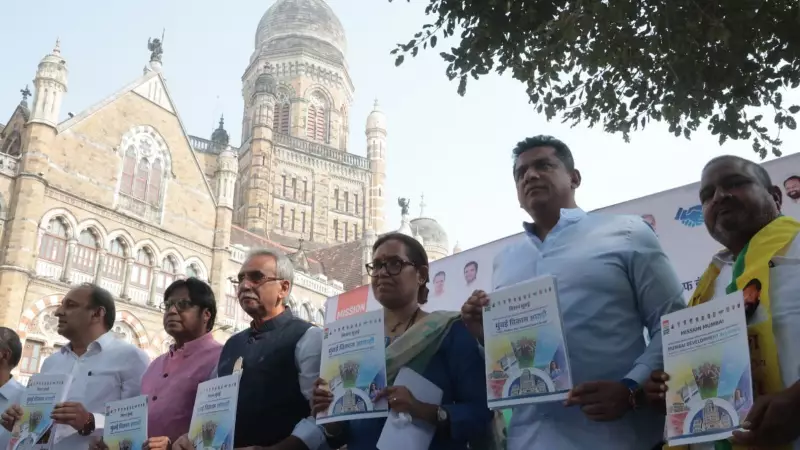
The Congress-led Mumbai Vikas Aghadi (MVA) alliance has officially presented its vision for India's financial capital, releasing a comprehensive manifesto for the upcoming Brihanmumbai Municipal Corporation (BMC) elections. Titled 'Mission Mumbai 2026', the document was unveiled at a press conference in Mumbai on Tuesday by coalition partners including the Indian National Congress, Vanchit Bahujan Aghadi (VBA), Rashtriya Samaj Paksha, and the Republican Party of India (Gavai).
Healthcare and Water Security Take Center Stage
Positioning itself firmly against the privatisation of the BMC's health care system, the alliance has made a series of ambitious promises to overhaul public health. The cornerstone is a proposed universal health card that would guarantee free essential medicines to all citizens. The manifesto also plans to transform Seven Hills Hospital into a premier critical care center and double the capacity of ICU and NICU units across BMC facilities.
To bring transparency, the MVA promises to introduce a real-time online bed tracking system. Furthermore, it vows to adopt international medical education standards in all civic-run hospitals and medical colleges.

Addressing Mumbai's perennial water woes, the coalition has made a significant pledge: 20 per cent free water supply for all Mumbaikars. It aims to increase the city's daily water supply to 5,000 million litres per day (MLD). To achieve this, the alliance plans to cancel the annual eight per cent water tax hike, fast-track the long-pending Gargai dam project, and implement desalination plants to convert seawater into potable water.
Education, Transport, and a Pothole-Free City
The education sector receives considerable attention in the manifesto. The MVA promises to reopen closed municipal schools and introduce AI-based smart classrooms to modernise education. It also commits to providing 32 free educational items to students and launching a free bus service specifically for BMC school students. In a move for social justice, the coalition has pledged to reserve five percent of the BMC's budget for Scheduled Caste (Nav-Bauddha) and Scheduled Tribe categories.
Infrastructure and mobility form another critical pillar. The alliance has vowed to make Mumbai pothole-free through extensive road concretisation and take strict action against contractors responsible for poor work. For public transport, it proposes to increase the BEST bus fleet to 6,000 vehicles and opposes any form of its privatisation. A notable promise is to bring suburban power supply back under BEST's control and use the profits to cross-subsidise and reduce bus fares.
Housing, Women's Safety, and Green Initiatives
The manifesto addresses housing rights, aiming to protect local Marathi families by developing planned housing projects on BMC-owned land. For women's welfare, it promises to establish 'Hirkani Units' in every municipal ward, along with more Anganwadis and day-care centers to support working mothers.
Environmental concerns are tackled through the proposed 'Green Mumbai 2030' initiative. This includes plans for real-time air quality monitoring across the city and enforcing strict dust control measures at construction sites to combat pollution. The coalition also promises to conduct audits of all existing parking lots and create new, safe parking spaces to ease congestion.
Built on the slogan of 'Unity, Mobility, Fraternity, and Inclusive Development', the MVA's 'Mission Mumbai 2026' manifesto presents a multi-pronged strategy to address the city's most pressing civic issues, setting the stage for a competitive BMC election.