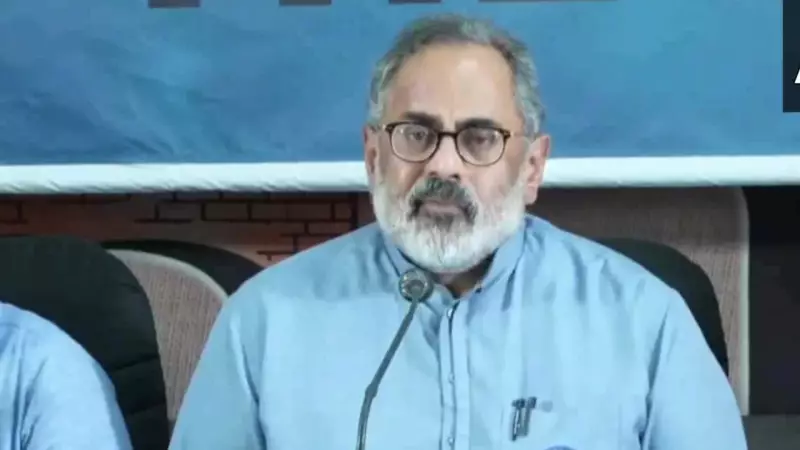
Kerala BJP president Rajeev Chandrasekhar stated on Wednesday that the absence of Muslim ministers in the Union cabinet directly reflects electoral realities rather than deliberate exclusion, emphasizing that Muslim voters largely do not support the BJP in elections.
Electoral Reality, Not Discrimination
Speaking in Kozhikode, Chandrasekhar directly addressed the representation issue, stating Muslims don't vote for us as a matter of electoral fact. He questioned what benefits Muslim communities have gained from consistently voting for Congress instead, while maintaining that the BJP has never discriminated against Muslims and provides representation wherever voters back party candidates.
The BJP leader pointed to several Muslim leaders within party structures, including Mukhtar Abbas Naqvi and Shahnawaz Hussain as prominent examples. He also noted that Muslim MPs currently represent Jammu and Kashmir in the Rajya Sabha, while Kerala has seen numerous Muslim BJP candidates in local body elections.

Countering Decades of Misconceptions
Chandrasekhar described a 30-year false narrative portraying the BJP as communal and anti-Muslim, which he labeled as hypocrisy at its highest level. He asserted that the party openly works for everyone's welfare and respects all faiths equally.
The Kerala BJP chief highlighted that the party has established a Muslim outreach team led by Prof Abdul Salam that is actively engaging with community groups to address perception gaps and build trust. He characterized this outreach as central to the BJP's strategy to counter what he called decades of misconception-driven narratives about the party.
Constitutional Values vs Anti-Constitutional Forces
Chandrasekhar drew clear distinctions between the BJP's constitutional approach and organizations he claims work against democratic values. We are against Jamaat-e-Islami and SDPI because they act against the Constitution, he stated, adding that the party also opposes political groups that support these organizations.
He emphasized that the BJP believes in the Constitution and democracy, contrasting this with Jamaat-e-Islami's stated position against both. The party will work hard to earn Muslim community trust and end what he described as the poisonous campaign led by LDF and UDF.
Despite opposition criticism accusing the BJP of justifying under-representation rather than addressing it, Chandrasekhar maintained that minority outreach represents a gradual process. The party intends to continue its engagement with Muslim communities in preparation for future elections, viewing this as essential to changing long-standing voting patterns.