The political landscape of India is set for a significant shift in 2026, with assembly elections scheduled in four major states and one Union Territory. This comes after a year of decisive victories for the ruling NDA alliance led by the BJP in the 2025 Delhi and Bihar assembly polls, which delivered major setbacks to the opposition.
The 2026 Electoral Battleground: States in Focus
Elections are due between March and May 2026 in West Bengal, Kerala, Tamil Nadu, Assam, and Puducherry. With the exception of Assam, which is ruled by the BJP, the opposition holds a dominant position in the other three states. Political parties have already begun fine-tuning their strategies for these high-stakes contests.
A crucial factor influencing these elections will be the Special Intensive Revision (SIR) of electoral rolls, which has been extended to several poll-bound states including West Bengal, Tamil Nadu, and Puducherry. The updated voter lists could significantly alter the dynamics in key constituencies.

West Bengal: A Saffron Surge vs. TMC Fortress
Buoyed by its success in Bihar, the BJP has clearly marked West Bengal as its next major battleground. The party aims to convert its rising momentum into seats, challenging the long-held fortress of Mamata Banerjee's Trinamool Congress (TMC).
The TMC, which won a massive 213 of 294 seats with a 48% vote share in 2021, is campaigning vigorously to defend its decade-long rule. The BJP's rise has been dramatic, jumping from just 3 seats in 2016 to 77 seats and a 38% vote share in 2021. The 2026 election will determine if this was a one-time surge or a sustained challenge.
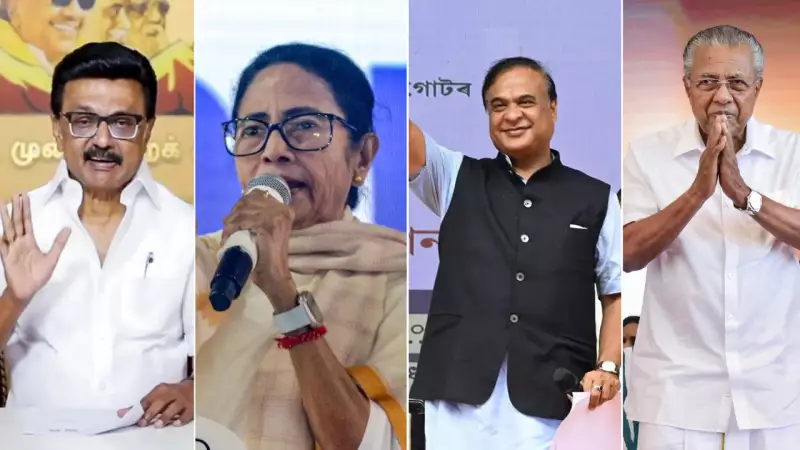
The Congress, once dominant, is now fighting for relevance. The future of the opposition INDIA bloc in the state is uncertain, with Chief Minister Mamata Banerjee repeatedly stating, "Bengal is ours, we will fight here alone." This leaves Congress caught between national alignment and local confrontation.
Tamil Nadu: Bipolar Contest with a New Entrant
Tamil Nadu is preparing for another intense duel between the Dravida Munnetra Kazhagam (DMK) and the All India Anna Dravida Munnetra Kazhagam (AIADMK). The ruling DMK, which secured 133 seats on its own in 2021, faces the test of anti-incumbency and a regrouped AIADMK-BJP alliance.
Chief Minister M.K. Stalin has announced the DMK will contest as part of the INDIA bloc. The AIADMK, led by Edappadi K. Palaniswami, is desperate for a comeback after two consecutive defeats and has vowed to shatter the DMK's ambitions.
A potential game-changer is the entry of actor Vijay's Tamilaga Vettri Kazhagam (TVK). While his massive youth following introduces a surprise factor, the party's electoral debut is shadowed by the tragic Karur stampede that claimed 41 lives during a roadshow.
Kerala: A Bid for a Historic Third Term
Kerala presents a rare scenario where the CPI(M)-led Left Democratic Front (LDF) is attempting an unprecedented third consecutive term in office, breaking the state's traditional pendulum politics. The LDF won 99 of 140 seats in 2021.
Chief Minister Pinarayi Vijayan is campaigning on a platform of continuity, but the coalition faces significant anti-incumbency. The Congress-led United Democratic Front (UDF), which dropped to 41 seats, sees this as its best chance for revival. The BJP continues its struggle to open its account in the state assembly.
Assam: BJP Aims for a Hat-Trick
In Assam, the BJP-led NDA under Chief Minister Himanta Biswa Sarma is fighting to secure an unprecedented third consecutive term. Despite winning 75 seats in 2021, anti-incumbency is a key challenge. Sarma has set an aggressive target, claiming the NDA can win "104 out of 126 seats."
The Congress, which won 50 seats last time, is attempting a revival under new state chief Gaurav Gogoi, who is leveraging public sentiment against a decade of BJP rule. The role of Badruddin Ajmal's AIUDF, which won 16 seats, will be critical, as a split in the opposition vote could benefit the BJP.

Puducherry: A Test for a Fragile Coalition
In the Union Territory of Puducherry, the ruling coalition of N. Rangasamy's AINRC and the BJP faces the dual challenge of internal discord and anti-incumbency. The alliance, which together won 16 seats in 2021 (AINRC 10, BJP 6), has been rattled by resignations exposing fault lines.
The DMK, with 6 seats, is the main opposition and seeks to expand its footprint. For the Congress, the 2026 election is a battle for survival to prevent political irrelevance in the territory.
Conclusion: A Pivotal Year for Indian Politics
The 2026 assembly elections represent a pivotal moment for both the ruling NDA and the opposition. For the BJP, it is an opportunity to consolidate its gains and make inroads into new territories. For the fragmented opposition, it is a crucial test to demonstrate resilience and mount an effective challenge. The outcomes in these states will not only shape regional politics but also set the tone for the subsequent national electoral landscape.