In a startling revelation, Pakistan's President Asif Zardari has shared tense details from the period following India's decisive military response, Operation Sindoor, stating that he refused his military secretary's advice to seek safety in a bunker. This admission comes alongside continued analysis of the operation's impact, with Indian experts challenging Pakistan's narrative of minimal damage.
Zardari's Defiant Stance During Heightened Tensions
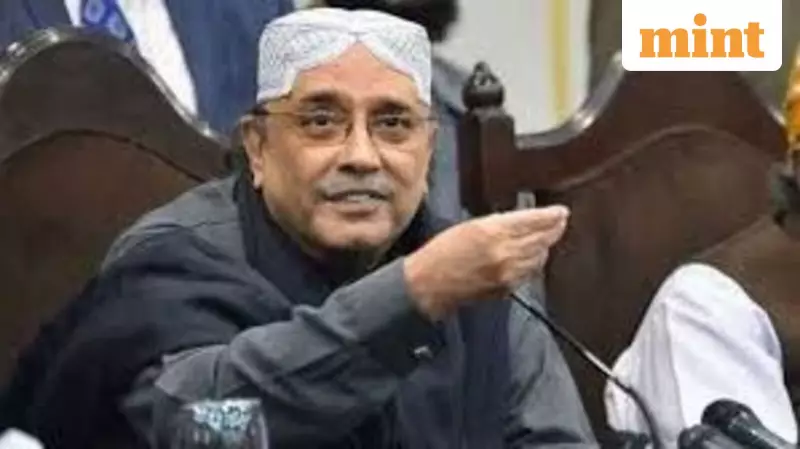
Recalling the critical moments after Operation Sindoor was launched by the Indian Armed Forces, President Zardari described how his Military Secretary (MS) urgently advised him to move to a secure bunker. "My MS was there. He came to me and said, 'Sir, the war has started.'... He came to me and said, 'Sir, let's go to the bunkers,'" Zardari recounted in an interview cited by ANI.
However, Zardari claimed he declined the protective measure, responding with rhetoric about martyrdom. "I said, 'If martyrdom is to come, it will come here. Leaders don't die in bunkers. They die on the battlefield,'" he stated. This personal account sheds light on the high-stakes environment in Pakistan's leadership circles during the cross-border crisis.

Operation Sindoor: Retaliation and Escalation
The context for this episode was India's precision military strikes, codenamed Operation Sindoor, conducted in the early hours of May 7. This action was a direct retaliation for the devastating terror attack in Pahalgam, Jammu and Kashmir, on April 22, which resulted in the deaths of 26 people, most of them tourists.
The Indian operation targeted nine terror camps in Pakistan and Pakistan-occupied Jammu and Kashmir (PoJK), along with strikes on Pakistani military installations. The aftermath saw a significant escalation, with intensified cross-border shelling from Pakistan and robust countermeasures from Indian forces.
The tensions eventually led to a de-escalation initiated by Pakistan. Pakistan’s Director General of Military Operations (DGMO) contacted his Indian counterpart to propose a ceasefire, which India accepted. This outreach was later confirmed by Foreign Secretary Vikram Misri, noting both nations agreed to suspend military actions across all domains.
Contesting Pakistan's Narrative on Damage
Recently, Pakistan's Foreign Minister and Deputy Prime Minister, Ishaq Dar, acknowledged that Indian strikes during Operation Sindoor caused damage to a military installation and injuries at the Nur Khan Air Base in Rawalpindi's Chakala. However, he downplayed the impact, alleging India launched around 80 drones, of which Pakistan intercepted 79, with only one causing "minor" damage.
This characterization has been strongly contested by Lt Gen (Retd) KJS Dhillon, author of a book on the operation. Dhillon labeled Dar a "compulsive liar" who eventually tells the truth. He pointed to a critical piece of evidence: a report on Pakistan's own Samaa TV website on August 14, 2025, which listed 138 personnel awarded posthumous gallantry awards for actions during Operation Sindoor.
"If 138 were awarded posthumously, that means at least 400 to 500 people had died during Operation Sindoor because of military action," Dhillon asserted, directly contradicting the official Pakistani stance of limited casualties. He further criticized the description of "minor injuries," citing videos from Pakistani civilians showing the Nur Khan Air Base on fire and insisting that all eleven targeted Pakistani air bases were severely damaged.
The disclosures from President Zardari and the ongoing debate over the operation's consequences underscore the lasting impact of Operation Sindoor. They highlight the continued gap between the narratives of the two nations regarding one of the most significant military confrontations in recent years, even as official channels maintain a fragile ceasefire.