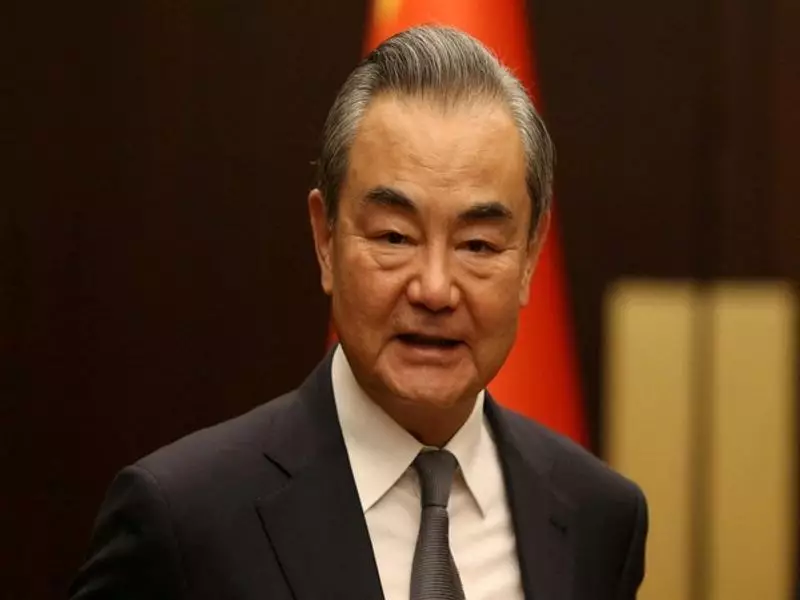
China's top diplomat, Foreign Minister Wang Yi, has explicitly pointed to the longstanding tensions between India and Pakistan as one of the prominent global hotspots where Beijing is actively involved in mediation efforts. This statement provides a rare public glimpse into China's diplomatic priorities and its self-perceived role as an international peacemaker, particularly in regions close to its strategic interests.
Wang Yi's Candid Assessment of Global Flashpoints
During a significant press conference held on the sidelines of the National People's Congress in Beijing on March 7, 2024, Wang Yi addressed a wide array of foreign policy matters. The veteran diplomat, who also serves as a member of the Political Bureau of the Communist Party of China Central Committee, outlined the complex landscape of international conflicts. He did not shy away from naming the India-Pakistan situation as a key area of concern, placing it alongside other protracted disputes around the world.
Wang Yi emphasized that China maintains a consistent and principled position on such international issues. "We consistently uphold fairness and justice," he stated, outlining Beijing's approach. His remarks suggest that China views the stability of South Asia as integral to its own security and economic corridors, including the massive China-Pakistan Economic Corridor (CPEC) that passes through Pakistan-administered Kashmir, a region also claimed by India.

China's Dual Role: Mediator and Stakeholder
The Chinese Foreign Minister's comments underscore a nuanced, and often debated, aspect of Beijing's foreign policy. While positioning itself as a neutral mediator, China is simultaneously a major strategic and military partner to Pakistan. This relationship includes significant defense cooperation and unwavering political support on issues like Kashmir at international forums such as the United Nations Security Council.
For India, this declared mediation role is likely to be viewed with considerable skepticism. New Delhi has consistently maintained that all issues with Pakistan, including the core dispute over Jammu and Kashmir, are strictly bilateral matters to be resolved without any third-party intervention. India's official stance rejects any external mediation, including from China. Wang Yi's statement, therefore, highlights a fundamental divergence in perspective between New Delhi and Beijing on the very nature of resolving the India-Pakistan conflict.
The timing of the statement is also notable, coming amidst a prolonged period of frozen high-level dialogue between India and Pakistan and continued cross-border tensions. It signals China's continued interest and potential involvement in the region's stability, which it links to the security of its Belt and Road Initiative projects.
Broader Implications for Regional Diplomacy
Wang Yi's identification of the India-Pakistan tensions as a hotspot for mediation has several immediate implications. Firstly, it publicly reaffirms China's intent to remain an active, if not central, player in South Asian geopolitics. Secondly, it may be interpreted as a message to both India and Pakistan about Beijing's readiness to facilitate dialogue, should both parties signal an openness to it—a scenario currently unlikely from the Indian side.
Furthermore, this stance is part of a larger Chinese narrative of promoting a "multipolar world" and offering an alternative to Western-led diplomatic models. By showcasing its involvement in complex disputes like that between India and Pakistan, China aims to bolster its image as a responsible global power capable of managing international crises.
The development adds another layer to the already complicated trilateral dynamic between China, India, and Pakistan. It comes at a time when India's relationship with China is itself under strain due to the prolonged military standoff along the Line of Actual Control in eastern Ladakh. The juxtaposition of border tensions with India and an offer to mediate between India and Pakistan presents a complex diplomatic challenge for all nations involved.

In conclusion, Foreign Minister Wang Yi's candid remarks have brought China's diplomatic calculus into sharper focus. While the prospect of China acting as a genuine neutral mediator in the India-Pakistan conflict remains low from New Delhi's viewpoint, the statement firmly establishes Beijing's official interest and perceived role in one of Asia's most enduring and dangerous confrontations. The move is likely to be analyzed in diplomatic circles as part of China's broader strategy to shape the regional order in Asia.