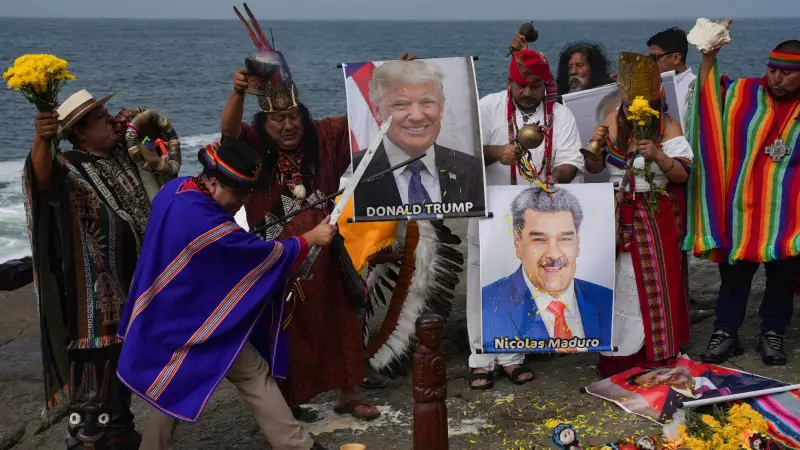
The recent American military strikes in Venezuela have been framed, like so many interventions before, in the language of moral urgency. The justification of combating "narcotics terrorism" is presented as a decisive and righteous necessity. While it is crucial to acknowledge without evasion that Venezuela under President Nicolás Maduro has suffered profound repression, economic collapse, and institutional decay—a regime that demands scrutiny and change—history demonstrates that military strikes are never a viable solution.
The Familiar Script of Imperial Overreach
This latest action follows a well-worn pattern. A global power identifies a crisis, views it through the lens of its own strategic fears, and then acts as if its intervention is both unavoidable and salvific. The rationales shift from counterterrorism and humanitarian rescue to narcotics interdiction, but the core impulse remains unchanged: the desire for control.
For decades, American foreign policy has provided a case study in this dynamic. From Vietnam and Iraq to Afghanistan and Syria, and now via Venezuela, the United States has repeatedly learned that invading, reshaping, or attempting to manage another society yields unforeseen and unmanageable consequences. The nation is seldom prepared to bear the long-term burdens of its actions.

However, focusing criticism solely on the United States would be incomplete. Russia's brutal invasion of Ukraine stems from the same imperial mindset—the conviction that neighbouring nations are pawns on a chessboard, not sovereign entities. The Kremlin's rhetoric of historical entitlement mirrors the American narrative of exceptionalism. Different flags and slogans, but the same underlying pathology.
The Stubborn Reality Beyond Military Force
Empires often see themselves as architects of stability. They operate under the belief that removing a "bad" regime and installing "good" incentives will steer history toward their vision. Yet reality consistently proves more stubborn.
In Iraq, the ouster of a dictator led to devastating sectarian conflict. In Afghanistan, two decades of occupation evaporated within days. In Ukraine, a reckless invasion has fortified NATO, ravaged cities, and caused generational trauma, while failing to secure Moscow's objectives. Now, in Venezuela, US strikes risk entangling Washington in the complex fate of a fractured state it does not fully comprehend and is not ready to reconstruct.
Imperial ventures always incur hidden costs: open-ended commitments, political blowback, moral compromise, and the grim understanding that while force can overthrow governments, it cannot, by decree, create legitimacy.
The Path Forward for Venezuela and Beyond
There is no denying that Nicolás Maduro's governance has severely harmed the Venezuelan people. But swapping one form of domination for another is not liberation. Notably, opposition figure Maria Corrina Machado has drawn criticism for openly praising former US President Donald Trump and urging military intervention, a stance some argue tarnishes her Nobel Laureate status and reveals concerning power ambitions.
A sustainable future for Venezuela must prioritise a broader spectrum of Venezuelan voices, robust regional diplomacy, and international frameworks designed to curb unilateral adventurism—whether American or otherwise. The US mistake of opting for readily available military alternatives, seen in Afghanistan and Syria, must not be repeated in Caracas.
The enduring lesson of our era, one that is often ignored, is starkly simple: Nations cannot be engineered from the outside. Sovereignty is not a privilege to be bestowed. Empires, no matter how enlightened they believe themselves to be, ultimately confront the repercussions of their own ambition.

The events in Venezuela should spark more than a debate on US policy. They should compel a confrontation with the broader age we live in—an era where multiple powers, assured of their civilisational missions, overextend themselves and discover the world is not malleable clay. If genuine peace is the goal—in Caracas, Kyiv, Gaza, or elsewhere—our critique must look beyond specific locations. The core issue is not merely American overreach or Russian aggression. The fundamental problem is the imperial imagination itself.
Authored by Manav Sachdeva, Humanitarian Food Security & Diplomacy Ambassador, India, for President Zelenskyy’s Office. First published on January 3, 2026, at 04:10 PM IST.