

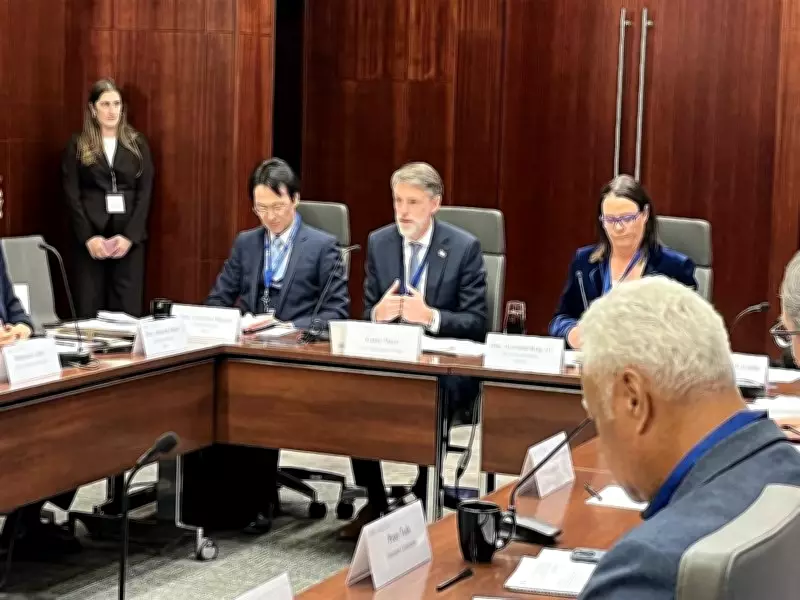
US Delegation Attends Inaugural APEC 2026 Senior Officials' Meeting in Guangzhou
The United States has officially commenced its participation in the first Asia-Pacific Economic Cooperation (APEC) 2026 Senior Officials' Meeting and Related Meetings (SOM1), currently underway in Guangzhou, China. This engagement is a strategic move aligned with the Trump Administration's America First foreign policy objectives, as confirmed by an official statement released by US authorities.
Leadership and Objectives of the US Delegation
The American delegation is spearheaded by US Senior Official Casey Mace, with support from Acting Principal Deputy Assistant Secretary of State for Oceans and International Environmental and Scientific Affairs Ruth Perry. The meetings, scheduled from February 1 to 10, 2026, serve as a critical platform for the US to advance its economic and environmental priorities in the Asia-Pacific region.
During the SOM1 sessions, the United States aims to intensify efforts to open Asian markets to American exports. This initiative is part of a broader strategy to promote deregulation and implement business policies that favor US interests. The delegation is focused on creating new opportunities for American companies, thereby restoring a level playing field and fostering job creation domestically.

Key Focus Areas and Environmental Leadership
In a decisive move, the US is addressing pressing global issues at the meeting, including combating illegal fishing, marine debris, and the illicit timber trade. These activities are identified as significant threats to American businesses, workers, and national security. By leveraging American technology and industry, the United States seeks not only to expand its market presence in Asia but also to lead international efforts in environmental protection.
The official statement emphasized the US's long-standing role within APEC, noting that it has hosted the forum three times in the past. American companies, technological innovations, and workforce have historically contributed to economic growth and prosperity across the Asia-Pacific region, reinforcing the nation's commitment to regional cooperation.
APEC as a Platform for America First Policies
According to the press release, APEC remains a pivotal forum for pursuing America First foreign, trade, and investment policies. The objectives include breaking down barriers to business, advocating for fair and reciprocal trade practices, and supporting job growth. The United States Trade Representative's website highlights APEC as the leading forum in the Asia-Pacific for facilitating trade, investment, economic growth, and regional collaboration.
APEC Membership and Operational Framework
APEC membership comprises 21 economies, including:
- Australia
- Brunei Darussalam
- Canada
- Chile
- People's Republic of China
- Hong Kong, China
- Indonesia
- Japan
- Republic of Korea
- Malaysia
- Mexico
- New Zealand
- Papua New Guinea
- Peru
- the Philippines
- the Russian Federation
- Singapore
- Chinese Taipei
- Thailand
- the United States of America
- Vietnam
Decisions within APEC are made by consensus, with commitments being voluntary. Over the years, APEC has played a crucial role in reducing tariffs and other trade barriers across the region, thereby driving economic growth and enhancing international trade.
The Bogor Goals and APEC's Vision
Central to APEC's mission are the "Bogor Goals," established as foundational objectives for free and open trade and investment in the Asia-Pacific. These goals were adopted by APEC Leaders at their 1994 meeting in Bogor, Indonesia, with targets set for 2010 for industrialized economies and 2020 for developing economies. The ongoing meetings in Guangzhou are part of efforts to advance these goals and strengthen regional economic integration.
This participation underscores the United States' continued engagement in multilateral forums to safeguard its economic interests while contributing to global stability and prosperity.






