

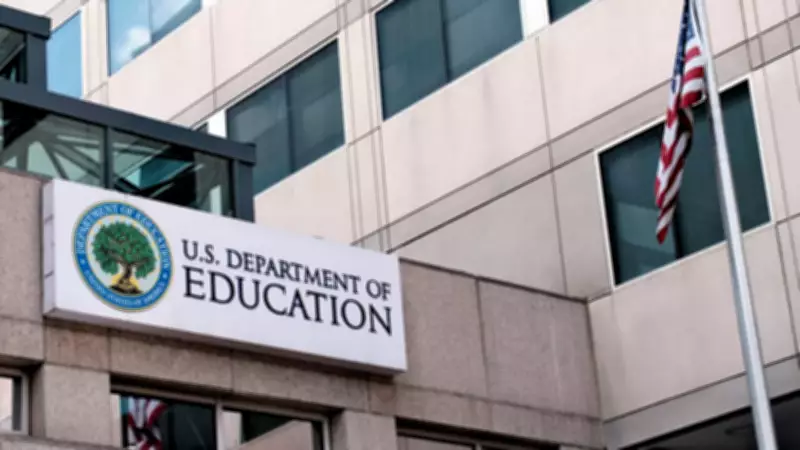
US Education Department Confronts Renewed Legal Scrutiny Over School Mental Health Funding
The United States Department of Education is embroiled in fresh legal challenges after multiple states accused the federal agency of failing to fully adhere to a judicial mandate. The court order required the complete reinstatement of previously cancelled school mental health grants, but states contend that only partial compliance has been achieved.
Court Filing Highlights Funding Shortfall
According to a legal submission spearheaded by California on March 17, the Department of Education restored merely six months of funding to affected recipients instead of the mandated full year. This action directly contradicts judicial instructions to reinstate the grants in their entirety, sparking allegations of non-compliance.
The origins of this dispute trace back to April 2025, when sixteen states initiated a lawsuit after school districts were notified that their mental health grants would be revoked. The administration of President Donald Trump had justified the cancellation by stating these programs were misaligned with its policy priorities concerning diversity, equity, and inclusion.

Appeals Court Upholds Lower Court Ruling
The legal conflict resurfaced in court following a decision by the United States Court of Appeals for the Ninth Circuit. The appellate court upheld a lower court ruling that directed the Department of Education to reconsider its termination of the grants. Despite this judicial reinforcement, states argue that the department's subsequent partial funding decision jeopardizes the continuity of essential mental health services in schools.
The March 17 filing reveals that some districts have already issued advance layoff notices and scaled back internship programs in high-need schools due to funding uncertainties. This situation underscores the tangible impact of the funding dispute on educational support systems.
Funding Dispute Linked to Broader Policy Shift
This legal confrontation is part of a larger ongoing dispute over federal education funding that was approved during the administration of President Joe Biden. In April 2025, the Department of Education cancelled up to $1 billion in multi-year grants under two key programs: the School-Based Mental Health Services Grant Program and the Mental Health Service Professional Demonstration Grant.
The department introduced revised funding guidelines in September of that year, specifying that grant funds could not be utilized for activities such as promoting gender ideology, political activism, racial stereotyping, or what it described as creating hostile environments for students. Under these new criteria, previously awarded grants were not restored through the updated application process.
In December, despite a federal court order issued the same month requiring the reinstatement of earlier grants across sixteen states, the department distributed more than $208 million in new grants aligned with its updated priorities. The order covered approximately 50 school districts, colleges, and nonprofit organizations. Although the department appealed the ruling, the appellate court rejected its challenge last month.
States Allege Incomplete Compliance with Court Order
Despite the appellate court's decision, states assert that the Department of Education has limited the funding period to six months, characterizing this move as a "risk mitigation measure" linked to financial and operational uncertainty while litigation continues. Additionally, the department has imposed a requirement for affected grant recipients to submit performance reports by June 1.
States argue that this condition effectively establishes a mid-year review that could determine whether funding continues beyond that date. "Defendants make clear that they may decline to provide funding after June 1," the states stated in the March 17 filing, as reported by K-12 Dive. They further noted that this approach shortens the budget cycle and creates significant uncertainty for grant recipients, complicating long-term planning.

Concerns Over Program Continuity and Service Delivery
States and grant recipients have emphasized that federal regulations permit the cancellation of such grants only after performance evaluations have been conducted. These evaluations had not yet taken place when the funding was withdrawn in 2025. They also highlight that repeated changes in funding have adversely affected the delivery of mental health services in schools, creating instability in support systems for students.
"Without the certainty of a full year of funding, some grantees will lose essential staff and will be unable to properly plan and budget for the fall semester," California's attorney general's office declared in a statement on March 18, according to K-12 Dive. This statement underscores the practical challenges faced by educational institutions reliant on these grants.
The case remains ongoing, with states actively seeking the full restoration of funding and greater clarity on future disbursements to ensure the stability and effectiveness of school-based mental health programs across the nation.





