

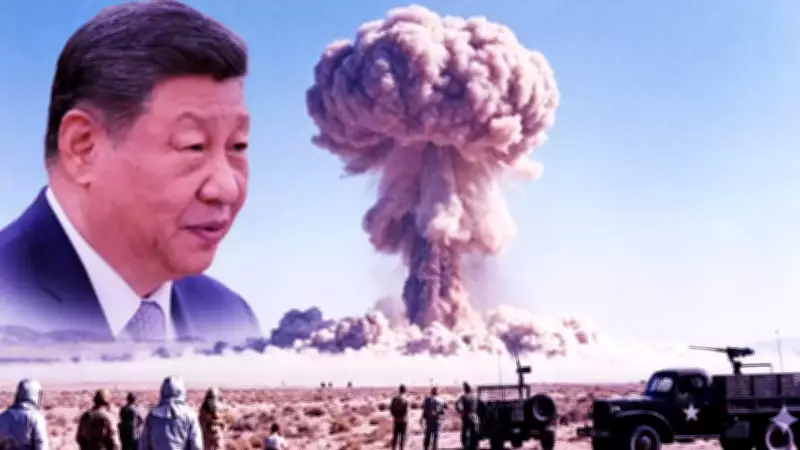
US Alleges China Conducted Covert Nuclear Test in June 2020
The United States has leveled a serious accusation against China, claiming it conducted a covert nuclear explosive test on June 22, 2020. This date is particularly significant as it falls just one week after the deadly Galwan Valley clash between Indian and Chinese troops in eastern Ladakh, which resulted in the deaths of 20 Indian soldiers and an estimated 30 to 35 Chinese casualties.
Allegations of Evasion and Deception
US Under Secretary of State Thomas G DiNanno stated that China employed advanced techniques specifically designed to evade international monitoring systems while carrying out these yield-producing nuclear tests. In a detailed post on X, DiNanno elaborated, "China has conducted nuclear explosive tests, including preparing for tests with designated yields in the hundreds of tons. China has used decoupling – a method to decrease the effectiveness of seismic monitoring – to hide its activities from the world. China conducted one such yield producing nuclear test on June 22, 2020."
The timing of this alleged test, coming so soon after the violent border confrontation, adds a layer of geopolitical tension to the accusation, highlighting the complex and often hostile dynamics between the two global powers.

Expiration of New START Treaty Intensifies Concerns
DiNanno's remarks emerged against the backdrop of the formal expiration of the New START treaty, the last remaining nuclear arms control agreement between the United States and Russia. This development leaves the world's two largest nuclear powers without binding limits on their strategic arsenals for the first time in over five decades, creating a precarious security environment.
The US official criticized the treaty as outdated and ineffective in the current strategic landscape. "New START was signed in 2010 and its limits on warheads and launchers are no longer relevant in 2026 when one nuclear power is expanding its arsenal at a scale and pace not seen in over half a century and another continues to maintain and develop a vast range of nuclear systems unconstrained by New START's terms," DiNanno asserted.
He further highlighted the treaty's uneven constraints, noting that while almost all US deployed nuclear forces were subject to New START, only a fraction of Russia's larger stockpile was covered, and exactly zero Chinese nuclear weapons were included under its provisions.
US Calls for New Arms Control Framework
In light of these developments, the United States is pressing for a new global arms control architecture. DiNanno argued that the alleged covert testing by China, combined with Russian violations and the overall growth of worldwide nuclear stockpiles, necessitates a framework better suited to contemporary threats.
"This confluence of factors – serial Russian violations, growth of worldwide stockpiles, and flaws in New START's design and implementation – gives the United States a clear imperative to call for a new architecture that addresses the threats of today, not those of a bygone era," he explained.
DiNanno added that Washington is now positioned to strengthen deterrence while remaining open to meaningful negotiations, stating, "No longer constrained by the political-military circumstances of 2010 and the treaty they yielded and in response to the destabilizing behavior of these other countries, the United States can now finally take steps to strengthen deterrence on behalf of the American people and our allies."
Push for Three-Way Talks and China's Rejection
Following the expiration of New START, the US has renewed calls for three-way nuclear arms control talks involving China and Russia. Washington insists that any future agreement must include Beijing, a demand that China has firmly and repeatedly rejected.
China has categorically denied the US allegations of covert nuclear testing. Beijing maintains that it will not participate in disarmament negotiations at this stage, arguing that its nuclear arsenal remains significantly smaller than those of the United States and Russia, and therefore does not warrant inclusion in such talks.

Historical Context and Broader Implications
These allegations are not entirely new. Former US President Donald Trump had previously hinted at similar accusations without providing specific details. On October 31 last year, Trump stated that Washington would begin nuclear testing "on an equal basis" with Moscow and Beijing, though he did not elaborate on the nature of such tests.
Security analysts have issued stark warnings, noting that the end of the New START treaty marks a critical turning point in global nuclear stability. The absence of formal limits is seen as increasing the risk of a renewed and potentially dangerous arms race, exacerbated by rising geopolitical tensions and deepening mistrust among the world's major powers.
The combination of these events – the Galwan clash, the alleged nuclear test, and the treaty's expiration – paints a concerning picture of escalating strategic competition and the urgent need for diplomatic engagement to prevent further destabilization.





