

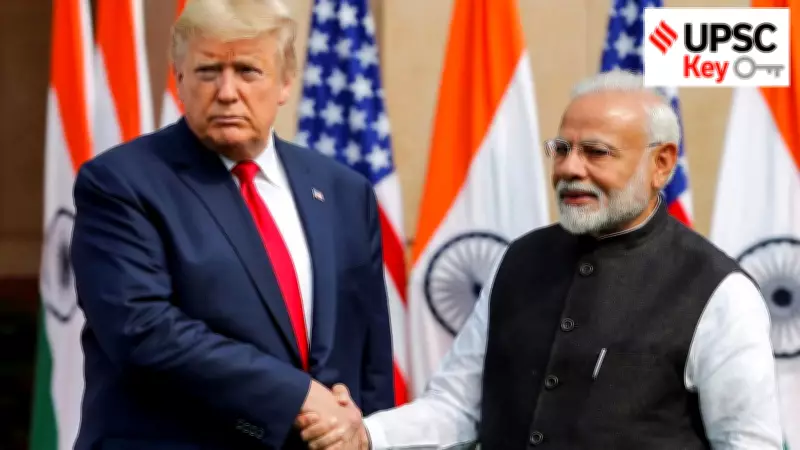
India-US Interim Trade Deal: A Strategic Economic Shift
The United States has officially removed a punitive 25 percent tariff on Indian goods, marking a pivotal moment in bilateral relations. This decision follows India's commitment to cease importing Russian oil and instead purchase energy products from the US. The interim trade agreement framework, unveiled after nearly a year of negotiations, aims to lower tariffs and deepen economic ties between the two nations.
Key Highlights of the Trade Agreement
Commerce Minister Piyush Goyal emphasized that sensitive sectors, particularly agriculture and dairy, have been safeguarded to protect domestic interests. The deal opens a massive $30 trillion market for Indian exporters, including MSMEs, farmers, and fishermen, potentially creating lakhs of new job opportunities. Under the agreement, the US will reduce tariffs on Indian goods from 50 percent to 18 percent, while India will eliminate or cut import duties on a wide range of American industrial goods, food, and agricultural products.
Specific concessions include:

- Zero-duty access for Indian products like tea, coffee, vegetable oil, cashew nuts, bananas, mangoes, and papayas to the US market.
- Market access for American motorcycles and automobiles, benefiting manufacturers like Harley-Davidson.
- India has agreed to purchase $500 billion worth of US energy products, aircraft, technology goods, and coking coal over the next five years.
The joint statement reaffirms both countries' commitment to broader Bilateral Trade Agreement negotiations, with the first phase expected to be signed by mid-March. However, India has not extended concessions on sensitive items such as meat, poultry, dairy products, GM foods, and certain cereals.
Geopolitical Implications and Oil Import Dynamics
This trade deal signifies a decisive shift in India's engagement with the US, moving beyond historical defensive postures. The removal of tariffs is contingent on India halting direct or indirect imports of Russian oil, with US officials monitoring compliance. India's rationale for previously increasing Russian oil imports was based on commercial interests, leveraging discounted rates to cushion inflationary pressures. However, declining imports to a three-year low reflect changing dynamics under US pressure.
India-Malaysia Relations and Strategic Partnerships
Prime Minister Narendra Modi's visit to Malaysia highlights the strengthening of bilateral ties, elevated to a Comprehensive Strategic Partnership in 2024. Modi emphasized that trust has become India's strongest currency, citing recent trade deals with the UK, UAE, Australia, and others. Malaysia, home to nearly three million people of Indian descent, serves as a key partner in ASEAN and the Indo-Pacific region under India's Act East Policy.
Key initiatives include:
- Establishment of the Thiruvalluvar Chair at the University of Malaya to promote academic and cultural exchange.
- Plans for a Thiruvalluvar Centre to further strengthen shared heritage, particularly with the Tamil diaspora.
- Collaboration in defence sectors, including potential sales of Dornier aircraft and maintenance of submarines.
Constitutional Provisions for Ministers Without Legislative Seats
The appointment of ministers who are not members of the legislature is governed by Article 164(4) of the Constitution, which permits such appointments for up to six months, provided they secure legislative membership within that period. This provision was tested in the late 1960s in Bihar and Uttar Pradesh, leading to a landmark 1971 Supreme Court verdict that upheld the appointment of a chief minister without a legislative seat.
Historical precedents include Bindeshwari Prasad Mandal in Bihar and subsequent cases that clarified the legal standing of such appointments. This constitutional flexibility ensures governance continuity during political transitions, though it requires eventual legislative validation.

India Semiconductor Mission 2.0: Focusing on Indigenous Innovation
Union Minister Ashwini Vaishnaw announced that ISM 2.0 will prioritize indigenous chip design, productisation, ecosystem partnerships, and talent development. The government aims to produce chips as small as 2 nanometers, building on the initial phase that focused on setting up fabrication and packaging plants.
Key focus areas under ISM 2.0:
- Support for design startups to innovate and compete globally, akin to companies like Qualcomm.
- Development of a comprehensive semiconductor ecosystem, including equipment, materials, and supply-chain resilience.
- Industry-led research and training centres to build a skilled workforce.
The initiative aligns with India's broader goals of technological self-reliance and reducing import dependence, with the first phase of ISM launched in 2021 with a $10 billion outlay.
Environmental and Governance Challenges
In other developments, the standing committee of the National Board for Wildlife approved the diversion of 272 hectares of forest for the Kopra irrigation project in the Veerangana Durgavati Tiger Reserve. This project, aimed at providing irrigation in Madhya Pradesh, involves compensatory afforestation but raises concerns about wildlife habitat disruption.
Additionally, a tragic blast in an illegal rat-hole mine in Meghalaya claimed 27 lives, prompting a crackdown on unlawful mining activities. These incidents underscore ongoing challenges in balancing development with environmental conservation and regulatory enforcement.
UPSC Examination Relevance
These topics are crucial for UPSC aspirants, covering current events of national and international importance, bilateral agreements, constitutional provisions, and economic policies. They align with syllabus areas such as General Studies II and III, emphasizing India's strategic engagements, governance frameworks, and technological advancements. Understanding these issues provides insights into India's evolving geopolitical stance, economic strategies, and legal structures, essential for both Preliminary and Main examinations.





