

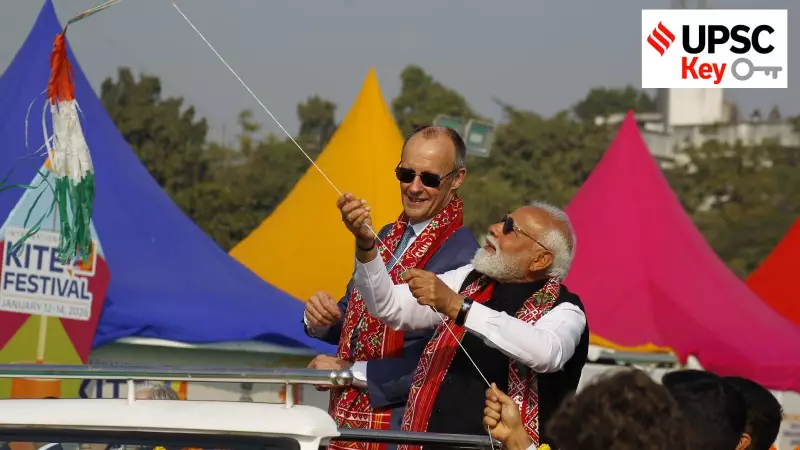
India and Germany Forge Stronger Ties with 19 Key Agreements
Prime Minister Narendra Modi and German Chancellor Friedrich Merz held significant bilateral talks in Gandhinagar on Monday. The two leaders signed nineteen important pacts during this high-level meeting. These agreements cover multiple areas of cooperation between the two nations.
The signed documents include roadmaps for defence industrial cooperation and higher education collaboration. Both countries also issued a joint declaration on critical minerals and semiconductor ecosystems. They established a bilateral dialogue mechanism focused on the Indo-Pacific region.
Germany announced a visa-free transit regime for Indian passengers. This means Indian passport holders can now transit through German airports without needing a separate transit visa. This move simplifies travel for many Indian citizens.

Prime Minister Modi highlighted the importance of this visit. He noted that last year marked twenty-five years of strategic partnership between India and Germany. This year celebrates seventy-five years of diplomatic relations. Modi emphasized these milestones represent shared ambitions and mutual trust.
The leaders discussed enhancing cooperation between defence industries. They aim to open new opportunities for co-development and co-production of defence equipment. Germany has committed to facilitating expeditious export clearances for defence items.
In education, the comprehensive roadmap will give new direction to partnership in this sector. Modi invited German universities to open campuses in India. Both nations also agreed to establish an Indo-German Centre of Excellence for Skilling in Renewable Energy.
Bilateral trade reached a record high in 2024. Trade in goods and services surpassed fifty billion US dollars. This amount represents over twenty-five percent of India's trade with the European Union.
Modi and Merz reiterated support for concluding the India-EU Free Trade Agreement. They see this as a key outcome of the upcoming EU-India Summit. The agreement will facilitate trade flows and boost economic relations.
The two sides signed a joint declaration on strengthening bilateral economic cooperation through the German-Indian CEO Forum. This will promote further business and industry collaboration.
Regarding digital dialogue, leaders finalized a work plan for 2026–27. They emphasized collaboration on internet governance, artificial intelligence, semiconductors, and emerging technologies.
On global issues, both leaders reaffirmed readiness to support efforts for just and durable peace in Gaza. They called for a negotiated two-state solution to the Middle East conflict.
Modi stated that India and Germany agree on reforming global institutions. He mentioned their joint efforts through the G4 group to reform the United Nations Security Council.
Historical Context of India-Germany Relations
India and Germany established diplomatic relations soon after both nations gained independence. India recognized the Federal Republic of Germany in 1951. The two countries entered a Strategic Partnership in May 2000.
Since 2011, they have held Intergovernmental Consultations at the level of Heads of Government. This framework allows comprehensive review of cooperation and identification of new engagement areas. India belongs to a select group of countries with which Germany maintains such a dialogue mechanism.
ISRO Faces Second Consecutive PSLV Failure
The Indian Space Research Organisation suffered a major setback on Monday. Its PSLV-C62 mission failed to reach the intended orbit due to problems in the rocket. This marks the second successive failure for a PSLV rocket.
The PSLV-C62 rocket carried EOS-N1, an earth observation satellite, and fifteen other payloads. Seven payloads came from Brazil and Nepal. All payloads were lost in this failed mission.
In both recent failures, problems arose during the third stage of flight. The rocket encountered issues while attempting to enter Earth's orbit. The exact reason for Monday's failure remains unknown immediately.

The previous failure in May 2025 was attributed to an unexpected pressure drop in the third-stage engine combustion chamber. PSLV has powered sixty-five of India's one hundred five launches to date. Only four missions, including the first in 1993, have failed previously.
Two failures within six months blemish an otherwise fine record. This development raises concerns about reliability. PSLV serves as ISRO's mainstay rocket for most commercial launches.
Commercial launches bring significant revenue and credibility to ISRO. The agency has launched over four hundred thirty satellites from thirty-four countries. ISRO is seen as one of the most cost-effective and reliable agencies for commercial launches.
This year's first launch follows last year's problematic start. In 2025, the first launch involving navigation satellite NVS-02 also encountered trouble. That problem originated with the satellite's thrusters rather than the rocket.
ISRO carried out only five launches last year. This year, the agency targeted at least six launches in the first quarter alone. Monday's setback may force revision of this schedule, including the first unmanned Gaganyaan mission.
Understanding PSLV Rocket Stages
The Polar Satellite Launch Vehicle operates as a four-stage rocket. Each stage has its own engines and fuel. Stages sequentially take charge of propelling the mission before detachment.
The first stage involves lift-off and vertical journey to about fifty to sixty kilometers altitude. This stage requires heavy engines and lots of fuel to fight gravity and atmospheric drag. PSLV uses solid propellant fuel in this stage.
The second stage continues vertical and horizontal movement as the rocket prepares for orbit. This stage uses the indigenously developed Vikas engine with liquid fuel. It takes the vehicle to about two hundred twenty to two hundred fifty kilometers from Earth's surface.
The third stage involves rapid acceleration to maintain orbit. The rocket must achieve velocities between twenty-six thousand and twenty-eight thousand kilometers per hour. PSLV burns solid fuel in this stage to achieve necessary acceleration.
The fourth stage maneuvers the satellite into its designated low-earth orbit. This stage again uses liquid propulsion. The third stage proves particularly tricky for maintaining required velocity.
Space missions operate with razor-thin margins of error. Every space agency faces multiple failures. However, back-to-back failures with a trusted rocket cause particular concern for ISRO.
India Receives Invitation to Join Pax Silica Initiative
The United States has invited India to join the Pax Silica initiative. This invitation comes a month after Washington initially left New Delhi out of this US-led initiative. The move indicates softening tensions between the two countries.
Pax Silica focuses on securing artificial intelligence and technology supply chains. It aims to bring friendly countries together to ensure key technologies remain safe and reliable. The initiative seeks to prevent hostile control over critical technologies.
This strategic initiative counters China's grip on global manufacturing supply chains. It launched on December 12 to reduce coercive dependencies. Pax Silica aims to build secure, prosperous, and innovation-driven silicon supply chains.
The initiative covers everything from critical minerals and energy inputs to advanced manufacturing. It includes semiconductors, AI infrastructure, and logistics. Original member countries included Japan, South Korea, Singapore, and several European nations.
India's absence from the initial list raised concerns about broader differences between India and the US. Later in December, India extended a formal invitation to China for its Artificial Intelligence Impact Summit in February.
Western skepticism about China's manufacturing dominance triggered global companies to pursue China-plus-one strategies. The US has engaged in trade war with China to decouple due to widening trade gaps. India positions itself to gain from manufacturing supply chain shifts.
Experts note that Pax Silica member countries rank among top AI and semiconductor supply chain players. India currently lacks global-scale AI infrastructure. Participation could bring investments and partnerships under this initiative.
The US State Department stated Pax Silica will protect sensitive technologies and critical infrastructure. It will prevent undue access or control by countries of concern. The initiative will build trusted technology ecosystems including ICT systems and data centers.
India has expressed concerns about China's involvement in its critical infrastructure, particularly telecom. India's presence in Pax Silica could help growth in technology-heavy sectors. Currently, India faces import dependency in these areas.
Researchers note that invited countries lead in AI and semiconductor domains. The US leads in design and intellectual property for semiconductor chips. The Netherlands provides essential lithography machines for printing chips.
India's entry into Pax Silica follows considerable US company investments in Indian AI infrastructure. Last month, Microsoft announced plans to spend seventeen point five billion dollars over four years. This investment expands AI infrastructure and cloud computing capacity in India.
India's Critical Minerals Engagement
India joined the Minerals Security Partnership in June 2023. This US-led collaboration includes fourteen countries. It aims to catalyze public and private investment in critical mineral supply chains globally.
A joint India-US statement reiterated intention to ensure well-supplied markets with essential critical minerals. Both sides pledged to hasten bilateral collaboration for resilient critical minerals supply chains.
MSP partners include Australia, Canada, Japan, South Korea, and several European nations. The European Union participates through the European Commission. The grouping focuses on supply chains for cobalt, nickel, lithium, and rare earth minerals.
This alliance primarily evolves as an alternative to China. China has created processing infrastructure for rare earth minerals. It has acquired mines in Africa for elements like cobalt.
India launched a National Critical Mineral Mission in January 2025. This mission aims to achieve self-reliance in the critical mineral sector. The government identified thirty critical minerals in 2023, including lithium, cobalt, nickel, and graphite.
Coal-Fired Electricity Generation Declines After Fifty Years
For the first time in half a century, coal-fired electricity generation in India saw year-on-year decline in 2025. A new study by Centre for Research on Energy and Clean Air revealed this significant shift. Rapid growth in renewable energy generation largely drove this decline.
Coal-fired plants generated one thousand two hundred eighty-three billion units of electricity in 2025. This represents a three percent decrease from one thousand three hundred twenty-two billion units in 2024. Overall electricity generation increased by about one percent compared to the previous year.
The overall trend of coal-fired electricity generation has shown changes in recent years. Even when generation increased in absolute numbers, growth rates had been declining. In 2024, coal-fired generation increased by five percent compared to fifteen percent in 2023.
Actual generation from coal showed decline in 2022 as well. However, that could be attributed to reduced industrial activity during the COVID-19 pandemic. The 2025 decline marks the first non-pandemic related decrease in fifty years.
Apart from renewable energy increase, relatively milder summer contributed to the dip. Decreased power demand growth due to other reasons also played a role. Generation from renewable sources increased by twenty-two percent in 2025.
Renewable sources produced two hundred seventy billion units instead of two hundred twenty-one in 2024. Large hydro generation grew by fifteen percent, reaching one hundred eighty billion units. India added forty-one gigawatts of new renewable capacity in the first eleven months of 2025.
Considering rapid clean energy expansion, India might revise coal capacity addition plans for 2030. India ranks as the third largest greenhouse gas emitter globally. The power sector contributes about forty percent of these emissions.
China also experienced decline in coal-fired electricity generation in 2025. Research showed coal-based generation in China was one point six percent lower than the previous year. This marks the first annual dip in fifty years for China as well.
China remains the world's largest greenhouse gas emitter. In October last year, China said it would begin reining in emissions. The country set a target of seven to ten percent reductions from an unspecified peak level by 2035.
Venezuela's Heavy Crude Oil Attracts US Interest
The United States shows clear interest in Venezuelan crude oil despite being the world's largest oil producer. The Trump administration's pursuit involves multiple factors including energy market dominance and oil price control. The specific nature of Venezuelan oil appears as a key reason behind American interest.
Venezuelan crude is classified as heavy sour crude. It is heavier because it is thicker and denser than lighter crude grades. It is sour due to high sulphur content. By contrast, most US oil production, particularly from shale formations, is light and sweet.
American refining infrastructure, especially Gulf Coast refineries, were engineered to process heavy crudes. These refineries were built when heavy sour crudes were most available to the US. The shale oil revolution occurred only in the 21st century, creating a mismatch.
Crude oil is not perfectly fungible due to quality differences among grades. Available crude types influence refinery configurations. Securing heavy sour crude supplies from Venezuela at low prices interests the Trump administration.
Venezuela possesses the world's largest oil reserves. Heavy sour crudes are usually cheaper than light sweet crudes. This makes feedstock cost lower for complex refineries designed for heavy crude processing.
The financial arithmetic goes awry if complex refineries must consume expensive light sweet crude. The US continues importing significant volumes of cheaper heavy crudes. Simultaneously, it exports domestic light crude oil at premium international prices.
This economic approach means the US constantly seeks stable heavy crude supplies from other countries. However, some countries with significant heavy crude reserves maintain adversarial relationships with Washington. These include Venezuela, Iran, and Russia.
Venezuela served as a major crude source for the US until the early 2000s. American oil majors heavily dominated Venezuela's oil sector during that period. Then production and exports started dwindling as state control increased under Hugo Chavez.
Nationalisation of assets saw US oil majors exit Venezuela in 2007. The national oil company grappled with corruption and mismanagement. Oil infrastructure suffered from extreme underinvestment during this period.
US sanctions on Venezuela greatly constrained crude flow in international markets. China became Venezuela's leading oil destination over past decades. China poured billions into Venezuela, including in the oil sector, filling the vacuum left by American companies.
Russia also invested heavily in Venezuela's petroleum industry. With recent political changes in Venezuela, the future of oil supplies to China becomes unclear. Experts believe much Venezuelan oil could flow to American refineries going forward.
This shift would help US refineries reduce intake of costlier heavy oil from other countries. The outlook for Chinese and Russian investments in Venezuela now appears uncertain. Trump's declaration about taking over Venezuela's oil sector may attempt to cut Chinese and Russian influence in the Americas.
Additional Current Affairs for UPSC Preparation
Several other developments merit attention for UPSC aspirants. The Delhi government plans to incentivise retrofitting of old petrol and diesel cars into electric vehicles. EV retrofitting involves replacing fuel systems with batteries, controllers, and motors.
The United Nations top court opened a landmark case on Rohingya genocide. Gambia filed this case at the International Court of Justice in 2019. It argues Myanmar's military clearance operations in 2017 violated the 1948 Genocide Convention.
West Bengal detected two Nipah virus cases among medical staffers. The government started contact-tracing procedures. Nipah is a viral infection that mainly affects animals but can jump to humans through contaminated food or contact.
President Donald Trump recently invoked the Monroe Doctrine following actions in Venezuela. This doctrine originated in 1823 under President James Monroe. It contains non-colonisation and non-interference principles regarding European powers in the Americas.
These diverse topics cover current events of national and international importance. They relate to multiple UPSC syllabus areas including bilateral relations, science and technology, environmental issues, and global affairs. Aspirants should study these developments for comprehensive preparation.





