

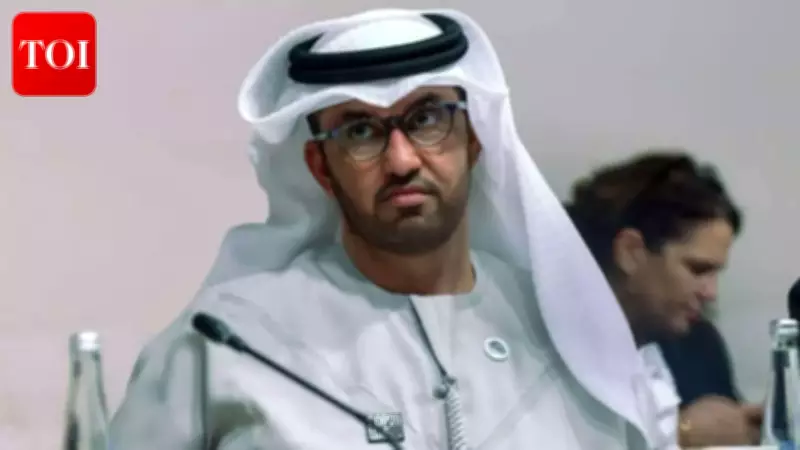
UAE Minister Decries Hormuz Strait Weaponization as 'Economic Terrorism'
Dr Sultan bin Ahmed Al Jaber, the UAE Minister of Industry and Advanced Technology and Group CEO of ADNOC, has issued a stark warning, declaring that weaponizing the Strait of Hormuz constitutes an act of 'economic terrorism' with far-reaching global consequences. Speaking at the CERAWeek energy conference in Texas, USA, from March 23-27, he emphasized that threats to this critical waterway extend beyond energy markets, affecting factories, farms, and families worldwide.
Global Impact of the Strait's Closure
Al Jaber highlighted the strategic importance of the Strait of Hormuz, describing it as a vital artery for the global economy. "Twenty-one miles wide. Twenty million barrels a day. Nearly a fifth of the world’s oil and gas. Over a third of the world’s fertiliser. Almost a quarter of the world’s petrochemicals and significant amounts of industrial metals," he stated. "In short, much of the oxygen of the global economy runs through a single throat." He accused Iran of choking this passage as an unacceptable strategy following a US-Israel attack, leading to its closure.
The Strait of Hormuz is a 33-kilometer waterway between Iran, Oman, and the UAE, connecting the Gulf to the Gulf of Oman and the Arabian Sea. It is a crucial route for global shipping, with approximately 20% of the world's oil and liquefied natural gas (LNG) passing through. In 2025 alone, an estimated 20 million barrels of oil transited daily, according to the US Energy Information Administration (EIA).

Economic Fallout and Security Concerns
The closure has triggered significant economic disruptions over the past three weeks:
- Oil, gas, fertiliser, and other commodity prices have surged sharply.
- Supply has been reduced by around 10-12 million barrels per day.
- Oil prices have risen by 50%, increasing living costs for vulnerable populations and slowing global economic growth.
Al Jaber stressed that this is not merely a supply issue but a security crisis. "This is not a supply issue. It is a security issue, and it has only one durable answer: keeping the Strait open. We cannot trade our way out of this crisis," he asserted. He called for international action, stating, "Weaponising the Strait of Hormuz is not an act of aggression against one nation. It is economic terrorism against every nation. And no country should be allowed to hold Hormuz hostage, not now, not ever."
UAE's Defense and Partnerships
Despite not initiating the conflict, Al Jaber affirmed the UAE's readiness to defend itself. "Our defences have been tested. Our resilience has been tested. Our character has been tested. And we withstood," he said. He outlined the UAE's pragmatic approach, focusing on results and deepening energy partnerships, particularly with the United States. ADNOC, XRG, and Masdar have collectively invested over $85 billion in US energy assets, supporting power generation, advanced chemicals, and job creation across multiple states.
"For the UAE, partnership is not just something we do. It is who we are. Our commitments are concrete. Our word is our currency. And when it really matters, we step up and show up," he added.
Call for Collaborative Stability
Inviting energy leaders to attend ADIPEC in Abu Dhabi this November, Al Jaber urged collaboration over conflict. "One can choose to be an architect of stability or a spectator to volatility. And if you believe that collaboration should prevail over conflict, then your place is with us," he said. He positioned ADIPEC as a working platform to enhance the resilience of the global energy system, emphasizing that stability must be built deliberately and collectively.






