

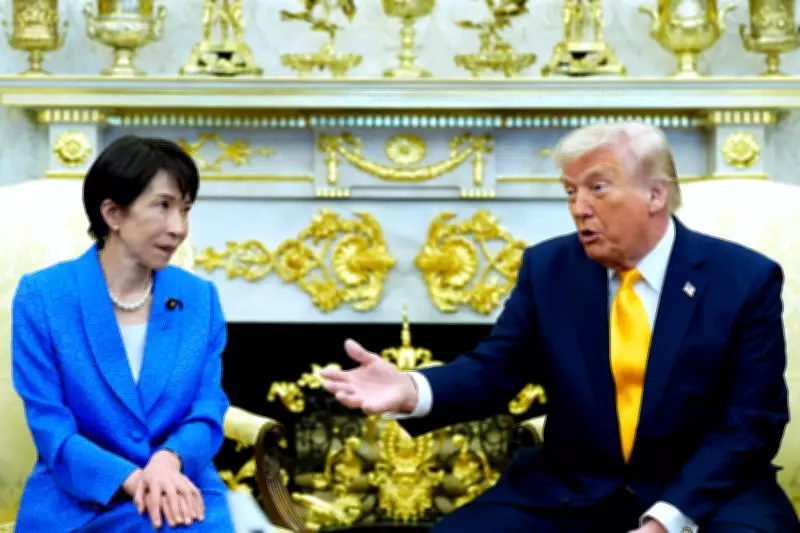
Trump's Oval Office Pearl Harbor Remark Shatters Decades of Diplomatic Protocol
In a moment that lasted mere seconds but carried the weight of decades, former President Donald Trump made a startling joke about the Pearl Harbor attack directly to Japanese Prime Minister Sanae Takaichi during a meeting in the Oval Office on Thursday. The incident occurred during a discussion about military operations against Iran, revealing a stark departure from longstanding diplomatic norms between the two nations.
The Diplomatic Setting and Sudden Shift
Prime Minister Takaichi had arrived in Washington having meticulously prepared for the high-stakes meeting. She had traveled from Tokyo, taken her seat in the historic Oval Office, and offered Trump flattering remarks about his potential to achieve world peace. The atmosphere was congenial, shaped by careful diplomacy and the management of a crucial bilateral relationship that requires both substance and performance under this administration.
The turning point came when a Japanese journalist asked Trump why he hadn't given advance warning to allies, including Japan, before launching military operations against Iran. Trump responded initially with reasonable explanation about the element of surprise in military strategy. Then he added the provocative remark: "Who knows better about surprise than Japan, OK? Why didn't you tell me about Pearl Harbor, OK? Right?"

Across the room, Takaichi's reaction was telling. She widened her eyes, took a deep breath, and kept her arms crossed in her lap. She maintained her composure without speaking—a response that spoke volumes given the circumstances.
The Historical Weight of Unspoken History
The Pearl Harbor attack on December 7, 1941, represents one of the most significant moments in 20th-century history. The Imperial Japanese Navy's surprise assault on the American naval base in Hawaii resulted in approximately 2,400 American deaths and propelled the United States into World War II. What followed was a brutal Pacific conflict that ended only after atomic bombs devastated Hiroshima and Nagasaki in 1945.
In the post-war years, both nations embarked on an extraordinary journey of reconciliation. The United States helped draft Japan's 1947 constitution, which included Article 9—a clause prohibiting Japan from maintaining war potential or resolving disputes by force. This constitutional limitation continues to shape every conversation about Japan's military capabilities, including discussions about the Strait of Hormuz that Takaichi and Trump were addressing.
For eight decades, American and Japanese leaders have deliberately avoided weaponizing this painful history in each other's presence. The relationship evolved from bitter enemies to close allies, with the United States extending its nuclear umbrella over Japan. This diplomatic convention reached a symbolic peak in 2016 when President Barack Obama visited the Pearl Harbor memorial alongside then-Prime Minister Shinzo Abe, who offered condolences for the lives lost.
The Cost of Breaking Convention
The diplomatic norms Trump discarded were not mere formalities. American presidents have consistently avoided harsh references to Pearl Harbor when meeting Japanese leaders because the alliance they've built—encompassing security guarantees, economic interdependence, and strategic partnership—has been more valuable than any momentary satisfaction from revisiting historical grievances.
This calculation has held across administrations of both political parties for eighty years because policymakers understood Japan's unique position. Constitutionally prevented from projecting military force abroad and dependent on American security guarantees, Japan sits at the geographic center of Indo-Pacific strategy precisely as China's military ambitions make the region the defining theater of great power competition.

Trump had complained earlier in the week that allies including Japan hadn't sufficiently supported his request to help safeguard the Strait of Hormuz after operations against Iran. "It's appropriate that people step up," he said on Thursday, the same afternoon he made the Pearl Harbor joke. Takaichi later told reporters she had explained Japan's constitutional limitations to Trump and that they agreed on the importance of the Strait, without mentioning the uncomfortable exchange.
A Pattern of Diplomatic Disruption
This incident follows a consistent pattern in Trump's approach to international relations. When German Chancellor Friedrich Merz mentioned D-Day in conversation last year, Trump observed that it was "not a pleasant day" for the chancellor, prompting Merz to patiently explain that it represented Germany's liberation from Nazi dictatorship.
These are not conventional gaffes or unintended revelations that get quickly walked back. They represent a governing style that treats diplomatic norms—the careful management of historical grievance, the established grammar that makes difficult relationships function—as optional performances of weakness rather than structural necessities.
The Resilience of the Alliance
Despite the uncomfortable optics that dominated headlines, Takaicha demonstrated remarkable diplomatic skill throughout the exchange. She smiled through the moment and recovered quickly, showing a talent for absorbing Trump's energy and redirecting it without visible friction—a skill that has become essential for foreign leaders dealing with this administration.
The Japanese prime minister left Washington having secured what she came for: a meeting, photographs, official communications, and the continued functioning of an alliance too important for Japan's security to let deteriorate. The relationship will likely endure because both nations have too much at stake—Japan depends on American security guarantees, and the United States needs Japan as a key ally in countering China's influence in the Pacific.
Yet the brief exchange in the Oval Office revealed how quickly decades of patient diplomatic construction can be undermined, and how some historical wounds, though carefully tended for generations, remain raw enough to reopen with a single ill-considered remark.





