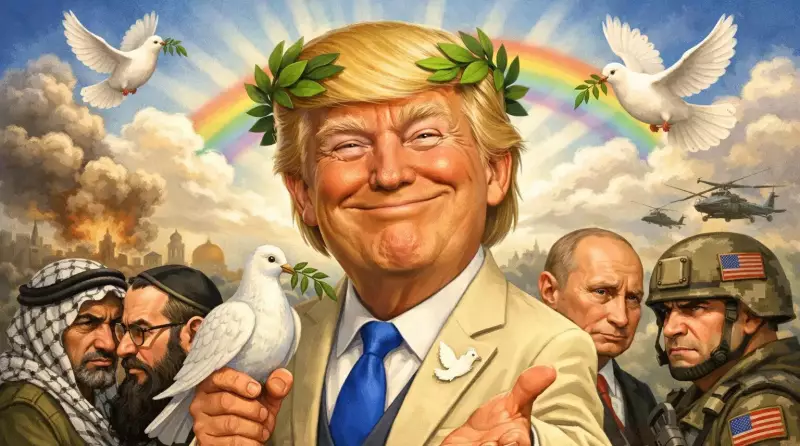
Trump's Letter to Norway Prime Minister Signals Major Foreign Policy Shift
When Donald Trump writes that he is "no longer obligated to think purely of peace," this statement carries significant weight. It represents more than just political rhetoric or social media posturing. The letter to Norway's prime minister, deliberately circulated among European diplomats, marks the clearest expression yet of Trump's evolving worldview.
This document does not simply revisit old grievances about Nobel Prize snubs or Greenland acquisition attempts. Instead, it establishes a formal doctrine that reflects Trump's return to power and his consistent disregard for traditional international norms. The letter arrives at a crucial moment when American foreign policy appears increasingly assertive following global developments.
Five Key Insights from Trump's Diplomatic Communication
1. Peace Becomes Optional, Not Essential
Trump's statement about no longer feeling bound to think "purely of peace" has drawn various interpretations. Some observers initially viewed this as emotional manipulation related to Nobel Prize disappointments. However, this interpretation misses the deeper meaning.

Trump is not rejecting peace as a possible outcome. Rather, he is rejecting peace as a necessary constraint on American action. For generations, American presidents have justified military interventions using moral language about humanitarian concerns or democracy promotion. Trump removes this diplomatic veneer completely.
In Trump's framework, peace becomes desirable only when it serves American interests or enhances personal legacy. When peace conflicts with these objectives, it transforms into an optional consideration rather than a fundamental goal. This represents not a sudden change but the explicit articulation of a long-held perspective that views international restraint as weakness.
2. Nobel Prize Fixation Reveals Alternative Legitimacy Framework
Trump's continued focus on the Nobel Peace Prize extends beyond simple trophy collection. It reflects his distinctive understanding of political legitimacy. For Trump, validation flows not from established institutions but from personal recognition and symbolic achievements.
The 2009 Nobel award to Barack Obama remains particularly galling because it represented international acclaim without corresponding military or diplomatic conquest. By blaming Norway's prime minister for a decision made by an independent committee, Trump demonstrates his tendency to collapse institutional processes into personal relationships.
In this worldview, symbolic recognition carries tangible policy consequences. Awards become transactional markers where recognition given might purchase restraint while recognition denied could trigger retaliation. This transforms prestige into leverage and snubs into potential costs.
3. Greenland Rhetoric Evolves from Provocation to Claim
Trump's interest in Greenland has undergone significant evolution. During his first term, commentators often dismissed his Greenland comments as real estate speculation or diplomatic trolling. The current letter reframes this interest as a serious security imperative.
The document questions Denmark's ownership rights, argues that Denmark lacks adequate defense capabilities for the territory, and asserts that global security requires American control. This represents a fundamental reframing of sovereignty concepts.
In Trump's emerging doctrine, territorial ownership becomes conditional on demonstrated power and capability. Historical claims, existing treaties, and international law become secondary considerations. Greenland's strategic importance at the intersection of Arctic militarization, great-power competition, and resource exploration transforms from a diplomatic challenge into justification for dominance.
4. NATO Transforms from Alliance to Transactional Relationship
Trump's assertion that he has contributed more to NATO than any previous leader, followed by demands for reciprocal benefits, perfectly illustrates his transactional approach to international relations. Alliances cease to represent shared commitments built on mutual trust.

Instead, they become calculated relationships governed by credits and debits. The United States makes payments while allies accumulate obligations. Collective defense transforms from mutual guarantee into conditional service that requires continuous validation.
European capitals express particular concern about this shift. The primary danger no longer involves potential American withdrawal from NATO. Rather, the threat involves hollowing the alliance from within by converting mutual defense commitments into instruments of political leverage.
5. Deliberate Circulation Converts Ambiguity to Coercion
The letter's distribution method carries as much significance as its content. This document was not accidentally leaked but deliberately circulated by national security staff to European ambassadors. This intentional dissemination provides the message with institutional weight beyond presidential musings.
Traditional diplomacy often values strategic ambiguity that creates negotiating space. Trump's approach favors explicit clarity that demands submission. The letter removes plausible deniability, telling allies precisely how Washington now operates: expecting gratitude, assuming compliance, and preparing pressure against resistance.
This represents coercive diplomacy without customary euphemisms. It reflects a broader pattern evident since Trump's political return, encompassing public criticisms of allied leaders and open threats regarding trade, territory, and loyalty expectations.
The Emerging Trump Doctrine in Historical Context
Every American president eventually develops a distinctive foreign policy doctrine, whether formally acknowledged or not. Historical examples include the Monroe Doctrine warning European powers away from the Western Hemisphere, Roosevelt's policing rights claims, Truman's containment framework, Reagan's freedom rhetoric, Bush's pre-emption principles, and Obama's drone-focused approach.
Trump's doctrine appears simpler and more transparent about its underlying assumptions. Power matters fundamentally while rules become secondary considerations. Deals consistently trump established norms. Insults demand proportional retaliation. Loyalty operates as political currency. Peace becomes conditional rather than absolute.
The letter to Norway's prime minister represents not an isolated anomaly but a coherent thesis statement. It reflects a world transformed by recent conflicts, the erosion of restraint in certain regions, the reassertion of American hard power, and Trump's conviction that moral pretenses in international relations have finally exhausted their usefulness.
In this emerging framework, the rules-based international order faces not reform but replacement. What emerges instead is not chaos but explicit hierarchy where strength establishes legitimacy and hesitation invites consequences. Trump did not invent this logic, but he has ceased pretending otherwise. The letter matters precisely because it marks the moment when peace stopped being American foreign policy's starting assumption and became merely another bargaining instrument.