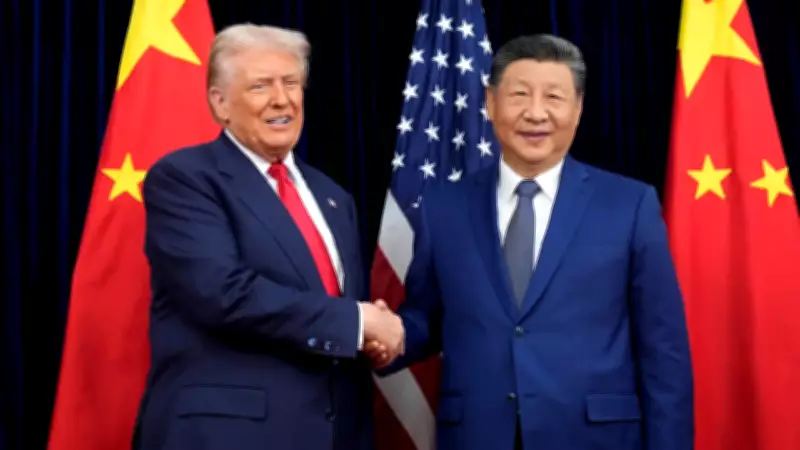
In a significant diplomatic engagement, US President Donald Trump and Chinese President Xi Jinping conducted an extensive telephone conversation on Wednesday, covering a broad spectrum of critical issues. The discussion aimed at stabilizing the complex relationship between the world's two largest economies, touching upon trade, security matters, Taiwan, Iran, and the ongoing conflict in Ukraine.
Trump Hails "Excellent" and "Thorough" Dialogue
President Trump characterized the call as "excellent," "long," and "thorough" in a post on his Truth Social platform. He emphasized that the two leaders addressed "many important subjects," which included trade negotiations, military concerns, Trump's anticipated visit to China in April, the Taiwan issue, Russia's war with Ukraine, the situation in Iran, and potential energy and agricultural agreements between the nations.
"The relationship with China, and my personal relationship with President Xi, is an extremely good one, and we both realize how important it is to keep it that way," Trump stated. He added that he anticipates "many positive results" over the remaining three years of his presidency, highlighting a commitment to constructive engagement.

Iran Pressure and Trade Warnings Feature in Talks
The leaders discussed Iran at a time when the US administration is intensifying efforts to isolate Tehran. Trump has previously warned that Washington would impose a 25% tariff on imports from countries that continue conducting business with Iran, as part of broader measures to curb its nuclear program. Despite years of international sanctions, Iran engaged in nearly $125 billion worth of international trade in 2024, with $32 billion of that involving China, according to Associated Press reports citing World Trade Organization data.
Energy, Agriculture, and Commercial Deals on Agenda
Trade and economic cooperation were prominent themes during the call. Trump indicated that China is considering increasing purchases of US oil and gas, as well as additional American agricultural products. He specifically mentioned that Beijing is looking at boosting soybean imports, potentially lifting purchases to 20 million tonnes for the current season and committing to 25 million tonnes for the next season. The US president also noted that the leaders discussed airplane engine deliveries and other commercial issues, underscoring the multifaceted nature of their economic dialogue.
Taiwan Remains a Core Issue for Beijing
According to a Chinese readout cited by the South China Morning Post, Taiwan emerged as a key topic during the conversation. President Xi told Trump that the Taiwan question is the "most important" issue in China-US relations. He stressed that Taiwan is an integral part of Chinese territory and urged Washington to handle arms sales to the island with "extreme caution."
Beijing consistently views Taiwan as part of China and has not ruled out the use of force to achieve reunification. In response, Trump acknowledged that he values China's concerns regarding Taiwan and expressed willingness to maintain communication with Beijing to ensure stable bilateral ties. He described the US-China relationship as the world's most important bilateral relationship, emphasizing his respect for President Xi and his desire for ties to remain "positive and stable" throughout his term.
Call Follows Xi-Putin Talks Amid Global Tensions
The Trump-Xi conversation occurred just hours after President Xi held a video dialogue with Russian President Vladimir Putin, illustrating Beijing's active engagement on multiple diplomatic fronts. Putin and Xi discussed expanding Russia-China cooperation in areas such as energy, nuclear power, space, and high-technology projects. This occurs even as China continues its outreach to Western leaders amid the ongoing Ukraine war, highlighting its strategic balancing act.
Trump reiterated that his conversation with Xi reinforced the importance of sustained dialogue. "We both realize how important it is to keep it that way," he remarked, referring to the overall US-China relationship. As Washington and Beijing navigate strategic competition alongside economic interdependence, such high-level communications are crucial for managing tensions and fostering cooperation on global challenges.