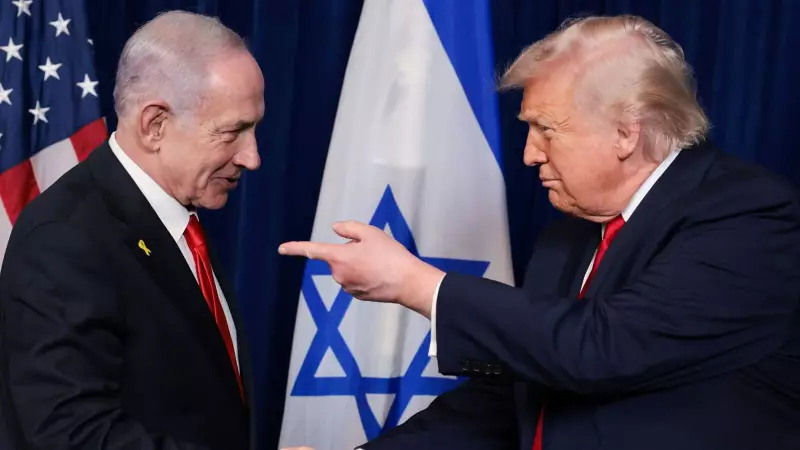
US President Donald Trump has delivered a blunt ultimatum to Hamas, stating the militant group has only a short timeframe to lay down its weapons. This warning came after high-stakes discussions with Israeli Prime Minister Benjamin Netanyahu at Trump's Mar-a-Lago resort in Florida, as the United States pushes to solidify the fragile Gaza ceasefire and advance to the next phase of the agreement.
United Front on Gaza and Regional Threats
Speaking alongside Netanyahu at a news conference, President Trump emphasized that the onus is now on Hamas to comply with the terms of the October ceasefire. "If they don't disarm as they agreed to do, then there will be hell to pay for them," Trump told reporters. He stressed that the group must surrender its arms "in a fairly short period of time."
The meeting, the fifth between the two leaders since Trump returned to office this year, was described by Netanyahu as "highly productive." In a significant gesture, the Israeli leader announced that Israel would bestow its top civilian award on President Trump, marking the first time the honour has been granted to a non-Israeli.

Beyond Gaza, the leaders addressed other regional flashpoints, including Syria and the Iran-backed Hezbollah group in Lebanon. Trump expressed hope that Netanyahu could "get along" with Syria's new president, a former Islamist rebel commander who toppled Bashar al-Assad a year ago, despite ongoing Israeli strikes along their shared border.
Iran in the Crosshairs
A major portion of the dialogue focused on Iran, with Netanyahu steering attention toward Israel's deep-seated concerns. Trump issued a severe warning to Tehran against any attempts to rebuild its nuclear program or ballistic missile arsenal, which was damaged during a 12-day conflict with Israel in June.
"I hope they're not trying to build up again because if they are, we're going have no choice but very quickly to eradicate that buildup," Trump stated, adding that a potential US response "may be more powerful than the last time." However, he also noted a belief that Iran remains interested in a deal with Washington regarding its nuclear and missile programs, which Tehran denies are for weaponization.
This warning was swiftly countered by Ali Shamkhani, a top political adviser to Iran's supreme leader, who declared on social media platform X that any aggression would be met with an "immediate harsh response" beyond the imagination of its planners.
The Stumbling Block: Hamas's Refusal to Disarm
The path to the next phase of the Gaza agreement, which envisions an interim governing authority and a multinational force, faces a critical obstacle. Hamas's military wing, the Ezzedine al-Qassam Brigades, has repeatedly refused to give up its weapons.
In a video message released earlier on Monday, the group asserted, "Our people are defending themselves and will not give up their weapons as long as the occupation remains." This stance directly contradicts the disarmament requirement that Trump and the ceasefire framework demand.
Despite some White House officials fearing Netanyahu is slow-walking the peace process, Trump downplayed any tensions, saying he had "very little difference" with the Israeli premier and was "not concerned about anything that Israel's doing." He expressed hope that reconstruction could soon begin in the Palestinian territory, devastated by Israeli attacks following Hamas's October 7, 2023 assaults.
The Gaza ceasefire, reached in October, stands as a key accomplishment of Trump's first year back in office. The United States, along with regional intermediaries, is now working to maintain momentum towards a more lasting settlement, even as fundamental disagreements over security and sovereignty threaten to derail progress.