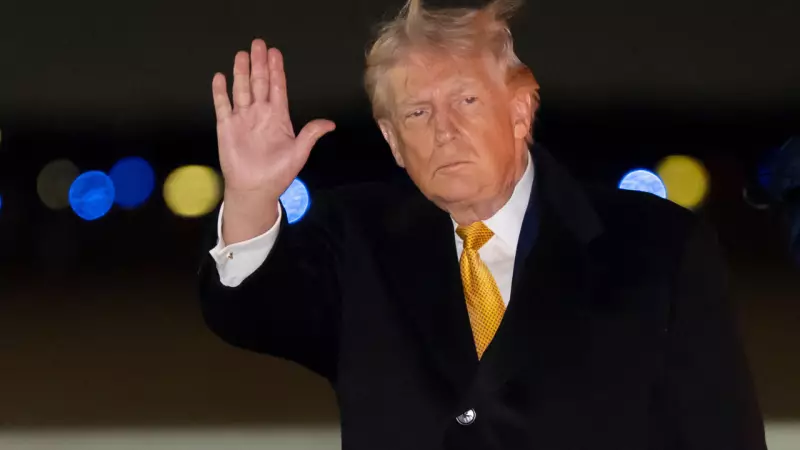
In a remarkable series of statements over the past day, US President Donald Trump has adopted an aggressively confrontational stance towards multiple nations, signalling potential escalations in US foreign policy across several regions. This comes just a day after a daring American military operation in Venezuela led to the capture of President Nicolás Maduro, who has been transported to New York to face federal charges related to drug trafficking and weapons.
Direct Warnings to Latin American Nations
While fielding questions about Venezuela aboard Air Force One on Sunday, President Trump expanded his criticism to include other Latin American countries. He specifically targeted Colombia and its President, Gustavo Petro, with incendiary remarks.
Trump accused Colombia of being "run by a sick man who likes making cocaine and selling it to the United States." Speaking about Petro, a frequent critic, Trump warned, "He's not going to be doing it for very long. He has cocaine mills and cocaine factories." This verbal attack occurs amidst rising tensions between Washington and Bogotá over US-led boat strikes in the Caribbean and eastern Pacific, actions that pressure Colombia's role in regional drug trafficking. When questioned about the possibility of a US operation targeting Colombia, Trump's reply was succinct: "It sounds good to me."

Regarding Venezuela, despite Maduro's capture, Trump hinted at further action. He issued a stern warning to interim president Delcy Rodríguez, suggesting she could "pay a very big price, probably bigger than" Maduro's if she resists US demands. When reporters asked who was currently in charge of Venezuela, Trump's response was unequivocal: "We're in charge."
On Cuba, Trump suggested military action might not be necessary, claiming the nation is collapsing economically. "I don't think we need any action. It looks like it's going down," he stated, attributing Cuba's crisis to the loss of Venezuelan oil income.
Revived Greenland Claim and Warning to Iran
President Trump also resurrected his longstanding ambition for the United States to acquire Greenland, the semi-autonomous Danish territory. He framed it as a critical national security need, alleging, "We need Greenland... It's so strategic right now. Greenland is covered with Russian and Chinese ships all over the place." He asserted that Denmark could not manage it and claimed European support for the idea. Danish Prime Minister Mette Frederiksen swiftly rejected the notion, stating it "makes absolutely no sense."
Turning to Iran, where protests over the economy are ongoing, Trump drew a red line. He warned that if Iranian authorities "start killing people like they have in the past," they would "get hit very hard by the United States." He confirmed his administration was watching the situation "very closely," though he did not detail potential US responses.
Fresh Caution to India Over Russian Oil
In comments with direct implications for New Delhi, President Trump issued a fresh warning to India concerning its purchases of Russian oil. Speaking to reporters on Air Force One, he remarked that Prime Minister Narendra Modi "knew he was not happy" with the situation and suggested corrective action was needed.
"They wanted to make me happy, basically. Modi is a very good man; he is a good guy. He knew I was not happy, and it was important to make me happy," Trump said. He pointed to trade levers, stating, "We can raise tariffs on them very quickly. It would be very bad for them." This statement followed Senator Lindsey Graham's observation that Trump's tariffs were the "chief reason" India has significantly reduced its Russian oil imports.
This cascade of warnings from the US President marks a significant hardening of rhetoric and outlines a potentially turbulent phase in America's diplomatic and strategic engagements worldwide, with India finding itself directly addressed in the context of its energy imports and trade relationship with the US.