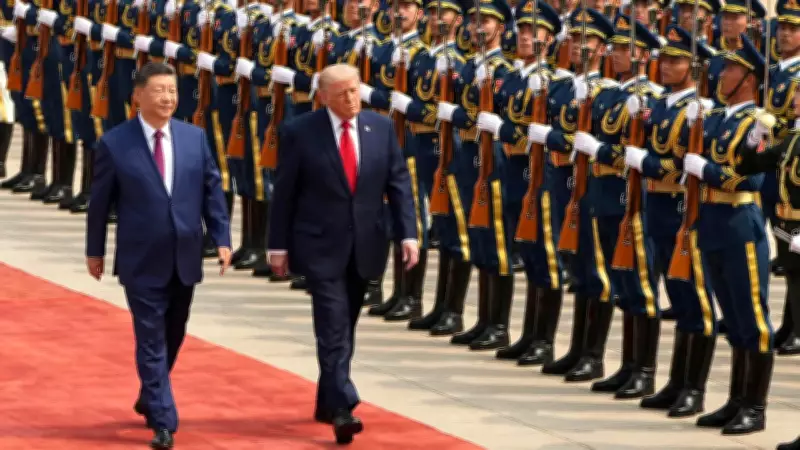
During a state visit to Beijing, US President Donald Trump found himself in a carefully orchestrated display of Chinese military might, a spectacle that seemed to temper his usual boastfulness. Standing alongside Chinese President Xi Jinping at the Great Hall of the People, rows of soldiers in perfect formation, red carpets, and waving children set a stage of precision and power. Trump, who often touts the American military as the "greatest and best," appeared subdued, his admiration mixed with recognition of a shifting global balance.
A Changing Global Order
For decades after the Soviet Union's collapse, the US stood alone at the pinnacle of global power. But Beijing's message was clear: that era is evolving. Trump repeatedly praised Xi as a "great leader," but beneath the diplomatic smiles lay a deeper undercurrent—a showcase of China's confidence in military, technological, and geopolitical domains.
Taiwan: A Flashpoint Intensifies
China's messaging on Taiwan turned blunt, with officials warning that US involvement could "lead to US-China conflict." Taiwan, a self-ruled island claimed by Beijing but backed by Washington, has become the most dangerous fault line in bilateral relations. Taiwan's defense ministry accused Beijing of "military harassment" and stated that "Beijing has no right to make any claims on behalf of Taiwan internationally."

Chinese Technology in Iran
Beyond Taiwan, the Iran conflict under "Operation Epic Fury" revealed Chinese technology's behind-the-scenes role in strengthening Iran's military capabilities. The BeiDou Navigation Satellite System, China's answer to GPS, has been used by Iran since 2021 to improve drone accuracy and deploy decoy systems. This technical detail has enormous strategic implications, signaling that China's influence extends into modern warfare's future.
Modern Warfare: A New Battlefield
The 21st-century battlefield is no longer defined solely by fighter jets or aircraft carriers. Power is increasingly measured through drones, AI systems, cyber capabilities, satellite navigation, and precision technology. In these areas, Beijing is rapidly emerging as a serious challenger to Washington.
US Arsenal Under Strain
The Iran war exposed both strengths and vulnerabilities in the American military machine. US forces fired thousands of missiles and drones, but the scale of operations triggered alarm about stockpile depletion. According to CSIS assessments, America's long-range precision munitions were under pressure before the conflict, and production timelines for critical weapons remain slow, taking three to four years. Strategic analysts fear that prolonged conflict could rapidly expose shortages.
China's Wartime Production
China's defense industry operates with a wartime mindset, rapidly producing warships, submarines, missiles, drones, and cyber capabilities. Unlike the US, which faces procurement delays, China's centralized system allows faster scaling. This shift is critical as modern warfare increasingly relies on drones, AI-enabled targeting, and autonomous platforms.
Taiwan: The Center of the Storm
During Trump's visit, China warned that mishandling Taiwan could lead to conflict. War-game simulations show US forces exhausting critical long-range missiles within the first week of a Taiwan conflict, and Taiwan running out of anti-ship missiles almost immediately. China's missile systems now threaten American bases in Japan, Guam, and the Philippines, making US aircraft carriers increasingly vulnerable.
The 'Hellscape' Concept
The Pentagon's answer to this challenge is "Hellscape," a strategy to turn the Taiwan Strait into an overwhelming maze of drones and unmanned systems. Instead of relying on expensive jets or warships, the focus is on "precise mass"—huge numbers of cheaper, expendable systems. Military planners believe future wars will be won by the side capable of sustaining enormous numbers of smart systems, where China's manufacturing strength becomes central.

Industrial Capacity: The Ultimate Decider
The CSIS report concludes that wars between great powers are ultimately won by industrial capacity. America's historic mobilizations during World War II and the Cold War transformed it into a defense production giant, but today, the US lacks that speed and readiness. Aircraft maintenance problems, overstretched naval deployments, and delayed weapons production point to a system under strain. The report calls for a modern industrial mobilization effort to accelerate defense manufacturing and expand production of drones, missiles, and air defense systems.
Beneath the diplomatic handshakes in Beijing, the strategic contest is no longer about who has the stronger military today, but who can sustain the next war tomorrow.