

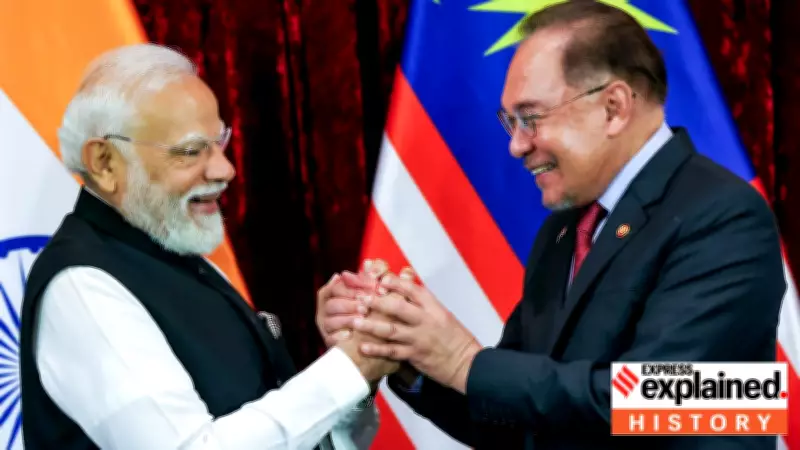
PM Modi Spotlights Tamil's Enduring Legacy in Malaysia During Diplomatic Visit
During his first foreign visit of 2026, Prime Minister Narendra Modi chose to emphasize the Tamil language in Malaysia, highlighting its deep cultural and historical connections rather than focusing on Hindi or English. In a joint press statement with Malaysian Prime Minister Anwar Ibrahim in Kuala Lumpur on February 8, Modi noted that India and Malaysia are united by a shared affection for Tamil, which maintains a strong presence in education, media, and cultural life across the Southeast Asian nation.
A Language Rooted in History, Not Just Diplomacy
For most diplomatic speeches, such remarks might appear as mere gestures toward diaspora communities. However, in Malaysia's case, this statement reflects a profound historical reality. Tamil is not simply a migrant language here; it is a public language heard in schools, temples, television broadcasts, newspapers, and cinema halls. Its presence predates the Malaysian nation-state itself and even colonial rule, arriving not through government policy but through the natural flow of maritime trade and cultural exchange.
The story of Tamil in Malaysia begins centuries before British colonialism. Maritime routes connected the Coromandel coast of South India to ports along the Malay Peninsula, particularly in Kedah and the Strait of Malacca. These trade networks facilitated the movement of spices, textiles, and forest goods, while also enabling people to travel and settle. Merchant guilds from South India established semi-permanent settlements, built temples, and left Tamil inscriptions, embedding Hindu and Buddhist practices into local societies.

These early connections were not transient but formed durable ties. Tamil Muslim trading communities, such as the Rowthers and Marakkayars, settled in the region, intermarried with locals, and integrated into the social fabric. By the time European powers arrived, Tamil presence was already an integral part of Malaysia's cultural landscape.
The British Era: Scaling Migration Through Labor
While trade brought the first Tamils to Malaysia, the British Empire dramatically expanded their numbers. Under colonial rule, plantation capitalism transformed Malaya's economy, creating demand for vast labor pools in rubber estates, railways, tin mines, and ports. Recruiters turned to the Madras Presidency, particularly districts like Thanjavur, Tirunelveli, and Ramanathapuram, implementing the "kangani" system where foremen brought groups of workers, often bound by debt or contract.
As noted by scholar Carl Vadivella Belle in his book Thaipusam in Malaysia: A Hindu Festival in the Tamil Diaspora, the large-scale migration of Indians to Malaya throughout the nineteenth and early twentieth centuries created a distinct Malaysian Indian society. However, this period was marked by oppression and brutalization for the laboring classes, with harsh conditions, limited mobility, and low wages on plantations.
Despite these challenges, Tamil life persisted with remarkable resilience. Workers built temples from available materials, established Tamil schools for their children, and maintained cultural practices. Local presses printed Tamil newspapers, and annual festivals like Thaipusam continued to thrive. Cinema from Tamil Nadu also found audiences among the diaspora, further reinforcing linguistic and cultural connections.
Post-Independence Evolution and Enduring Visibility
After Malaysia gained independence in 1957, mobility increased for the Tamil community. Families moved from plantations to urban centers like Kuala Lumpur and Penang in search of education and employment opportunities. This shift did not dilute their identity; instead, Tamil schools, media outlets, and cultural associations expanded their reach.
Today, Tamil newspapers circulate widely, television and radio broadcasts continue in the language, and Tamil cinema commands substantial audiences. This has resulted in a diaspora phenomenon where a migrant language has not faded into domestic memory but remains publicly visible and structurally integrated into Malaysian society.

Modi's speech framed these historical ties within contemporary diplomacy, describing the three million-strong diaspora as a "living bridge" between India and Malaysia. He announced measures including social security agreements, easier visa processes, and the introduction of India's digital payment interface in Malaysia. However, the deeper story of this bridge was built not through policy meetings but through centuries of individual decisions—traders staying behind, laborers planting roots, and educators preserving language and culture.
A Community That Feels Local Yet Connected
Walking through Kuala Lumpur's Tamil-speaking neighborhoods reveals a community that blurs the distinction between "Indian" and "Malaysian." Families have lived in Malaysia for five or six generations, with memories tied to estate lines rather than villages in Tamil Nadu. Their festivals and politics are local, yet their language retains the cadence of the old coast across the sea.
This continuity makes Malaysia's Tamil community distinct from newer migrations elsewhere. It is not merely an expatriate population but a historical community shaped by maritime trade, colonial empire, and modern nationhood. Tamil in Malaysia feels less like an imported tongue and more like an inherited one, deeply woven into the country's social fabric.
In diplomatic language, history is often compressed into phrases like "shared affection," "vibrant presence," and "living bridge." Behind these terms lies a timeline stretching from early seafarers to rubber estates to contemporary city streets—a connection that began with the sea long before governments formalized relations. This older current continues to shape the India-Malaysia relationship, steady and visible in everyday life and language that has traveled far and remained.





