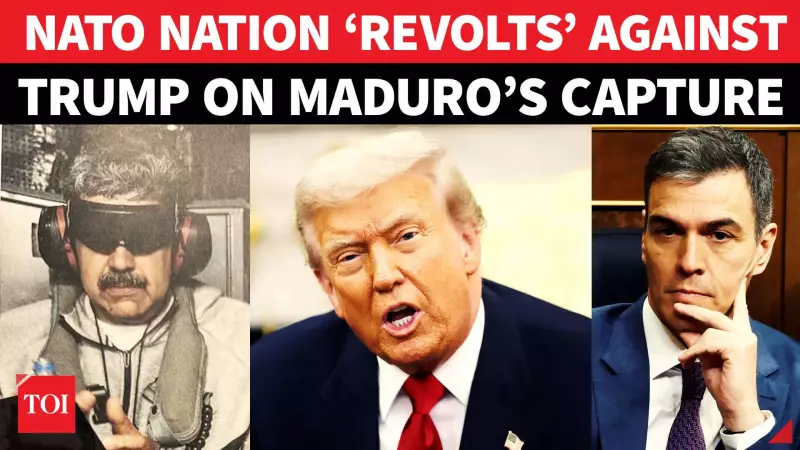
In a significant diplomatic rupture, a key NATO ally has publicly condemned the United States over its controversial military action in Venezuela. Spanish Prime Minister Pedro Sanchez has sharply criticised the operation that led to the seizure of Venezuelan President Nicolas Maduro, labelling it a perilous violation of established international norms.
Sanchez Condemns "Dangerous Breach" of International Law
The condemnation came on January 7, 2026, marking a clear divergence from Washington's stance. While Madrid has consistently refused to recognise the legitimacy of Maduro's presidency, Sanchez made it clear that this does not justify unilateral military action. He argued forcefully that "illegality cannot answer illegitimacy", framing the US operation as a step backward for global order.
Sanchez warned that such actions, undertaken without broad international consensus or a UN mandate, risk pushing the world toward greater instability and chaos. His statement implicitly rejected the notion that powerful nations can enforce regime change through force, a principle he associated with a "law of the jungle" approach to geopolitics.

The Context of the US Operation in Venezuela
The Spanish leader's remarks directly address the dramatic event where US forces captured Nicolas Maduro in Caracas. According to earlier reports, the operation resulted in significant casualties, with Venezuelan authorities admitting the loss of 24 troops and 32 Cuban military personnel. The incident has triggered widespread unrest, described as parts of Caracas being "burned".
This rift with Spain, a traditional US ally within the North Atlantic Treaty Organization (NATO), underscores the deep international divisions the operation has caused. It aligns Madrid closer to the positions of other nations that have denounced the action, including China and several African states, while isolating the Trump administration's policy further.
Broader International Repercussions and Fallout
The fallout from the Venezuela operation extends beyond US-Spain relations. Sanchez's critique adds weight to a growing chorus of international disapproval. Key developments include:
- African solidarity: South African President Cyril Ramaphosa has demanded Maduro's immediate release, rallying African support behind Venezuela.
- Chinese warnings: Beijing has issued multiple stern warnings to the US, drawing new "red lines" and challenging Washington's self-appointed role as global judge.
- Regional shifts: Reports indicate Colombian guerrilla leaders have fled Venezuela following Maduro's capture, seen as a strategic win for the US but a destabilising factor for the region.
Prime Minister Sanchez's statement is more than a bilateral critique; it is a defence of a multilateral, rules-based international system. By invoking the spectre of chaos, he highlights a fear shared by many capitals: that powerful states acting unilaterally could unravel decades of diplomatic precedent, setting dangerous new norms for intervention.
The Spanish position, balancing non-recognition of Maduro with rejection of his forceful capture, attempts to chart a middle course. It reaffirms principles of sovereignty and non-intervention, suggesting that political crises, however complex, must be resolved through dialogue and diplomatic pressure, not military raids. This stance places Spain at odds with a major ally and signals a potentially turbulent period ahead for transatlantic relations regarding the use of force.