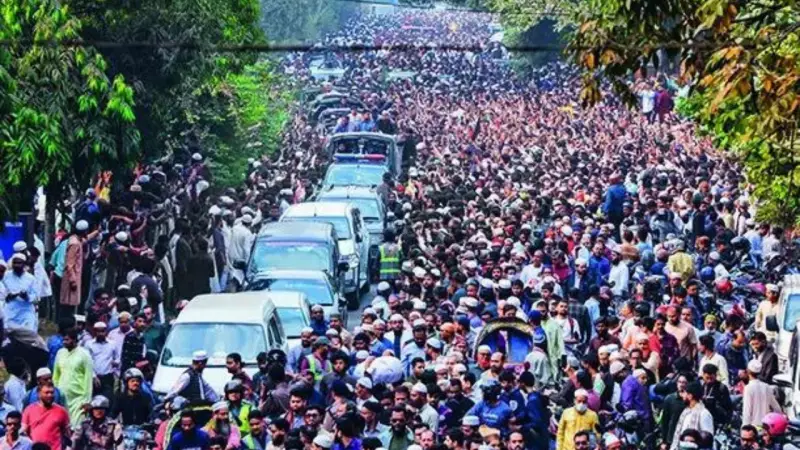
Dhaka witnessed a significant and politically charged funeral on Saturday as Sharif Osman Hadi, a prominent spokesperson for the Inqilab Moncho and a frontline leader of the July uprising, was laid to rest. The burial site, chosen to be beside the grave of the revered national poet Kazi Nazrul Islam near the Dhaka University Central Mosque, has itself become a point of intense debate and symbolism.
A Funeral Steeped in Political Symbolism
The attendance of Nobel laureate and Chief Adviser Muhammad Yunus at Hadi's funeral, where he paid rich tributes, is being widely interpreted as a pointed signal to neighbouring India. Hadi was widely known for his strong and vocal anti-India stance. Yunus, addressing the thousands of mourners, declared that "martyr Hadi would never be forgotten" and emphasised that his lessons would live on for the nation.
In his remarks, Yunus directly referenced Hadi's political aspirations, stating, "Dear Hadi, you wanted to take part in the election. By expressing your desire to contest, you also taught us how elections should be conducted. Let us all accept that process." He further vowed, "By embracing the lessons you gave us, we'll ensure that you remain alive in our memories. Hadi, you will never be lost."

Controversy and Public Outpouring
The decision to bury Hadi next to Kazi Nazrul Islam was not without controversy. Earlier in the day, exiled author Taslima Nasrin took to her verified Facebook page to question the move. She wrote, "Should Hadi, an obscene and abusive anti-India activist, be buried next to the grave of India’s rebel poet Kazi Nazrul Islam? Shouldn’t he be buried without disrespecting Kazi Nazrul Islam?" This highlighted the deep cultural and political cross-currents the event invoked.
Despite the controversy, the funeral saw a massive public turnout. Thousands of people from all walks of life attended, with many arriving in processions chanting slogans demanding justice for Hadi and vowing that his death would not be in vain. The public sentiment later converged at the Shahbagh intersection, where large crowds gathered chanting slogans like "Inquilab Inquilab—Zindabad Zindabad" and the pointed "Delhi Na Dhaka—Dhaka, Dhaka." Protesters at Shahbagh called for the intersection to be renamed "Hadi Chattor."
Political Reactions and Broader Implications
The assassination has sent ripples through Bangladesh's political landscape. The Bangladesh Nationalist Party (BNP) issued a statement urging the nation to remain vigilant so that Hadi's murder is not exploited by conspirators to delay elections or gain political advantage. Speaking after the funeral prayer, BNP standing committee member Salahuddin Ahmed warned, "some fallen fascist forces and those conspiring against the elections may attempt to use this incident for political gain."
Meanwhile, questions are being raised about the investigation. Hadi's elder brother, Abu Bakar Siddique, publicly questioned the authorities' failure to arrest the killers even seven to eight days after the shooting. In a related development, leaders of the social and cultural organisation Udichi Shilpi Gosthi have accused the interim government of failing to prevent an attack and arson at its central office, despite clear threats nearly 24 hours earlier. Udichi's general secretary Amit Ranjan Dey alleged, "The government has moved away from the spirit of the July uprising and is effectively appeasing fundamentalist forces."
The funeral of Sharif Osman Hadi has thus transcended a mere ceremony, becoming a focal point for political expression, public grievance, and regional diplomatic signalling, setting the stage for further political manoeuvring in the lead-up to elections.