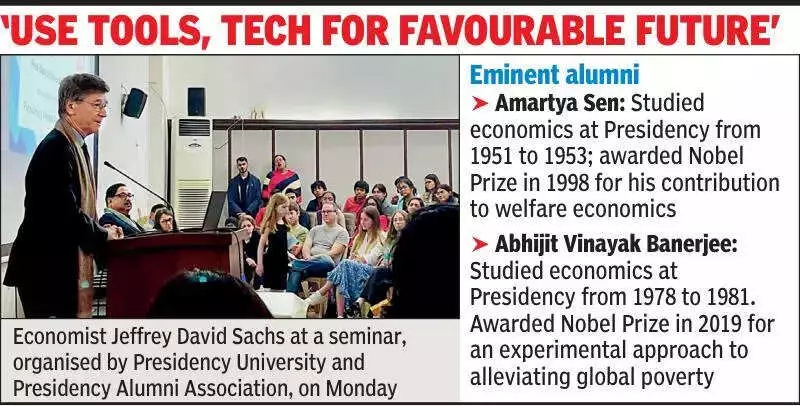
Prominent economist Jeffrey David Sachs delivered a strong message on Indian foreign policy during a visit to Kolkata on Monday. Speaking at Presidency University, he advised India to forge its own strategic path by cooperating with China and viewing the United States with skepticism.
Core Advice: Strategic Autonomy and China Engagement
Sachs, a professor at Columbia University and a global leader in sustainable development, addressed a colloquium at the A K Basak Hall. The event was organized by Presidency University and the Presidency Alumni Association. "My repeated advice to my Indian friends in Delhi is do not trust the US. Stand on your own. Have your own interests but also peacefully cooperate with China. China is not an enemy," Sachs stated clearly.
He linked current tensions to historical interference, specifically criticizing the legacy of the McMahon Line. Sachs identified "Mr McMahon" as an enemy of stability, accusing him of typical British tactics of stirring trouble. He referred to the disputed boundary between Arunachal Pradesh and Tibet, established by the 1914 Simla Convention between Britain and Tibet and named after British negotiator Sir Henry McMahon. China has never accepted this line as the legitimate border.

Diplomacy Over Conflict for Himalayan Disputes
The economist emphasized that Indian foreign policy should prioritize stability in South Asia and effective diplomatic cooperation with Beijing. He called for diplomatic solutions to resolve border disputes, particularly with China. The goal, he suggested, should be to explore cooperative opportunities and work on "figuring out that line in the Himalayas" through dialogue rather than confrontation.
Sachs expressed concern that global politics is becoming a major obstacle to progress. "Politics is more fraught than before, a considerable threat towards sustainable development," he observed. He pointed out a critical lack of diplomacy and engagement, driven by deeper political forces aiming to provoke an already unstable international system.
Critique of US Intervention and Call for Multilateralism
Sachs strongly criticized US interventionism in global hotspots like Ukraine, the Middle East, and Taiwan. He advocated for diplomatic solutions to counter what he termed "realist foreign policies" and to promote genuine multilateral engagement. "I spent decades on this idea that we should turn our goals into practical politics, which then will help move the world in the direction we want," he told the audience.
He urged the students at the alma mater of Nobel laureates Amartya Sen and Abhijit Vinayak Banerjee to look beyond propaganda. "Students should build a vision of what's possible ahead of political lobbies and propaganda," Sachs said, encouraging them to develop and harness technology to shape a better future.
India's Sustainable Development Challenges
Shifting focus to domestic priorities, Sachs outlined six key challenges India must overcome to achieve its sustainable development goals:
- Improving educational facilities
- Enhancing public health and nutrition
- Managing energy transformation related to global warming
- Undertaking land use transformation
- Achieving urban sustainability
- Learning to thrive in the digital age
He also took aim at the political climate in the United States, citing the Trump administration as a dangerous tipping point. Sachs, a known critic of Donald Trump, highlighted how the former president's dismissal of climate science as a "hoax" at the UN served corrupt oil lobbies and demonstrated a "measure of ignorance, shamelessness and recklessness."
The event underscored a pressing call for India to assert strategic autonomy, deepen regional diplomacy, and focus on its long-term developmental needs amidst a turbulent global order.