

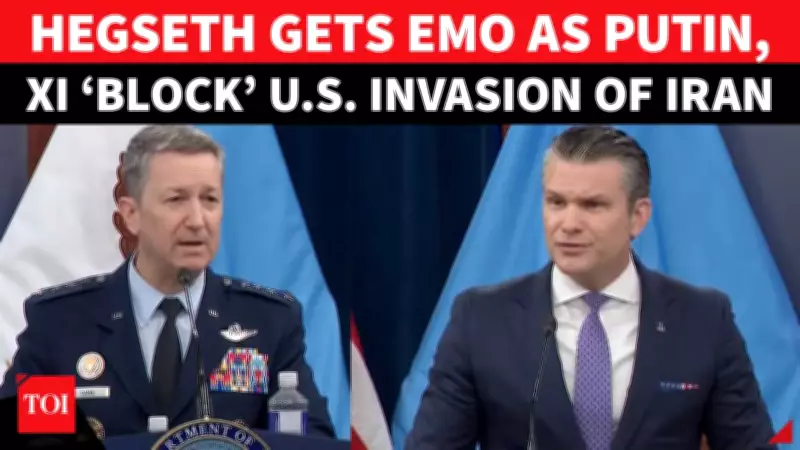
US Defense Secretary's Vague Stance on Iran Exposes Geopolitical Complications
In a high-stakes briefing that revealed mounting pressure on American strategy, US Defense Secretary Pete Hegseth struck a defiant tone regarding Iran but conspicuously avoided detailing the critical roles of Russia and China. The event, which has drawn significant scrutiny, highlighted how external powers are increasingly complicating Washington's plans in the volatile region.
Hegseth's Evasive Remarks Fuel Uncertainty
During the briefing, Hegseth admitted that the United States is fully aware of Moscow and Beijing's involvement in the Iran conflict. However, he refused to elaborate on specifics, stating only that the US is actively "addressing, mitigating, or confronting" their influence. This lack of clarity has sparked fresh doubts among analysts and policymakers, who question how these global powers factor into the escalating tensions.
The Pentagon maintains that it holds multiple military options against Iran, but Hegseth's reluctance to discuss Russia and China's actions suggests a broader strategic challenge. As questions grow over whether outside interference is derailing US invasion plans, the focus is shifting from a singular confrontation with Iran to a more complex geopolitical contest.

Expanding Battlefield and Rising Tensions
The conflict's dynamics are evolving rapidly, with the battlefield expanding beyond traditional borders. Tensions are rising as Iran continues to assert its influence, while Russia and China appear to be leveraging the situation to counter American dominance in the region. This development marks a significant phase in the war, where regional disputes are morphing into a proxy struggle among superpowers.
Observers note that Hegseth's performance during the briefing—described by some as "falling apart"—underscores the difficulties the US faces in navigating this multifaceted crisis. The absence of a clear plan to address Russian and Chinese involvement raises concerns about the viability of any military action against Iran.
Broader Implications for US Foreign Policy
The situation in Iran is no longer just about Tehran's nuclear ambitions or regional aggression; it has become a litmus test for US foreign policy in an era of renewed great-power competition. With Russia and China potentially derailing invasion plans, the US must reassess its approach to avoid being drawn into a protracted and costly conflict.
- Strategic Reassessment: The US may need to pivot from military threats to diplomatic engagements to manage the involvement of Russia and China.
- Intelligence Gaps: Hegseth's vague comments hint at possible intelligence shortcomings regarding the extent of foreign interference.
- Global Alliances: The conflict could reshape alliances, with Iran gaining tacit support from Moscow and Beijing against US-Israeli pressures.
As the war enters its next phase, the international community watches closely, aware that the stakes extend far beyond Iran's borders. The unfolding scenario serves as a stark reminder of how geopolitical rivalries can transform regional conflicts into global flashpoints.






