Russia and China Issue Strong Condemnation After US-Israeli Strike Kills Iran's Supreme Leader
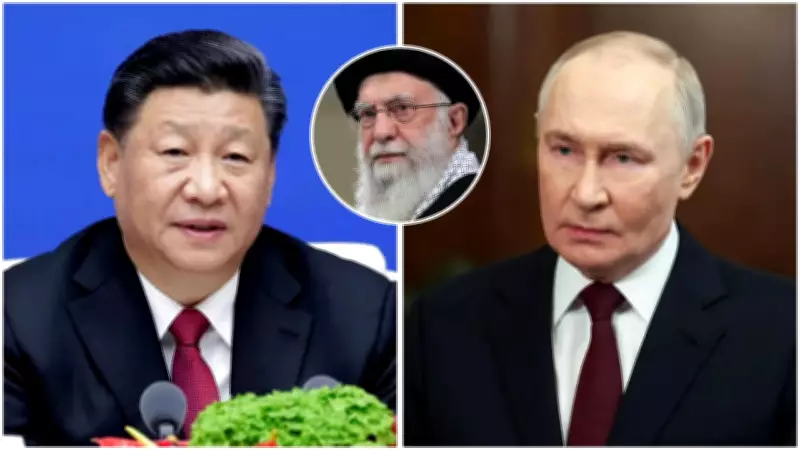
The assassination of Iran's Supreme Leader Ayatollah Ali Khamenei during joint United States and Israeli military strikes has triggered forceful diplomatic reactions from both Russia and China. Leaders in Moscow and Beijing have sharply criticized the operation, describing it as a violation of international law while urgently calling for an immediate halt to all military activities in the region.
Details of the Attack and Immediate Aftermath
Ayatollah Ali Khamenei, aged 86, was killed during a major aerial assault targeting Iranian military and government installations. This dramatic development has plunged the Middle East into fresh instability, with Iran already launching retaliatory missile and drone attacks across the Gulf region in response to the killing of its supreme leader.
Russia's Strong Response and Historical Context
Russian President Vladimir Putin characterized the assassination as "a cynical violation of all norms of human morality and international law" in an official statement released through the Kremlin. In a formal letter addressed to Iranian President Masoud Pezeshkian, Putin extended his deepest condolences and praised Khamenei as "an outstanding statesman who made an enormous personal contribution to the development of friendly Russian-Iranian relations."

Russia had previously condemned the US-Israeli strikes as a "dangerous adventure" that could potentially trigger a regional catastrophe. Moscow had advocated for restraint in the period leading up to the attacks. The relationship between Russia and Iran has strengthened significantly in recent years, particularly following Moscow's military offensive in Ukraine. In 2025, the two nations formalized their alliance through a strategic partnership treaty designed to deepen cooperation across multiple domains, including military affairs.
China's Firm Stance and Evacuation Measures
China issued an equally strong condemnation, with Beijing stating the killing represented "a serious violation of Iran's sovereignty and security, a trampling on the aims and principles of the UN Charter and the basic norms of international relations." The Chinese foreign ministry explicitly called for an immediate cessation of military operations.
Chinese Foreign Minister Wang Yi, during a telephone conversation with Russian counterpart Sergei Lavrov, declared that "the blatant killing of a sovereign leader and the incitement of regime change" by the United States and Israel was completely unacceptable. Wang expressed grave concern that the Middle East could be pushed into a "dangerous abyss" and warned that attacking a sovereign state without United Nations Security Council authorization undermines the post-World War II global order.
Amid escalating tensions, Beijing has urgently advised Chinese citizens in Iran to evacuate the country as soon as possible. The foreign ministry reiterated this advisory on Sunday, noting that Chinese passport holders could exit Iran through visa-free land routes into neighboring countries including Azerbaijan, Armenia, and Turkey.
Broader International Reactions and Geopolitical Implications
The killing has generated alarm beyond Moscow and Beijing. Pope Leo XIV appealed for an end to the "spiral of violence" and urged all parties to exercise moral responsibility before the situation deteriorates into what he described as "an irreparable chasm." Meanwhile, United States President Donald Trump defended the operation, asserting the strikes provided Iranians with their greatest opportunity to reclaim their country while warning Tehran against further escalation.
The forceful language from both Russia and China highlights a widening geopolitical divide. With Russia bound to Iran through their recent strategic treaty and China explicitly warning against regime change policies, the reactions demonstrate that Khamenei's assassination transcends regional boundaries, carrying significant global diplomatic consequences that could reshape international relations in the coming months.