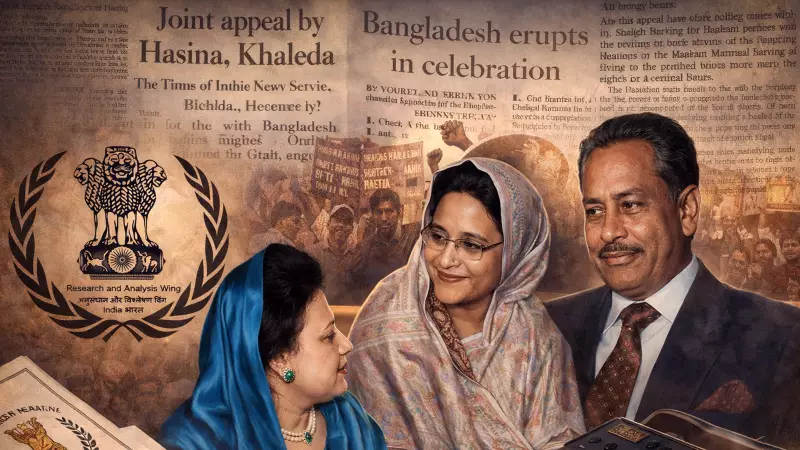
In a significant chapter of regional diplomacy, India's external intelligence agency, the Research and Analysis Wing (RAW), played a pivotal role in attempting to mend the deep political rift between Bangladesh's two most powerful leaders. This covert effort was triggered following General Hussain Muhammad Ershad's consolidation of power through the controversial March 1988 elections.
The Political Crisis After the 1988 Elections
The political landscape in Dhaka was in turmoil after the 1988 polls, which were widely seen as lacking legitimacy. A critical concern for Indian security and intelligence officials was the persistent and bitter division between Sheikh Hasina's Awami League and Begum Khaleda Zia's Bangladesh Nationalist Party (BNP). This schism threatened long-term stability on India's eastern frontier.
Indian analysts feared that a fragmented opposition would only strengthen military rule under Ershad. What made the situation particularly challenging was that despite their mutual animosity, both major parties, along with others like the Jamaat-e-Islami, had jointly boycotted the 1988 elections. This shared action, however, did not translate into a unified political strategy against the regime.

RAW's Covert Diplomatic Maneuvering
Recognizing the strategic imperative, RAW initiated discreet backchannel communications. The agency's objective was clear: to foster dialogue and explore common ground between the two rival 'Begums'—Sheikh Hasina and Khaleda Zia. The goal was to build a cohesive, broad-based opposition movement that could effectively challenge Ershad's military junta.
This was no simple task. The personal and political rivalry between the leaders was profound, rooted in the legacies of their families—Sheikh Mujibur Rahman and Ziaur Rahman respectively. RAW's operatives worked to highlight the greater threat posed by prolonged military dictatorship, arguing that it overshadowed their internal disagreements.
The Strategic Imperative for India
For India, a stable and friendly Bangladesh was a key geopolitical priority. A military regime, especially one that could potentially foster anti-India sentiments, was viewed as a security risk. By encouraging a return to democratic processes through a united opposition, India aimed to ensure a neighbor aligned with peaceful and cooperative ties.
The effort to unite Hasina and Khaleda Zia was part of a larger, nuanced strategy. It underscored India's preference for political democracy over military rule in its neighborhood, even if that meant mediating between fierce political competitors. This episode highlights the often-overlooked role of intelligence agencies in complex diplomatic engagement.
While the immediate success of these efforts in forging a lasting alliance was limited due to the deep-seated nature of the rivalry, they planted seeds for future coordinated actions against authoritarian rule. The story of RAW's involvement reveals the intricate layers of South Asian politics, where intelligence work often blends with statecraft to navigate turbulent regional waters.