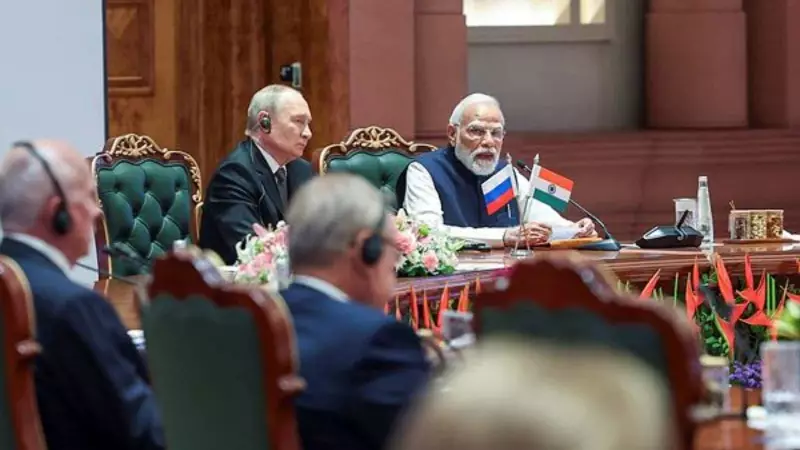
Russian President Vladimir Putin departed from New Delhi on Friday, concluding a significant two-day state visit that carried profound geopolitical implications for both nations. The visit, occurring against the backdrop of the ongoing war in Ukraine and shifting global alliances, was marked by notable gestures of hospitality from India, including a personal airport reception by Prime Minister Narendra Modi.
A Political Triumph for an Isolated Leader
For President Putin, facing stringent Western sanctions and international isolation, the warm reception in India served as a crucial public relations victory. The visuals of being welcomed by the Indian Prime Minister and sharing a ride to his official residence provided a powerful counter-narrative to his pariah status in the West. These images, broadcast globally, project a sense of international legitimacy despite Russia's invasion of Ukraine, a move widely condemned as a violation of international law. This external validation is expected to bolster Putin's standing in domestic Russian politics, making the visit a substantial political asset.
India's Strategic Recalibration Amid US Uncertainty
For India, the timing of Putin's visit is critical. It comes as the foundational assumptions of its foreign policy face unprecedented strain. The once-steady upward trajectory of the India-US strategic partnership has stalled during Donald Trump's second term. The US appears to be shifting its strategic focus away from the Indo-Pacific and the containment of China, thereby diminishing India's role in that framework.
This recalibration has had direct economic consequences. The US has imposed prohibitively high trade tariffs on India, inflicting significant economic damage. Notably, India has been singled out with penal tariffs—an additional 25%—for its continued purchase of Russian oil, even as similar purchases by other nations were exempted. With limited capacity for retaliation, India finds itself navigating a more hostile economic environment from its traditional partner.
The Enduring Pillars of the India-Russia Relationship
While the contemporary partnership is not equivalent to the Indo-Soviet alliance of the Cold War era, several enduring factors provide a solid foundation. The decades-old defence hardware relationship, built over 30 years, continues to be a cornerstone. Russia remains the sole provider of critical technologies like nuclear submarines and advanced anti-missile systems, such as the S-400, which India recently deployed effectively in Operation Sindoor.
During the visit, both sides made serious efforts to expand economic ties, agreeing on an Economic Vision for 2030 with a target of $100 billion in bilateral trade. Cooperation in nuclear energy was also highlighted, with Putin expressing Russian readiness to collaborate on small modular reactors (SMRs) and floating nuclear power plants.
Navigating a Complex Geopolitical Chessboard
The visit inevitably draws reactions from other global powers. European nations are displeased with the red-carpet welcome extended to Putin as he escalates the war in Ukraine. However, analysts suggest Europe's primary concern is shifting towards American unreliability and its pressure on Ukraine to concede to Russian demands, rather than India's diplomatic engagements.
China's reaction is nuanced. While some Chinese commentaries warn that a stronger India-Russia military partnership could empower a perceived adversary, Beijing might also welcome a strain in Indo-US ties, which would ease American containment efforts. India, however, remains clear-eyed that the "no-limits partnership" between Russia and China sets a boundary on how far the India-Russia relationship can develop.
India's challenge is to balance its continuing reliance on the US for high-tech collaboration and advanced weaponry—evidenced by the recent renewal of the Defence Cooperation Framework for another 10 years—with the need to diversify its strategic options. Given the unpredictability of the current US administration, expanding defence ties with Russia emerges as a pragmatic, if complex, choice.
Prime Minister Modi reiterated during the visit that India is "not neutral" on Ukraine and supports an early return to peace, upholding principles of territorial integrity and sovereignty, even while avoiding public condemnation of Russia. This nuanced stance reflects India's long experience in managing complex geopolitical terrain, with strategic autonomy as its guiding principle. As European leaders prepare to be honoured guests at India's Republic Day in January 2026, New Delhi continues its delicate diplomatic balancing act, securing its interests in an increasingly multipolar and unpredictable world.