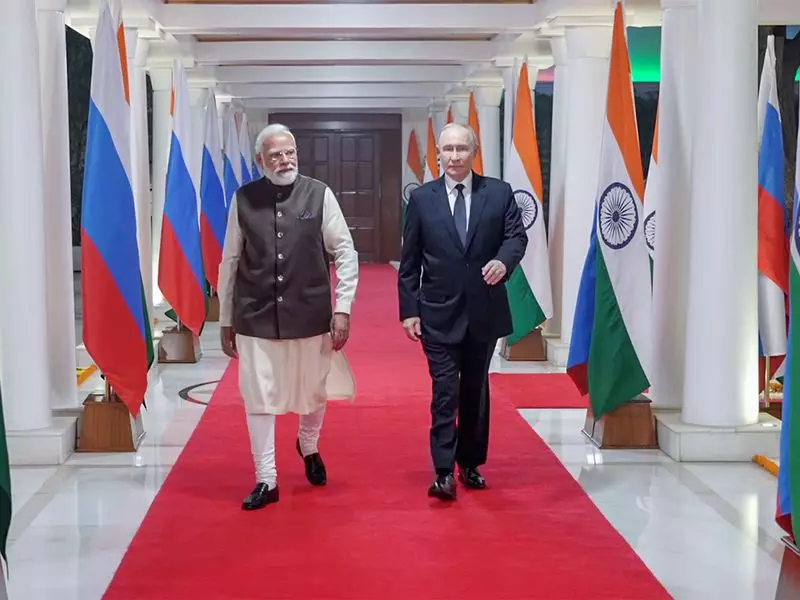
In a powerful endorsement of India's global stance, Russian President Vladimir Putin has publicly commended Prime Minister Narendra Modi for his resolute and independent leadership. The remarks came during their bilateral meeting on the sidelines of the Shanghai Cooperation Organisation (SCO) Summit in Astana, Kazakhstan, on July 3, 2024.
Putin's Resounding Praise for Modi's Leadership
President Putin explicitly highlighted Prime Minister Modi's ability to steer India's course without bending to outside influences. "India's Prime Minister Modi is not someone who can be pressured or intimidated," Putin stated, according to a Kremlin readout of the meeting. He emphasized that this quality of leadership is a significant asset for the Indian nation, allowing it to pursue a sovereign foreign policy based on its national interests.
This public acknowledgment from the Russian leader is seen as a major diplomatic moment, underscoring the respect Modi commands on the world stage for maintaining India's strategic autonomy. The comments are particularly significant in the current complex geopolitical landscape, where major powers often seek to influence the positions of other nations.
Key Outcomes of the Astana Meeting
The meeting between the two leaders was substantial and forward-looking. They engaged in a comprehensive review of the "Special and Privileged Strategic Partnership" between India and Russia. Discussions spanned a wide range of crucial areas, demonstrating the depth and breadth of the bilateral relationship.
The leaders focused on several pillars of cooperation:
- Trade and Economic Ties: Both sides expressed satisfaction with the growing trade volume, which has reached record levels. They discussed ways to further enhance economic engagement, including in energy and fertilizers.
- Defence and Security: Long-standing defence cooperation was reviewed, with a mutual commitment to further strengthen this key pillar of the partnership.
- Energy Security: Cooperation in the nuclear energy sector and the peaceful use of nuclear technology was a key point of discussion.
- Regional and Global Issues: The talks also covered important international matters, including the situations in Ukraine and Afghanistan, reflecting the high level of strategic dialogue.
Prime Minister Modi and President Putin agreed to maintain regular contact and instructed their respective officials to ensure timely implementation of the decisions taken during this summit.
Implications for India's Foreign Policy and Global Stance
This meeting and Putin's unequivocal praise reinforce the success of India's foreign policy doctrine under PM Modi. The approach, often described as "multi-alignment," involves engaging constructively with all major global powers while fiercely protecting core national interests. The ability to maintain strong, historic ties with Russia while simultaneously deepening partnerships with the United States, Europe, and other Quad nations is a delicate balancing act.
Putin's statement serves as a testament to India's growing diplomatic heft. It signals to the international community that India, under its current leadership, makes decisions based on a careful calculus of its own strategic and economic needs, rather than external pressure. This independence strengthens India's position as a leading voice of the Global South and a crucial, independent player in shaping the new world order.
The outcomes from Astana ensure that the India-Russia relationship, a constant in a changing world, continues to evolve and adapt to new realities. It provides India with a stable partnership in a critical region, ensuring continued access to energy, defence, and diplomatic support, which are vital for the nation's growth and security.