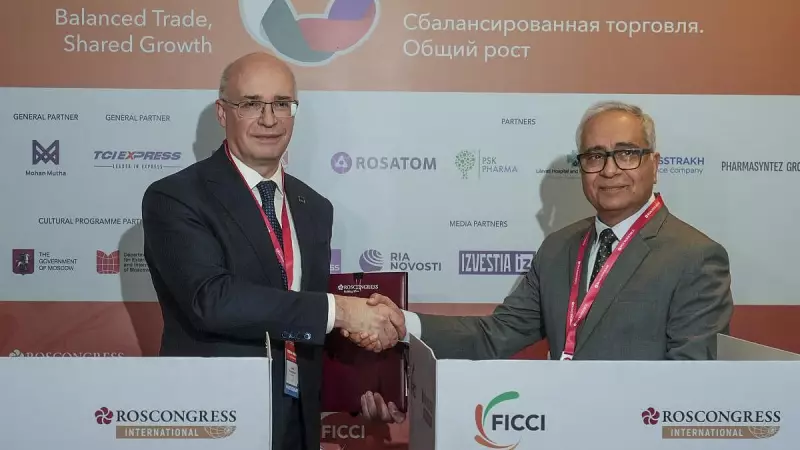
In a significant move to bolster media ties, India's premier news agency, the Press Trust of India (PTI), and Russia's leading news agency, TASS, have formally entered into a cooperation agreement. The pact, signed on the sidelines of the St. Petersburg International Economic Forum (SPIEF), is designed to facilitate the exchange of news content and deepen collaboration between the two media giants.
A Strategic Partnership Forged at SPIEF
The agreement was officially inked by the heads of both agencies. Vijay Joshi, the Editor-in-Chief of PTI, and Sergei Mikhailov, the Director General of TASS, signed the document, marking a new chapter in India-Russia media relations. The signing ceremony took place during the prestigious international forum in St. Petersburg, a venue known for fostering global economic and strategic dialogues.
This partnership is not merely symbolic. It establishes a concrete framework for the two agencies to share news reports, photographs, and video content. The collaboration aims to provide audiences in both India and Russia with a richer, more diverse, and direct perspective on events and developments in each other's countries, bypassing potential filters of Western media narratives.
Deepening the India-Russia Information Bridge
The agreement underscores the long-standing and time-tested strategic partnership between India and Russia. In an era of complex global information flows, this direct channel between PTI and TASS is poised to enhance the accuracy and depth of coverage concerning bilateral relations and domestic affairs.
The core of the agreement involves the mutual exchange of text-based news stories, photographic images, and video footage. This will allow PTI to access TASS's extensive coverage of Russia and the Eurasian region, while TASS will gain direct insights into Indian perspectives through PTI's vast domestic network. The move is seen as a step towards strengthening people-to-people connections by improving the quality and availability of news.
Implications for Media Landscape and Bilateral Ties
This collaboration between the national news agencies carries considerable weight. Both PTI and TASS are institutions of repute with massive reach within their respective countries and influence on public discourse. Their partnership signals a mutual desire to foster a more robust and independent channel of communication.
Analysts view this agreement as an extension of the strong diplomatic and economic bonds between New Delhi and Moscow. By facilitating a direct exchange of information, it reduces reliance on third-party sources and can lead to more nuanced reporting. The pact is expected to benefit newspapers, digital platforms, and broadcasters in both nations who rely on these agencies for content.
In conclusion, the PTI-TASS agreement is a strategic development in the media domain. It promises to enrich the news ecosystem for Indian and Russian audiences by providing authentic, agency-produced content directly from the source. This initiative stands as a testament to the enduring partnership between the two countries, now expanding firmly into the realm of information and media exchange.