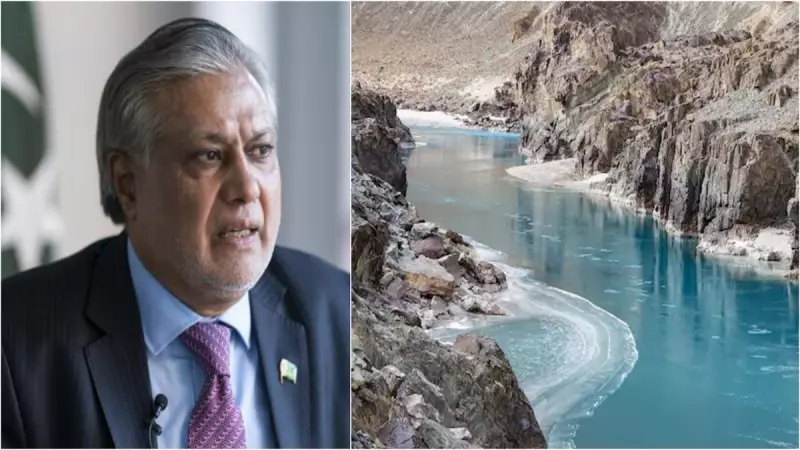
Pakistan has been plunged into a profound national crisis following India's momentous decision to suspend the 1960 Indus Waters Treaty. The move, announced by India's Foreign Minister S. Jaishankar, has triggered alarm and desperation in Islamabad, with Pakistan's Deputy Prime Minister and Foreign Minister, Ishaq Dar, issuing a stark warning about the potential for catastrophic human suffering.
A Treaty Torn Asunder: India's Historic Suspension
On December 19, 2025, Indian External Affairs Minister Dr. S. Jaishankar made a landmark declaration before the United Nations General Assembly. He stated that India was suspending the Indus Waters Treaty (IWT) with immediate effect. This historic pact, brokered by the World Bank and signed in 1960, has been a cornerstone of water sharing between the two nuclear-armed neighbours for over six decades.
Jaishankar justified this drastic step by accusing Pakistan of "continued sponsorship and financing of cross-border terrorism against India." He framed the treaty suspension not merely as a resource dispute but as a direct response to what India perceives as Pakistan's failure to uphold its obligations under international law to prevent terror activities emanating from its soil. This action represents an unprecedented escalation in leveraging natural resources as a tool of geopolitical pressure.

Pakistan's Desperate Plea: 'Our People Will Die of Thirst'
The reaction from Pakistan was swift and filled with anguish. Addressing a press conference, Deputy Prime Minister Ishaq Dar did not mince words. "Our people will die. Our people will die of thirst," he stated, painting a grim picture of the treaty's suspension. Dar emphasized that the IWT was not a bilateral agreement that could be easily discarded but was guaranteed by the World Bank, implying a breach of international commitment.
Dar revealed that Pakistan had received no prior formal notification from India regarding the suspension, learning about it only through media reports of Jaishankar's UN speech. He characterized India's action as a violation of international law and the UN Charter, arguing it set a dangerous precedent. "This will affect the lives of millions of Pakistanis," Dar asserted, highlighting the treaty's critical role in providing water for drinking, agriculture, and industry across Pakistan.
Implications and the Path Forward
The suspension of the Indus Waters Treaty carries immediate and long-term consequences that extend far beyond diplomacy. The Indus river system, governed by the treaty, is the lifeline of Pakistan's agrarian economy. A significant disruption in water flows could lead to:
- Severe water scarcity for millions of households and farmers.
- Crippling blows to agricultural output, threatening food security.
- Economic destabilization due to impacts on key sectors like farming and hydroelectric power.
Pakistan has signaled its intent to fight the suspension on all available forums, including likely appeals to the World Bank and the International Court of Justice. Ishaq Dar indicated that Pakistan would pursue all legal and diplomatic channels to challenge India's decision, framing it as a matter of national survival. This development marks one of the most serious confrontations between India and Pakistan in recent years, directly linking the issue of terrorism to the fundamental resource of water. The crisis underscores how environmental and humanitarian concerns are becoming deeply entangled in the complex and tense geopolitical rivalry of South Asia.
The world now watches closely as Pakistan navigates this existential threat, while India holds firm on its position, creating a volatile stalemate with the welfare of millions hanging in the balance.