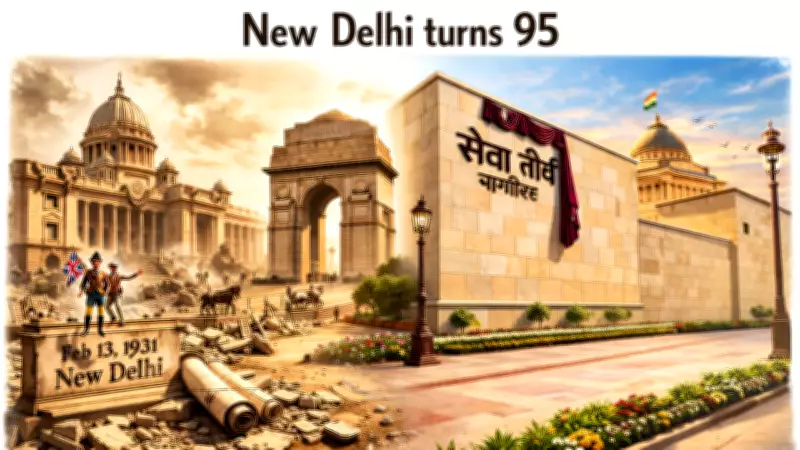
New Delhi Celebrates 95 Years: A Capital's Transformative Journey
Today marks the 95th anniversary of New Delhi's establishment as India's capital, connecting two pivotal moments in the city's administrative evolution. On this significant date, Prime Minister Narendra Modi inaugurated the relocation of the Prime Minister's Office to Seva Teerth, mirroring the historical moment when Lord Irwin moved the imperial administration into the Viceroy's House nearly a century ago.
The Colonial Foundation and Modern Transition
The transition from South Block to Seva Teerth has been characterized as the final separation of the Eighth City from its colonial legacy. However, the birth of New Delhi itself was neither sudden nor a simple ceremonial unveiling. Following King George V's dramatic announcement on December 12, 1911, during the Delhi Durbar that the capital would shift from Calcutta to Delhi, it required two full decades for the city to materialize into a functioning administrative center.
The inauguration of New Delhi unfolded through a week-long series of ceremonies in February 1931. During this period, the then Viceroy dedicated the All India War Memorial Arch, now known as India Gate, on February 12. This monument commemorates soldiers who perished in the First World War and the Third Anglo-Afghan War, with thousands of names permanently inscribed on its surface. Three days later, ceremonies at the Government of India Camp recalled when King George V and Queen Mary laid the foundation stones for the new capital in 1911.

The Strategic Shift from Calcutta to Delhi
The creation of New Delhi emerged from historical necessity as much as political calculation. Following the Swadeshi boycotts and violence after the 1905 Bengal partition that engulfed Calcutta's streets, the British Raj required a powerful statement of authority. They turned to Delhi, with its central location along rail networks, proximity to Punjab's military recruits, and strategic position near the Afghan frontier making it superior for administration and defense.
King George V's announcement at the Delhi Durbar declared: "We are pleased to announce to our people that we have decided upon the transfer of the seat of the Government of India, from Calcutta to the ancient capital of Delhi." This move served both practical and symbolic purposes, connecting British rule to the legacy of previous empires that had governed from Delhi.
The Seven Cities That Preceded New Delhi
Delhi's history as a capital extends far beyond its British incarnation, with seven distinct cities preceding the current administrative center:

- Lal Kot/Qila Rai Pithora (1052 CE): Established by Anangpal Tomar II and expanded by Prithviraj Chauhan, this fortified settlement on the Aravalli ridge represented Delhi's first major urban center.
- Siri (1303): Built by Alauddin Khilji as a fortified city designed to withstand Mongol invasions, featuring massive 13-meter-thick walls and the innovative Hauz-i-Alai water reservoir.
- Tughlaqabad (1321): Ghiyasuddin Tughlaq's grim fortress city, famously cursed by Sufi saint Nizamuddin Auliya, was abandoned shortly after completion due to water scarcity and disease.
- Jahanpanah (1325): Muhammad bin Tughlaq's ambitious but disastrous attempt to relocate Delhi's entire population to Daulatabad, resulting in massive loss of life and the city's temporary abandonment.
- Firozabad/Firoz Shah Kotla (1354): Firoz Shah Tughlaq's riverbank city that later suffered extensive looting by Timur's forces, though its architectural innovations influenced Central Asian design.
- Dinpanah/Purana Qila (1533): The sixth city co-developed by Mughal Emperor Humayun and Afghan ruler Sher Shah Suri, built on the supposed site of ancient Indraprastha.
- Shahjahanabad (1639): The seventh city representing Mughal architectural refinement with landmarks including the Red Fort, Jama Masjid, and Chandni Chowk, later devastated during the 1857 revolt.
Lutyens' Delhi: The Eighth City Emerges
Following the 1911 announcement, architects Edwin Lutyens and Herbert Baker faced a challenging four-year deadline to design a new capital across 6,000 acres. What began with a budget of approximately Rs 10 crore eventually ballooned as World War I diverted resources, with the final cost estimated at around £4 million at the time, equivalent to approximately Rs 7,528 crore today.
The grand inauguration in February 1931 featured dramatic symbolism. After three days of torrential rain, clouds parted precisely at 11:00 AM on February 10th as sunlight struck the red sandstone of the Secretariats. Lord Irwin and Lady Irwin unveiled the Dominion Columns in the Great Court of the Viceroy's House while military parades marched along Kingsway and Royal Air Force aircraft performed flypasts overhead.
The subsequent bureaucratic transfer represented one of history's largest administrative shifts, with thousands of files, furniture, and clerks transported via special trains from Calcutta to Delhi. By 1932, the Viceroy's House became fully operational, marking the British occupation of their "eighth city"—a capital they would control for only 16 years before Indian independence.
A Capital Transformed
Today, New Delhi stands as a testament to layered history, where colonial architecture coexists with modern government complexes. The city that once symbolized British imperial ambition now serves as the administrative heart of the world's largest democracy, home to millions who migrated following independence and countless others drawn by opportunity.
As the Urdu poet Zauq famously reflected: "Kaun jaye Zauq, Dilli ki galiyan chhod kar?" (Who would ever leave the streets of Delhi?) This sentiment captures the enduring magnetism of a city that has served as India's political center through eight distinct incarnations, each building upon the ruins and foundations of its predecessors.