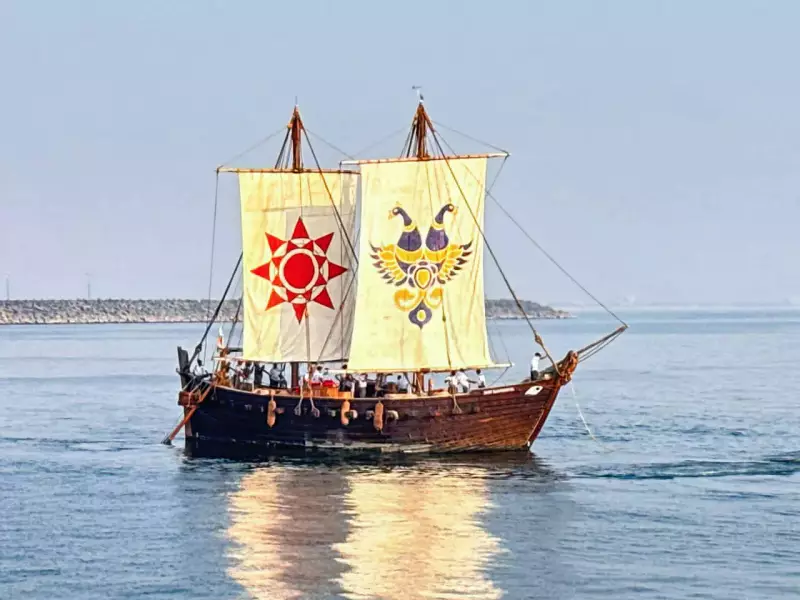
A daring maritime expedition is unfolding in the Arabian Sea, where a 16-member Indian Navy crew is sailing a unique, ancient-design wooden yacht on a historic route. The vessel, INSV Kaundinya, is a 20-metre ship stitched together entirely by hand without a single nail, based on a 1,600-year-old design. The crew, led by Commander Vikas Sheoran, embarked from Porbandar on December 29 and is aiming to reach Muscat around January 15, retracing ancient trade corridors between India and Oman.
A Brutal Dance with the Elements
The journey has been a gruelling test of endurance and skill. The Kaundinya, lacking a deep keel like modern yachts, pitches and rolls at severe angles up to 30 degrees, making steering a constant battle. Helmsmen work exhausting four-hour shifts, fighting steering oars that threaten to throw them overboard. The weather has been a fickle adversary, with winds shifting from helpful northeasterlies to stubborn westerlies that pushed the ship back towards Gujarat. For long periods, the wind vanishes entirely, leaving the crew adrift on eerily calm, glassy waters.
Progress is measured in slow knots. While the ship can theoretically make 4-5 knots, it often crawls at just 2 knots, the speed of a leisurely bicycle. A brief burst of strong northeasterly winds provided a glorious exception, pushing the Kaundinya to 6 knots. Life onboard is Spartan. There are no cabins; the crew sleeps in bags on deck or takes turns in a dark, cramped hold filled with supplies when the sea turns too violent. Fresh water is strictly rationed to 4.5 litres per person per day for all needs. Fresh vegetables lasted only six days, and the diet now consists of Gujarati thepla, mango pickle, pre-made military rations, and whatever fish they can catch—though the colourful Mahi-Mahi swimming alongside have so far escaped their lines.

Modern Perils on an Ancient Route
This expedition faces a hazard their ancient predecessors never imagined: navigating one of the world's busiest shipping corridors. The small wooden ship must cautiously avoid massive oil tankers and container vessels. The crew had a moment of amusement when a Pakistani reconnaissance vessel, apparently searching for an Indian warship, approached them only to leave bewildered by the unusual sight.
Despite the hardships, the voyage offers moments of sublime beauty that reward the crew. One night, they created a magical spectacle by throwing buckets of seawater, triggering a brilliant explosion of bioluminescent phytoplankton—a natural fireworks display in the dark ocean. These experiences are part of a steep learning curve that, as the crew affirms, no maritime museum could ever replicate.
The Vision Behind the Voyage
The idea for this audacious project was conceived by Sanjeev Sanyal, a member of the Prime Minister's Economic Advisory Council, who was inspired by an Ajanta cave painting. He envisioned building a ship using ancient Indian techniques. The expertise to bring this vision to life came from Divar's shipyard, Hodi Innovations, and a team of skilled artisans from Kerala who meticulously stitched the vessel together.
Onboard with Sanyal is Commander Y Hemanth Kumar, a naval architect overseeing the expedition. Sanyal has documented the challenging realities of the journey on social media, noting that sleep is hard-won with a sleeping bag sliding on deck, cold winds, and the constant angry flutter of the rigging. He emphasizes that sailing the Kaundinya is completely different from modern boats. The ship's square sails limit the directions it can sail, requiring specialized knowledge to handle its unique characteristics, which presents a significant psychological and physical challenge.
As the Kaundinya enters the final leg of its journey, having crossed more than two-thirds of the distance, it has already proven its seaworthiness. This remarkable expedition is more than a voyage; it is a living tribute to India's rich maritime heritage and a testament to the enduring skills of its shipbuilders and the resilience of its sailors.