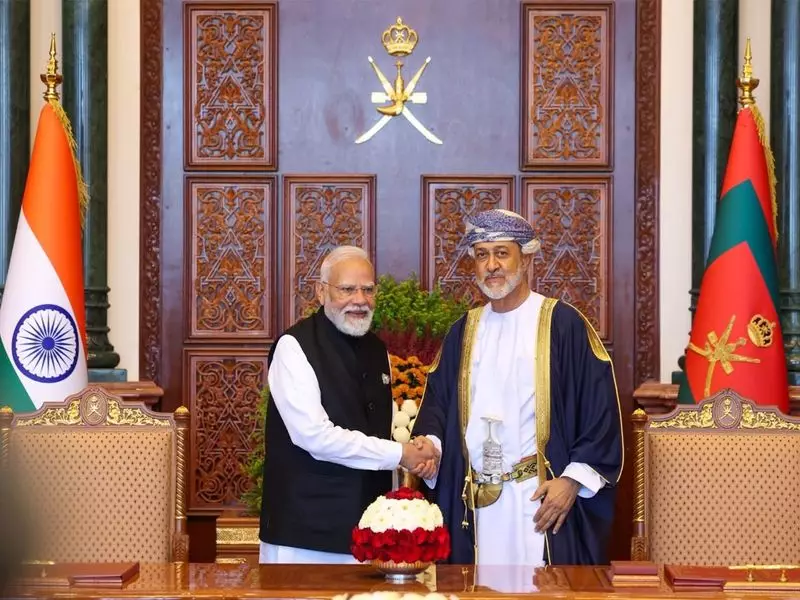
Prime Minister Narendra Modi's significant visit to the Sultanate of Oman concluded on a high note, solidifying the deep-rooted strategic partnership between the two nations. The visit, which took place on December 16, 2024, was marked by substantive talks with His Majesty Sultan Haitham bin Tariq and culminated in the announcement of a landmark Comprehensive Economic Partnership Agreement (CEPA) and the signing of eight crucial Memoranda of Understanding (MOUs).
Strategic Talks and a Vision for the Future
The diplomatic engagement began with a ceremonial welcome at the Al Alam Palace in Muscat, followed by restricted and delegation-level talks between Prime Minister Modi and Sultan Haitham bin Tariq. The leaders held extensive discussions covering the entire spectrum of bilateral cooperation. They focused on injecting new momentum into the strategic partnership, with a particular emphasis on trade, investment, technology, and energy security.
Both sides expressed immense satisfaction with the robust state of their bilateral relations. They reaffirmed their shared commitment to working closely on regional and global issues of mutual interest, underlining the trust and warmth that characterizes the India-Oman relationship.

The Cornerstone: India-Oman Comprehensive Economic Partnership Agreement
The centerpiece of the visit's outcomes was the formal announcement regarding the India-Oman Comprehensive Economic Partnership Agreement (CEPA). This major trade pact is set to be a game-changer for economic engagement. Officials from both countries have been directed to expedite the remaining technicalities and procedures to ensure the agreement is signed at the earliest possible date.
The CEPA is expected to significantly boost bilateral trade and investment flows by reducing tariffs, simplifying regulations, and enhancing market access across various sectors. This agreement lays a strong foundation for a new era of economic integration and shared prosperity between India and Oman.
Eight Key MOUs to Deepen Sectoral Cooperation
Beyond the broad economic framework of the CEPA, the visit yielded eight specific MOUs designed to deepen collaboration in targeted areas. These agreements reflect the diverse and growing nature of the partnership:
Maritime Collaboration: A pivotal MOU was signed between the Ministry of Ports, Shipping and Waterways of India and the Ministry of Transport, Communications and Information Technology of Oman. This pact aims to foster comprehensive cooperation in the maritime sector, including port development, logistics, and maritime education.
Agricultural Innovation: Another important agreement was inked between the Indian Council of Agricultural Research (ICAR) and the Ministry of Agriculture, Fisheries and Water Resources of Oman. This MOU focuses on collaboration in agricultural research, the development of climate-resilient crops, and the exchange of scientific knowledge and best practices.
Educational Partnerships: Strengthening people-to-people ties, an MOU was signed for academic and scholarly cooperation between the University of Hyderabad and the Arab Open University, Oman. This will facilitate student and faculty exchanges, joint research programs, and knowledge sharing.
The other MOUs covered vital areas such as financial intelligence, standards and metrology, culture, and IT cooperation, creating a comprehensive framework for multi-faceted engagement.
A Significant Stopover and Strengthened Regional Bonds
Prime Minister Modi's visit to Oman followed his attendance at the COP29 climate summit in Baku, Azerbaijan. His stop in Muscat underscores the high priority India places on its relations with the Gulf region, particularly with Oman, a longstanding and reliable partner.

The successful conclusion of this visit, with its tangible outcomes in the form of the impending CEPA and concrete MOUs, marks a significant upgrade in bilateral relations. It paves the way for enhanced economic synergy, deeper security cooperation, and stronger cultural connections. The agreements, especially in maritime and educational fields, are poised to create lasting impact, benefiting both nations and reinforcing India's 'Neighbourhood First' and 'Extended Neighbourhood' policy in a crucial region.