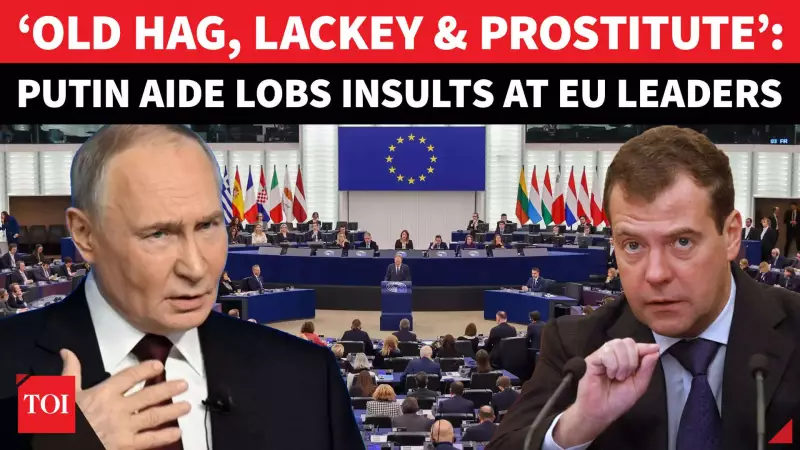
A major diplomatic firestorm has erupted between Russia and the European Union following a contentious Brussels summit. The flashpoint was the EU's failure to reach a unanimous decision on the highly sensitive issue of seizing frozen Russian state assets.
Medvedev's Unprecedented Verbal Onslaught
In response, a furious Dmitry Medvedev, the former Russian President and key aide to Vladimir Putin, launched an extraordinary and highly personal broadside against top European leadership. He did not mince words, branding the high-level meeting in Brussels a "summit of thieves." Medvedev accused the European bloc of orchestrating a plot to illegally confiscate Russian funds, essentially labelling the effort as state-sanctioned theft.
The vitriol was directed at specific individuals, breaking diplomatic norms with shocking insults. Ursula von der Leyen, the President of the European Commission, was mockingly referred to as an "old hag." Germany's Chancellor, Friedrich Merz, was dismissed as nothing more than a "lackey." Perhaps most provocatively, French President Emmanuel Macron was labelled a "prostitute." The leadership in Ukraine was not spared either, with Medvedev sneering at them as "rats."

The Context: Putin's Warning and EU Deadlock
This explosive tirade from Medvedev did not occur in a vacuum. It came directly on the heels of a stern warning from President Vladimir Putin to the EU regarding the consequences of touching frozen Russian reserves. The EU summit, held recently, ended without a consensus, revealing deep divisions within the bloc on how to proceed with the estimated billions of euros in immobilized Russian assets. Some member states advocated for outright seizure to fund Ukraine's reconstruction, while others expressed legal and financial stability concerns.
The deadlock in Brussels, combined with Putin's prior warning, set the stage for Medvedev's aggressive retaliation. His comments are seen as a deliberate escalation in rhetoric, aiming to shame and pressure European capitals by portraying them as corrupt and illegitimate in their actions.
Implications and the Road Ahead
The fallout from this incident is significant and multi-faceted. Firstly, it marks a new low in Russia-EU relations, already at rock bottom since the onset of the Ukraine conflict. The use of such undiplomatic language by a senior Russian official makes any near-term de-escalation or negotiation vastly more difficult.
Secondly, Medvedev's outburst serves a strategic domestic and international purpose. Domestically, it reinforces the Kremlin's narrative of a hostile and unethical West. Internationally, it aims to exploit the visible cracks within the EU's united front, potentially discouraging further aggressive financial measures against Russia.
For the European Union, the episode underscores the immense pressure and complexity of managing the economic war against Russia. The internal disagreement, now highlighted and mocked by Moscow, challenges the bloc's coherence. The leaders insulted by Medvedev are now under pressure to respond, not just to the personal slurs, but to the underlying issue of the frozen assets, with the world watching closely.
As the war continues, the battle of words is intensifying alongside the military conflict. Medvedev's "thieves' summit" allegation will likely become a rallying cry for Russian propaganda, while EU leaders are forced to reconcile their legal frameworks with the political imperative to support Ukraine, all while navigating an increasingly volatile diplomatic landscape.