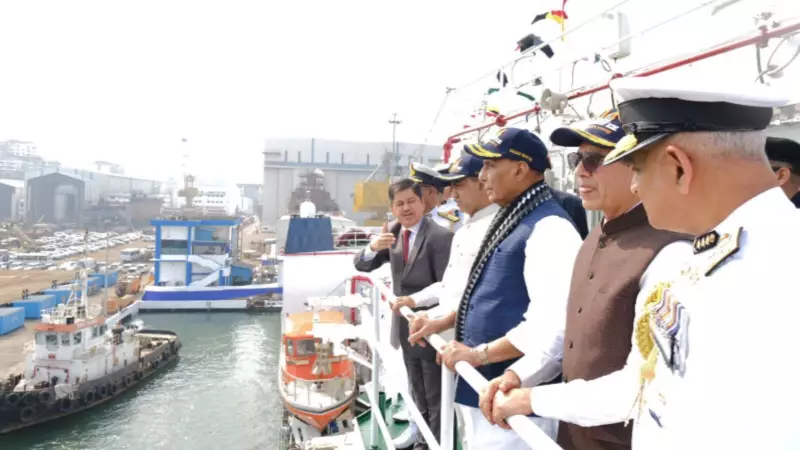
Defence Minister Rajnath Singh declared that the ocean's wealth belongs to all humanity, not any single nation, as he commissioned a new, powerful vessel for the Indian Coast Guard in Goa on Monday, January 5, 2026. Speaking at the induction ceremony of the ICGS 'Samudra Pratap', Singh positioned India as a responsible maritime power committed to peace and stability across the vast Indo-Pacific region.
A Grand Maritime Vision for a Shared Heritage
Addressing the gathering in Vasco, Goa, the Defence Minister connected the ship's commissioning to India's broader oceanic philosophy. "This occasion is linked to India's grand maritime vision, which believes that marine resources are not the property of any one country, but a shared heritage of humanity," Singh stated. He argued that this shared ownership naturally leads to a collective duty for protection.
In a world facing global maritime uncertainty, Singh emphasized that India has consistently proven its commitment to securing not just its own interests but also fostering peace and stability throughout the Indo-Pacific. "India's vision of taking everyone along makes us a responsible maritime power," he affirmed, adding that platforms like the 'Samudra Pratap' reinforce confidence in the nation's preparedness to fulfil its maritime responsibilities.

Samudra Pratap: A Beacon of Aatmanirbharta and Capability
The newly commissioned ICGS Samudra Pratap is a landmark achievement for indigenous defence manufacturing. Built by Goa Shipyard Limited (GSL), it is the first of two advanced pollution control vessels and now holds the title of the largest ship in the Coast Guard fleet. Singh hailed it as a major stride toward Aatmanirbharta (self-reliance) in shipbuilding.
With over 60 percent indigenous content, the vessel is India's first indigenously designed pollution control ship. The Defence Minister noted that it embodies the maturity of India's defence industrial ecosystem, which can tackle complex manufacturing challenges. He revealed that consistent efforts are underway to increase the indigenous content in future ships to an ambitious 90 percent.
While its primary role is pollution response, the Samudra Pratap is a multi-role asset. "The ship will prove to be effective in search and rescue operations, coastal patrol, and strengthening maritime safety," Singh explained. He highlighted its advanced systems for quick detection, precise station-keeping, and efficient recovery, which will be crucial for controlling pollution incidents and protecting vital marine ecosystems like coral reefs, mangroves, and fisheries.
Coast Guard's Expanding Role and Inclusive Ethos
Rajnath Singh praised the Indian Coast Guard as the first responder in any maritime crisis, be it an oil spill, a ship fire, or a threat to human life. He sent a strong message to potential adversaries, stating that the Coast Guard's multi-dimensional capabilities ensure any misadventure against India's maritime borders will meet a "bold and befitting response."
The Minister also acknowledged the service's progressive steps toward a gender-neutral work environment. He expressed pride that women officers are now serving as pilots, observers, air traffic controllers, and in logistics and law, while also being trained for hovercraft operations and deployed in frontline missions. "The two women officers appointed to ICGS Samudra Pratap are role models for future generations," he added.
Concluding his address, Singh framed marine environment protection as both a strategic necessity and a moral imperative in the age of climate change. The commissioning of the Samudra Pratap, therefore, strengthens India's tangible capacity to safeguard a heritage that belongs to the world.