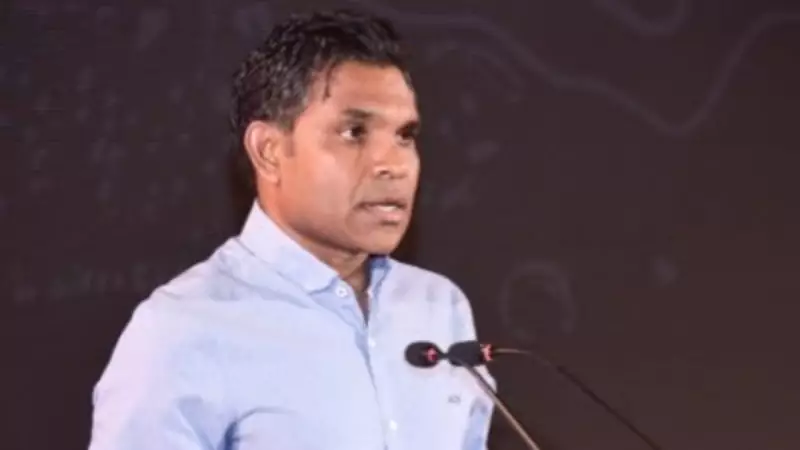
In a significant address that connected the political philosophies of the past with contemporary regional challenges, former Maldives Vice-President Faisal Naseem underscored the enduring relevance of former Indian Prime Minister Atal Bihari Vajpayee's statesmanship. Speaking in New Delhi on Wednesday, Naseem presented Vajpayee as a beacon for South Asia, a region currently navigating democratic and social turbulence.
Vajpayee's Philosophy: A Blueprint for Regional Stability
Delivering the 8th Atal Bihari Vajpayee Memorial Lecture, Naseem reflected on the late leader's centenary year. He described Vajpayee as a unique figure who proved that "firmness and civility can coexist" and that leadership could be "decisive without being divisive." This approach, Naseem argued, holds profound lessons in today's era of deep polarisation.
Representing a "small island nation in the Indian Ocean, a Muslim society and a young democracy," Naseem drew clear parallels between India and the Maldives. He critiqued the common view of peace as a mere outcome, stating that leaders like Vajpayee understood it as "a practice cultivated through restraint, dialogue and respect for institutions." He elaborated that peace is sustained by balance and is preserved when differences are managed with dignity and power is exercised with moderation.

Naseem also highlighted Vajpayee's unwavering faith in parliamentary democracy, forged through his long years in opposition. "He believed in Parliament not because it was perfect, but because it embodied the people’s voice," Naseem said, noting how this lesson resonated with the Maldives' own democratic transition in 2008 from a centralised authority to constitutional governance.
South Asia's Democratic Stress and the Maldivian Example
The lecture gained wider context against the backdrop of ongoing political stress across South Asia. Naseem's comments indirectly touched upon the situations in neighbouring countries:
- Bangladesh faces recurring political unrest and communal violence, raising concerns about protecting pluralism.
- Sri Lanka's post-crisis stabilisation is marred by public unease over austerity measures and questions of accountability.
- Nepal continues to struggle with fragile coalition politics and frequent leadership changes despite constitutional stability.
In contrast, Naseem pointed to democratic deliverables in the Maldives as proof of concept. He asserted that democracy must deliver dignity and security, citing achievements like universal healthcare, pension schemes, minimum wage laws, and free higher education as tangible outcomes of the system.
India-Maldives Ties: A Partnership Written in Deeds
Reflecting on the bilateral relationship, Naseem emphasised that the India-Maldives partnership was "written in deeds, not words." He specifically recalled India's swift and restrained military intervention during the 1988 coup attempt in the Maldives, an action he said left a lasting imprint on Maldivian strategic thinking. He also noted that Vajpayee's visit to the Maldives in 2002 was a powerful symbol of India's enduring commitment to its neighbours.
Naseem credited Vajpayee with early recognition of the Indian Ocean's strategic importance, framing maritime security as a matter of "trust among neighbours" rather than just naval strength. He pointed to current cooperation in areas like maritime surveillance, coast guard capacity-building, and emergency response as a security model built on partnership, not coercion.
Concluding his address, Naseem returned to Vajpayee's core understanding: while history can be shaped, geography is permanent. "Our shared responsibility is to ensure this region remains anchored in peace, democratic values and mutual respect," he stated, framing Vajpayee's legacy as a vital guide for a turbulent but interconnected neighbourhood.