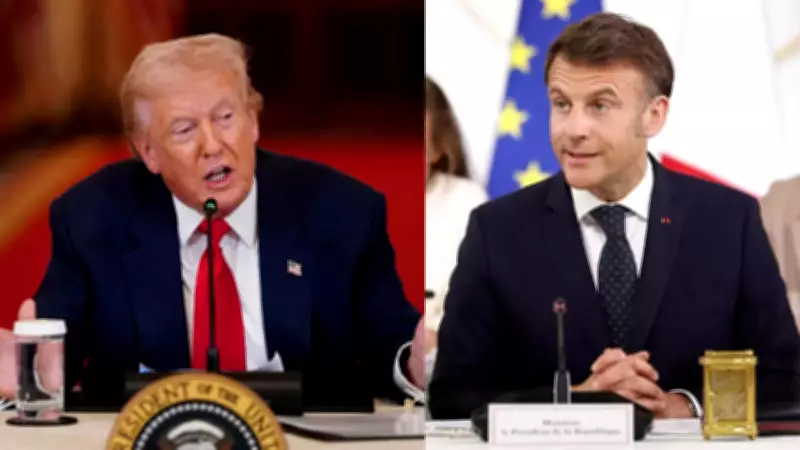
French President Emmanuel Macron Condemns Trump's Inconsistent Iran Policy
During a diplomatic visit to South Korea on Thursday, French President Emmanuel Macron delivered a pointed critique of US President Donald Trump's handling of the ongoing Iran conflict. Macron specifically highlighted what he described as inconsistent and contradictory positions from the American leader, emphasizing the need for serious and coherent international diplomacy.
Macron Dismisses Military Plans for Strait of Hormuz as 'Unrealistic'
President Macron directly addressed proposals that have been "sometimes expressed by the United States" regarding military action to secure the strategic Strait of Hormuz. He firmly declared such plans "unrealistic" due to practical constraints and security risks.
"It is unrealistic because it would take an inordinate amount of time and would expose anyone crossing the strait to coastal threats," Macron explained, specifically pointing to dangers posed by Iran's Revolutionary Guards and their missile capabilities.

The French leader stressed that any genuine resolution to the conflict requires "a ceasefire and a resumption of negotiations" with Iran, according to reports from AFP. The Strait of Hormuz remains a critically important global oil shipping route that has faced severe disruption amid the broader Middle East conflict.
Direct Criticism of Trump's Communication Style
Macron did not mince words when addressing Trump's approach to public messaging on the war. "You have to be serious. When you want to be serious, you don't say the opposite every day of what you said the day before. And perhaps you shouldn't talk every day," the French president stated bluntly.
He added with evident frustration: "You can't contradict yourself every day." These remarks highlight growing tensions and divergences among traditional Western allies regarding the Iran conflict.
Growing Divergence Among Western Allies
The diplomatic landscape shows increasing fragmentation as European nations distance themselves from US-led military approaches:
- The United Kingdom has explicitly stated that "Iran is not our war," according to Prime Minister Keir Starmer
- France has officially ruled out participation in military operations in the region
- Several other European nations have shown reluctance to join US efforts
Trump's Shifting Stance on Iran Conflict
Since the beginning of US-led military operations, President Trump's statements have exhibited significant variation across multiple dimensions:
Inconsistent Messaging on International Support
Trump has alternated between contradictory positions regarding allied involvement:
- He has urged NATO and other countries dependent on Middle Eastern oil to help secure the Strait of Hormuz, stating they "should be jumping to help us"
- Almost simultaneously, he has asserted that "We don't need anybody... we have the strongest military"
- Despite seeking support, Trump has criticized NATO as a "paper tiger" and suggested potential US withdrawal from the alliance
Unclear Military Escalation Timeline
The American president's threats regarding military action have shown notable inconsistency:
- Trump initially threatened to "obliterate" Iran's energy infrastructure if Tehran didn't reopen the Strait of Hormuz within 48 hours
- He subsequently walked back this timeline, first delaying action by five days and then extending it further
- These shifts were attributed to ongoing negotiations, creating uncertainty about actual US intentions
Evolving War Objectives
Trump's messaging has also fluctuated regarding broader strategic goals:
- Initial positions pushed for aggressive intervention and control of the Strait of Hormuz
- Later statements signaled the conflict could potentially end without securing the critical waterway
- This has created significant uncertainty about US strategic priorities and endgame objectives
Global and Domestic Reactions
Trump's inconsistent approach has generated varied responses internationally and within the United States:

International Reluctance: Several countries including European nations, China, and South Korea have shown hesitation to join US efforts in the region, reflecting broader diplomatic caution.
Domestic Criticism: Within the United States, analysts and political figures have raised substantial concerns about policy consistency. A recent Pew Research survey found that 61% of Americans disapprove of Trump's handling of the Iran conflict.
Social Media Backlash: The President's approach has triggered significant criticism on social media platforms, where the term "TACO" ("Trump Always Chickens Out") has circulated widely in reference to perceived reversals in policy positions.
The growing rift between traditional allies and the inconsistent messaging from Washington creates significant challenges for coordinated international response to the Iran conflict and broader Middle East instability.