

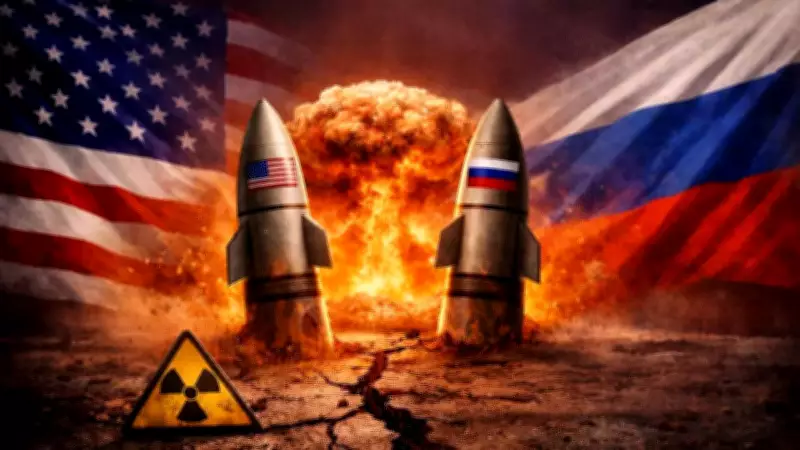
Kremlin Warns of Dangerous Phase as US-Russia Nuclear Treaty Nears Expiry
The Kremlin issued a stark warning on Tuesday, declaring that the world is heading into a dangerous phase as the last remaining nuclear arms control treaty between the United States and Russia is set to expire this week. This development could potentially leave the two largest nuclear powers without any formal limits on their arsenals for the first time in decades, raising significant global security concerns.
Imminent Expiration of New START Treaty
The treaty, known as New START, is due to expire on Thursday. It represents the final surviving agreement from a series of Cold War-era arms control deals that once governed nuclear competition between Washington and Moscow. Kremlin spokesman Dmitry Peskov emphasized the gravity of the situation during a daily briefing with journalists, stating, "In just a few days, the world will be in a more dangerous position than it has ever been before."
The Kremlin revealed that it had proposed a one-year extension of the treaty but had received no formal response from Washington. Peskov noted, "We still haven't received a response from the Americans to this initiative." If the treaty lapses without replacement or extension, the United States and Russia would be without any binding framework to limit or verify their strategic nuclear weapons, removing the only remaining mechanism to control the world's two largest nuclear arsenals.

Historical Context and Current Stalemate
New START was signed in 2010 by then Russian President Dmitry Medvedev and US President Barack Obama, coming into force the following year. The treaty included provisions for on-site inspections and data exchanges to ensure compliance. However, Russia suspended inspections during the COVID-19 pandemic, and broader talks on extending or replacing the treaty stalled as relations deteriorated following the war in Ukraine. Moscow has accused Washington of obstructing inspection missions on US territory.
In 2023, Russia announced it was freezing its participation in New START, although it said it would continue to voluntarily adhere to the numerical limits set by the treaty. US President Donald Trump, who oversaw the withdrawal of the United States from several international agreements, said in September that extending New START "sounds like a good idea," but no concrete steps have followed.
Rising Military Signalling and Global Implications
The warning comes amid rising military signalling on both sides. Moscow last year tested new nuclear-capable delivery systems without warheads, while Trump said he had ordered two US nuclear submarines to move closer to Russia. New START is widely seen as a cornerstone of global strategic stability, limiting both countries to 1,550 deployed strategic nuclear warheads each and capping deployed delivery systems.
Analysts warn that the expiry of New START would end more than five decades of formal nuclear arms control between Washington and Moscow. Previous agreements, including the Intermediate-Range Nuclear Forces treaty and the Anti-Ballistic Missile treaty, have already collapsed. Without a replacement framework, both sides would be free to expand their nuclear arsenals, though experts say large-scale increases would take time due to technical and logistical constraints.
Challenges in Negotiating a Successor Treaty
Efforts to negotiate a successor treaty face major hurdles. Trump has said he wants a broader agreement that includes China, an idea Beijing has rejected, arguing its arsenal is far smaller. Russia has countered that the nuclear forces of Britain and France should also be included, a proposal those countries oppose. With New START nearing expiration and no clear diplomatic breakthrough in sight, the future of US-Russia nuclear arms control remains uncertain, raising concerns about rising nuclear risks at a time of heightened global tensions.

Over the longer term, the absence of limits and transparency could fuel a renewed arms race driven by worst-case assumptions. The treaty was extended once in 2021, shortly after Trump's successor took office, as the agreement allows only a single extension. With that option exhausted, any further continuation would require a new deal or informal political understanding, adding to the complexity of the situation.





