

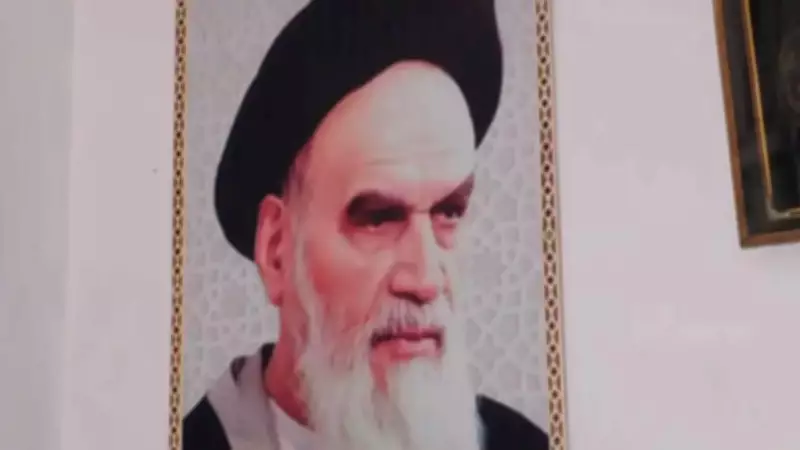
Iran's Revolutionary Leader Khomeini's Ancestral Roots Traced to UP's Barabanki Village
Iran and India share profound civilisational bonds that extend beyond contemporary geopolitics into deep cultural and spiritual connections, particularly within the Shia community. According to reports from news agency ANI, the quiet village of Kintoor in Uttar Pradesh's Barabanki district holds a remarkable historical distinction as the ancestral home of Ayatollah Ruhollah Khomeini, the iconic leader of the 1979 Iranian Revolution that transformed the Middle East.
Historical Migration from Kintoor to Khomein
Khomeini's grandfather, Syed Ahmad Musavi Hindi, was born in Kintoor in 1790 during a period of rich cultural exchange between India and Persia. He later embarked on a significant migration to Khomein in Iran, where his family lineage would eventually establish itself and flourish over generations. Even after settling permanently in the Iranian village that would give the family its name, Syed Ahmad Musavi Hindi retained the suffix "Hindi" in his name as a proud testament to his Indian origins.
Historical accounts suggest that around 1830, when Syed Ahmad Musavi Hindi was approximately 40 years old, he traveled to Iran via Iraq accompanied by the Nawab of Awadh. Disillusioned with expanding British colonial rule in India, he established his permanent residence in Khomein, Iran. After settling there, his family ascended to become highly influential figures in both religious and social spheres across the region.

The Lineage That Shaped Modern Iran
Syed Ahmad Musavi Hindi's son, Ayatollah Mustafa Hindi, became a renowned scholar of Islamic theology whose teachings would influence generations. His grandson, Ruhollah, was born in 1902 and would later rise to global prominence under the names 'Ayatollah Khomeini' or 'Imam Khomeini.' Ruhollah Khomeini eventually led the revolution that overthrew the Pahlavi monarchy in 1979, forever altering the political landscape of the Middle East while carrying a lineage that originated in the fertile plains of Uttar Pradesh.
While contemporary geopolitical discussions between India and Iran often focus on energy cooperation and trade agreements, this spiritual and lineage-based connection represents a profound, living history for residents of Barabanki district. The story bridges centuries and continents, connecting rural Uttar Pradesh with revolutionary Tehran.
Local Perspectives on the Historical Connection
Dr. Rehan Kazmi, a resident of Rasoolpur in Barabanki, emphasized the enduring significance of this connection. "Ayatollah Khamenei has a connection to the whole of India, and he was the supreme leader of the Shia community. We have learned the way of life from him," Dr. Kazmi noted. "Ayatollah Khamenei does not have a direct connection to Kintoor, but Ruhollah Khomeini, who led the Islamic revolution, his grandfather hailed from here. He migrated to Iran and resided in Khomein. The British regime did not want him to return to India."
Dr. Kazmi further explained that Ruhollah Khomeini's father passed away when he was just five years old, leaving him to be raised by his grandfather. This early family history created the foundation for one of the twentieth century's most influential religious and political figures.
Succession and Contemporary Connections
Regarding the leadership transition in Iran, Dr. Rehan elaborated, "Ayatollah Ali Khamenei, who succeeded Ruhollah Khomeini as the second Supreme Leader of the Islamic Republic of Iran, was his most trusted disciple and was later elected to lead the country after Khomeini's death. Ayatollah Khamenei was the most trustworthy disciple of Imam-e-Khomeini, and he was made the Supreme Leader of Iran. Hence, we also have a connection with him."
This historical linkage continues to manifest in contemporary community initiatives. "I have heard that some people from Iran came back here to find their ancestral roots. There has been an exchange of letters during the British rule," Dr. Kazmi added. "There is a trust in the name of Ayatollah Khamenei, under which we organize health camps and eye checkups, and we provide free education to students studying in government schools. I also run a free-of-cost education institute under the Trust."

Geopolitical Implications of Historical Ties
Syed Nihar Ahmad Kazmi, another resident of Kintoor, highlighted how these deep-rooted connections have translated into modern geopolitical considerations. "Ayatollah Ruhollah Khomeini has a direct connection to Kintoor. We have heard that Ayatollah Khamenei was a disciple of Ruhollah Khomeini. There was discrimination against women and alcoholism, so they led the revolution," Kazmi told ANI.
He further noted, "India and Iran have had an old connection. They had to block the route because of the circumstances, but still they allowed the Indian-flagged ships to pass." This reference pertains to Iran allowing Indian vessels passage through the strategically vital Strait of Hormuz amid West Asia conflicts and trade route blockages, a gesture some attribute to these historical and cultural bonds.
Contemporary Expressions of Solidarity
The strength of India-Iran ties was recently demonstrated when members of the Shia community across India took to the streets to mourn the passing of Ayatollah Khamenei. Following his demise, Ayatollah Mojtaba Khamenei, his son, was elected as the new Supreme Leader of Iran, continuing the family's leadership legacy.
On the occasion of the 40th day of public mourning for the late Iranian Supreme Leader, a solemn ceremony was held at the Iranian Embassy in India where the Iranian flag was hoisted in remembrance. These gestures underscore the living connection between the two nations that transcends ordinary diplomatic relations.
Regional Context and Diplomatic Developments
Amid a temporary two-week pause in conflicts between the US-Israel bloc and Iran, diplomatic delegations from Washington DC and Tehran are scheduled to meet in Islamabad, Pakistan, to discuss terms for a potential permanent ceasefire. The conflict initially erupted on February 28 with US and Israeli strikes against Iranian positions, prompting Tehran to retaliate by targeting Israeli and US assets across the Gulf region, thereby widening the conflict's scope.
This complex geopolitical backdrop makes the historical connections between rural Uttar Pradesh and revolutionary Iran all the more significant, serving as a reminder of how personal histories and family migrations can eventually influence global affairs. The story of Kintoor village and the Khomeini lineage represents a unique thread in the rich tapestry of India-Iran relations that continues to evolve across centuries.





