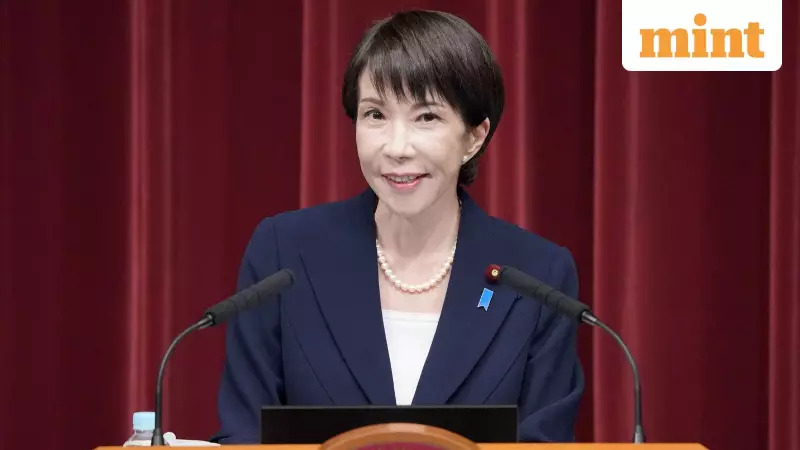
Japanese Prime Minister Sanae Takaichi made a major political announcement on Monday. She officially dissolved the House of Representatives. This action immediately triggers a snap general election for the country.
Election Date Set for Early February
The voting day is now scheduled for 8 February. This date marks the very first day of the current parliamentary session. Official campaigning across Japan will begin earlier, on 27 January.
Kyodo News agency reported that the government's decision to dissolve the lower house was actually finalized last Friday. Senior officials from the ruling party confirmed the planned polling date.

Seeking a Fresh Public Mandate
Speaking at a press conference, Prime Minister Takaichi explained her reasoning clearly. She stated she is seeking a renewed mandate directly from the Japanese public. By calling this sudden vote, she is directly linking her own political future to the election's final outcome.
This election represents a crucial first major test for Takaichi at the ballot box. She made history on 21 October by becoming Japan's first female prime minister. Now voters will give their verdict on her early tenure.
It also marks the debut electoral challenge for the new governing alliance. This coalition was formed just one day before her inauguration. It joins her Liberal Democratic Party (LDP) with the Japan Innovation Party (JIP).
Capitalizing on High Approval Ratings
According to Kyodo News, Takaichi aims to capitalize on her administration's current high public approval. She wants to validate what she calls a "responsible yet aggressive" approach to managing the nation's finances. The newly established coalition structure is also part of this political strategy.
This snap poll arrives surprisingly soon. It comes less than a year and a half after the previous lower house contest in October 2024. Normally, representatives serve four-year terms under the Japanese Constitution. However, the prime minister holds the power to dissolve the House of Representatives early.
A Fragile Legislative Environment
The political backdrop for this decision is complex. Takaichi's government has struggled with a fragile legislative environment from the start. The LDP-led group maintains only a slim majority in the lower house. Crucially, it lacks any control of the House of Councillors, the upper chamber.
This situation has forced the government into awkward compromises with opposition parties to pass laws. Last week, Takaichi signaled to ruling bloc leaders her plan to dissolve parliament swiftly. She planned to act shortly after next Friday's 150-day regular session begins.
Opposition Forces Unite
In response to the government's moves, opposition groups have been uniting. Last Thursday, a significant development occurred. The Constitutional Democratic Party and its former LDP partner, Komeito, established a new bloc called the Centrist Reform Alliance.
This alliance is now the largest opposition force in the parliament. These opposition forces have sharply criticized Takaichi's timing for the election. They argue she is prioritizing potential political gain over critical national business. Specifically, they point to the pending 2026 fiscal budget, despite her claims of being purely policy-focused.
Key Policy Pledge: Suspending the Food Tax
During her press conference, Prime Minister Takaichi also made a significant economic pledge. She vowed to suspend an 8% consumption tax on food for a full two years. This measure, she said, is designed to cushion the blow to households from rising living costs.
"We will overhaul past economic and fiscal policy," Takaichi told reporters. "My administration will put an end to an excessively tight fiscal policy and a lack of investment for the future."
Japan's tax system currently levies an 8% rate on food and a 10% rate on other goods and services. This revenue helps fund rising social welfare costs for the nation's rapidly ageing population.
Interestingly, many opposition parties have also proposed cutting the consumption tax. This debate is happening at a sensitive economic time. Concern over Japan's long-term fiscal health is currently pushing government bond yields to multi-decade highs.

The stage is now set for a intense political campaign. All eyes will be on Japan as voters prepare to head to the polls in February, deciding the immediate future of Prime Minister Sanae Takaichi and her governing coalition.