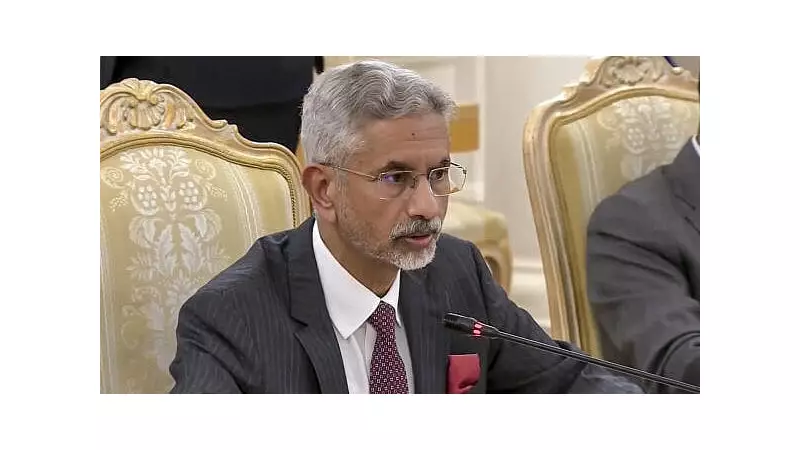
External Affairs Minister Dr. S Jaishankar delivered a pointed message to Pakistan, stating that a 'bad neighbour' cannot expect to receive the same benefits and gestures that are extended to 'good neighbours'. The minister's remarks, made on January 2, 2026, underscored a firm stance on bilateral relations, rooted in a history of perceived non-reciprocation from Islamabad.
A History of Unreciprocated Gestures
Dr. Jaishankar elaborated that no goodwill gesture extended by India to Pakistan in the past has been met with an appropriate or reciprocal response. He emphasized that India's attempts to foster a constructive relationship have consistently been met with actions that undermine trust and peace. The minister did not mince words, framing the core issue as one of fundamental conduct and reliability in the neighbourhood.
A central example cited by the External Affairs Minister was the long-standing and contentious issue of water sharing between the two nations. He implied that even in this critical domain, Pakistan's actions have not mirrored the spirit of cooperation expected between friendly states. This reference highlights the practical and strategic dimensions of the strained relationship, where shared resources become a point of friction rather than collaboration.

The 'Good Neighbour' vs. 'Bad Neighbour' Framework
By introducing the clear dichotomy of 'good neighbour' and 'bad neighbour', Jaishankar articulated a foundational principle for India's foreign policy in the region. The framework suggests that diplomatic engagement, economic considerations, and strategic concessions are now explicitly contingent on reciprocal and constructive behaviour.
The message signals a decisive shift from unilateral gestures to a more transactional and principle-based approach. It indicates that future engagements will be calibrated against Pakistan's actions, particularly regarding its stance on cross-border terrorism and other security concerns that New Delhi has repeatedly raised.
Implications for Future Bilateral Engagements
The minister's unequivocal statement sets a clear precedent for the trajectory of India-Pakistan relations. It suggests that any expectation from Pakistan for concessions or normalisation of ties without addressing India's core concerns is misplaced. The onus, as per this narrative, is squarely on Islamabad to alter its behaviour and establish itself as a 'good neighbour' to unlock potential benefits.
This posture aligns with India's broader strategic autonomy and its insistence on being treated with mutual respect in the international arena. The remarks, made firmly and publicly, are likely intended for both domestic and international audiences, reinforcing India's position while challenging Pakistan's narrative on bilateral disputes.
In conclusion, EAM S Jaishankar's comments mark a continuation of India's hardened diplomatic stance towards Pakistan. By explicitly linking the quality of neighbourly relations to tangible benefits and citing historical lack of reciprocity, India has drawn a clear line for future dialogue and engagement.