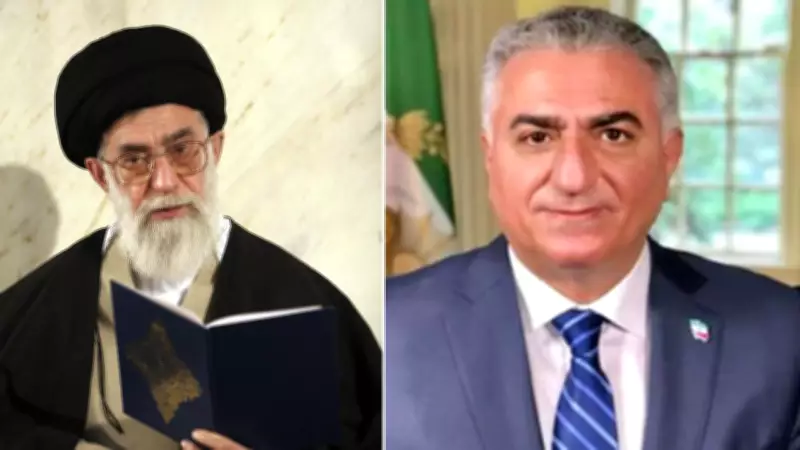
Iran's Exiled Crown Prince Reza Pahlavi Hails Death of Supreme Leader Ali Khamenei
Reza Pahlavi, the exiled crown prince of Iran, has publicly welcomed the announcement of Supreme Leader Ali Khamenei's death following joint military strikes by the United States and Israel. In a significant statement, Pahlavi praised US President Donald Trump for what he described as decisive action against the Iranian regime.
Pahlavi's Statement on Social Media Platform X
In a post on the social media platform X, Pahlavi wrote: "Ali Khamenei, the bloodthirsty despot of our time… has been erased from the face of history. With his death, the Islamic Republic has in effect reached its end and will very soon be consigned to the dustbin of history."
He further asserted that any attempt by remaining regime elements to appoint a successor would inevitably fail. Pahlavi warned that any new leader would lack legitimacy and would inherit the crimes of the outgoing regime. He made a direct appeal to Iran's military, law enforcement, and security forces to assist in ensuring a stable transition toward a free and prosperous Iran.

Direct Address to Iranian Citizens
Addressing Iranian citizens directly, Pahlavi emphasized: "This may be the beginning of our great national celebration, but it is not the end of the road. Remain vigilant and prepared. The time for a widespread and decisive presence in the streets is very near. Thanks to President Trump, their hour of liberation is at hand… the Iranian people know they are not alone."
He stressed that the final victory would be achieved by Iranians themselves, who have endured decades of repression, mass protests, and state violence.
Comprehensive Roadmap for Democratic Transition
In a detailed op-ed published in the Washington Post, Reza Pahlavi laid out a comprehensive and transparent plan for a peaceful transition in Iran following Khamenei's death. He described the Islamic Republic as an expansionist and oppressive regime that has subverted regional sovereignty, pursued nuclear weapons, and committed mass atrocities at home. Pahlavi cited the reported massacre of over 30,000 protesters in January 2026 as a key example.
While acknowledging that US and Israeli strikes have weakened the regime, Pahlavi emphasized that ultimate victory rests with the Iranian people. He called for unity among diverse opposition groups, including monarchists, republicans, liberals, leftists, and religious and ethnic minorities. This unity, he proposed, should be built around four core principles:
- Territorial integrity of Iran
- Individual liberties for all citizens
- Separation of religion and state
- The people's right to choose their government
The Iran Prosperity Project and Cyrus Accords
The proposed roadmap, named the Iran Prosperity Project, outlines a clear process for transition. It begins with a national referendum to draft and ratify a new constitution, followed by internationally supervised elections. After these elections, the transitional government would dissolve, paving the way for a permanent democratic administration.
Pahlavi also envisioned a future free Iran that actively pursues regional peace and cooperation. He proposed the "Cyrus Accords," a diplomatic framework inspired by Cyrus the Great. This plan aims to replace regional hostility with robust diplomatic and economic collaboration, including formal recognition of Israel. The goal is to transform Iran into a pillar of stability and prosperity in the Middle East.
In his op-ed, Pahlavi again praised President Trump for supporting the Iranian people, stating that US solidarity has empowered citizens in their struggle for freedom and democratic governance.
Background on Reza Pahlavi
Reza Pahlavi is the eldest son of Mohammad Reza Pahlavi, Iran's last Shah, who was overthrown during the 1979 Islamic Revolution. Born in Tehran in 1960, he was formally named crown prince in 1967. Pahlavi left Iran in 1978 for military training in the United States and later earned a degree in political science from the University of Southern California. Following his father's death in 1980, he declared himself Shah in exile, maintaining a symbolic leadership role for monarchist factions.

Context of US-Israel Military Strikes
The joint US-Israel strikes on Iran occurred early Saturday, targeting key military and nuclear sites located near Supreme Leader Khamenei's office. President Donald Trump characterized the strikes as a necessary measure to protect American lives and global security. In a related statement, Trump declared, "the hour of your freedom is at hand" for the Iranian people, aligning with Pahlavi's message of imminent liberation.
The developments mark a pivotal moment in Iran's modern history, with the exiled crown prince positioning himself as a key figure advocating for a complete regime change and a democratic future.