

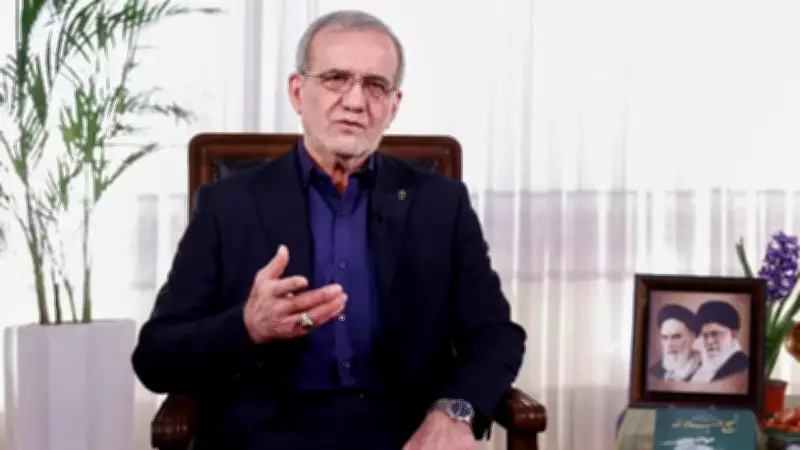
Iranian President Issues Open Letter to American People Amid Rising Tensions
In a significant diplomatic move, Iranian President Masoud Pezeshkian has published an open letter addressed directly to the American people. The communication comes during a period of heightened regional tensions and represents a direct appeal to the American public over the heads of their political leadership.
Accusations of US Acting as Israeli Proxy
President Pezeshkian made the explosive claim that the United States government is functioning as a "proxy for Israel" in regional conflicts. He questioned whether Washington's foreign policy decisions are truly aligned with American interests or whether they are being "influenced and manipulated by that regime." The Iranian leader suggested that Israel is deliberately "manufacturing an Iranian threat" to divert international attention away from the ongoing situation in Gaza.
Rejection of Iranian Threat Narrative
The letter strongly refutes what Pezeshkian describes as prevailing narratives portraying Iran as a regional threat. "Portraying Iran as a threat is neither consistent with historical reality nor with present-day observable facts," he asserted. According to the Iranian president, such claims represent deliberate efforts to "manufacture an enemy" to justify continued military pressure, maintain regional dominance, sustain the arms industry, and control strategic markets.

Pezeshkian emphasized that Iran has "never, in its modern history, chosen the path of aggression, expansion, colonialism, or domination." He added that the Iranian people "harbor no enmity toward other nations, including the people of America."
Historical Grievances and Current Tensions
The letter traces current tensions back to the 1953 coup in Iran, which Pezeshkian characterized as "an illegal American intervention" that derailed Iran's democratic development and restored dictatorship. He listed several additional grievances that have compounded distrust between the two nations:
- US support for the Shah's regime following the 1953 coup
- American backing of Saddam Hussein during the Iran-Iraq War in the 1980s
- Decades of economic sanctions against Iran
- What he described as "unprovoked military aggression" carried out during negotiations
Despite these challenges, Pezeshkian highlighted Iran's domestic achievements in strengthening key sectors including literacy, education, technology, healthcare, and infrastructure development.
Military Presence and Recent Actions
The Iranian president pointed to what he described as disproportionate US military presence in the region, noting that Washington has "concentrated the largest number of its forces, bases, and military capabilities around Iran." He characterized recent actions as "aggressions" that have targeted both infrastructure and civilians.
Context of Escalating Tensions
The letter arrives amid escalating regional tensions marked by several concerning developments:
- Attacks on energy and industrial infrastructure throughout the region
- Continued imposition of economic sanctions against Iran
- Stalled diplomatic efforts between Tehran and Washington
- Conflicting claims about ceasefire proposals
Former US President Donald Trump recently claimed that Iran had approached the United States seeking a ceasefire, but Iranian officials have firmly denied this assertion. Tehran maintains that no such proposal has been made, highlighting the deepening communication breakdown between the two sides.
Questioning American Priorities
In a pointed rhetorical question, Pezeshkian asked whether the "America First" policy remains a genuine priority for Washington's foreign policy establishment. He suggested that Israel seeks to make Iran "fight to the last American soldier and the last American taxpayer dollar," implying that American resources are being expended in pursuit of Israeli rather than American interests.

The open letter represents a significant public diplomacy effort by Iran's new president, who appears to be attempting to bypass traditional diplomatic channels and speak directly to the American public. This approach reflects the current deadlock in official communications between Tehran and Washington and suggests a new strategy for addressing long-standing grievances and misunderstandings.
As tensions continue to simmer in the region, with attacks on shipping, infrastructure, and military assets occurring with concerning frequency, this direct appeal to the American people adds another layer to the complex relationship between two nations that have been adversaries for more than four decades. The letter's publication comes at a particularly sensitive moment, with regional conflicts threatening to escalate and diplomatic channels appearing increasingly ineffective at managing differences.





