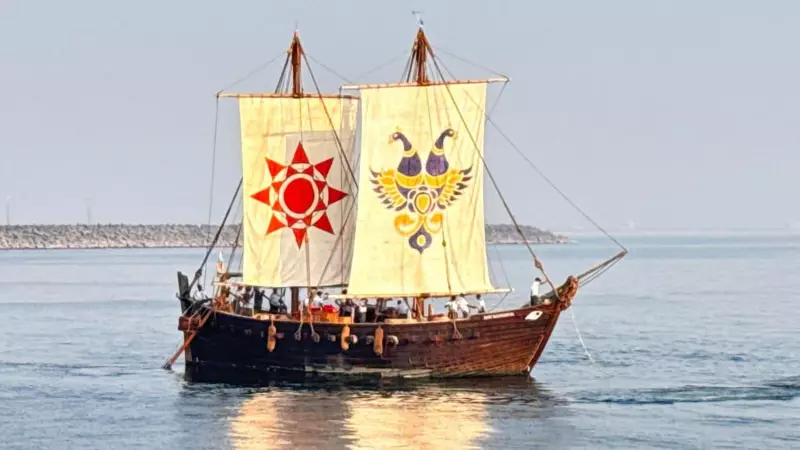
In a historic moment blending tradition with maritime prowess, the Indian Naval Sailing Vessel (INSV) Kaundinya embarked on its maiden voyage from Gujarat to the Sultanate of Oman on Monday. The unique ship, a recreation of ancient Indian naval architecture, was towed out to sea from the Indian Coast Guard jetty in Porbandar to the celebratory tune of "Jai Ho," played by a Naval band.
A Voyage Steeped in History and Diplomacy
The two-masted INSV Kaundinya, with its specially trained crew, is retracing the historic maritime routes that connected India with the wider Indian Ocean world for thousands of years. Its destination is Muscat, Oman. The launch ceremony was graced by the Omani Ambassador to India, Issa Saleh Abdullah Alshibani, who highlighted the deep historical and cultural ties between the two nations.
He was joined by senior Indian Navy officials, including Vice Admiral Krishna Swaminathan, Flag Officer Commanding-in-Chief of the Western Naval Command, and Rear Admiral Sritanu Guru, Flag Officer Commanding of the Gujarat Naval Area.

The Inspiration and Build of INSV Kaundinya
INSV Kaundinya is a stitched sail ship, a design based on a 5th-century CE vessel depicted in the famous paintings of the Ajanta Caves. The ambitious project was set in motion in July 2023 through a tripartite agreement between the Ministry of Culture, the Indian Navy, and Hodi Innovations, with funding provided by the Ministry of Culture.
The vessel is named after the legendary mariner Kaundinya, who is believed to have sailed from India to Southeast Asia in ancient times. It serves as a floating testament to India's rich maritime legacy. Key symbolic elements adorn the ship:
- Its sails display motifs of the Gandabherunda and the Sun.
- The bow features a sculpted Simha Yali.
- A symbolic Harappan-style stone anchor is placed on its deck.
The construction was a feat of traditional craftsmanship. With no surviving blueprints, the design was inferred from iconographic sources. The Indian Navy oversaw the design, technical validation, and construction. The hull form and traditional rigging were recreated in collaboration with the shipbuilder, validated through hydrodynamic model testing at IIT Madras.
A team of 20 skilled artisans from Kerala, led by master shipwright Babu Sankaran and stitcher Rejeesh, built the vessel using the ancient stitching method, a skill they are among the last to possess. Construction occurred between September 2023 and February 2025.
Timeline from Conception to Launch
The journey of INSV Kaundinya from idea to reality was a meticulous process:
- December 17, 2021: The concept was first proposed by Sanjeev Sanyal, a member of the Prime Minister's Economic Advisory Council.
- September 12, 2023: The keel of the vessel was laid, marking the start of construction.
- February 26, 2025: The ship was launched in Goa.
- May 15, 2025: Hodi Innovations handed over the vessel to the Indian Navy.
- May 21, 2025: The Indian Navy formally inducted and named the vessel INSV Kaundinya at a ceremony in Karwar.
Life Aboard the Ancient Vessel
Sanjeev Sanyal, who first pitched the idea, detailed the spartan living conditions aboard INSV Kaundinya in a social media thread. The experience is intentionally authentic, with minimal modern amenities except for essential safety and communication devices.
There are no cabins; the space under the deck is a dark hold for storing supplies. The crew sleeps in sleeping bags on the open deck or below, depending on the weather. For sanitation, a basket is slung over the side of the vessel.

Rations are basic and carefully planned. The crew started with some fresh vegetables expected to last 5-6 days, after which they will rely on dry rations and any fish they catch. Fresh water is strictly rationed to 4.5 litres per person per day for all purposes, including drinking, cooking, and washing. Cooking is done on an outdoor stove specially modified with a fire-retardant wooden casing and a metal holder to prevent utensils from toppling over on the rolling ship.
The maiden voyage of INSV Kaundinya is more than a naval exercise; it is a powerful symbol of India's ancient maritime glory and a bridge strengthening cultural diplomacy with Oman. As it sails the historic routes, it carries with it the legacy of a nation intrinsically connected to the seas.