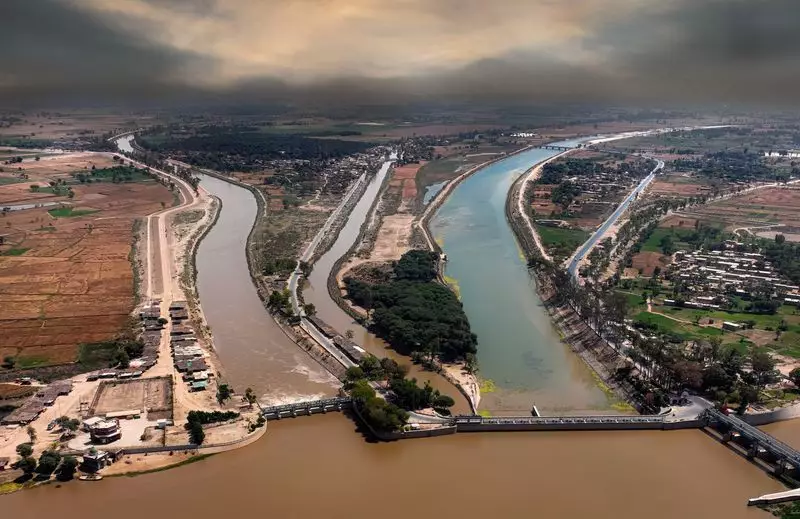
The sharing of river waters between India and Pakistan is governed by one of the world's most enduring, yet periodically tense, international agreements: the Indus Waters Treaty (IWT). Signed on September 19, 1960, in Karachi by then Indian Prime Minister Jawaharlal Nehru and Pakistani President Ayub Khan, with the World Bank as a guarantor, this pact has survived multiple wars and diplomatic crises. However, recent developments have brought it under unprecedented strain, raising questions about its future and its critical role in regional water security.
The Foundation: Dividing the Six Rivers of the Indus System
The treaty's core principle is the division of the six major rivers of the Indus basin. The three "western rivers" – the Indus, Jhelum, and Chenab – were allocated to Pakistan for largely unrestricted use, with some exceptions for India. Conversely, the three "eastern rivers" – the Ravi, Beas, and Sutlej – were allocated to India.
This arrangement was not merely a geographical split but a complex engineering solution. To compensate Pakistan for losing the eastern rivers, a transition period was established, and crucially, India funded the construction of dams, canals, and barrages in Pakistan to help it build its irrigation network around the western rivers. The treaty meticulously outlines what India can and cannot do on the western rivers, allowing for limited use in run-of-the-river hydropower projects, domestic use, and non-consumptive needs, but strictly prohibiting storage that would alter the timing or volume of water flow to Pakistan.

Recent Flashpoints and the Path to Dispute Resolution
The treaty established a Permanent Indus Commission (PIC), with commissioners from both countries meeting annually and touring project sites. This has been its first line of defense. When disagreements arise, they are classified into three escalating stages:
- Questions: Handled by the PIC.
- Differences: Referred to a Neutral Expert.
- Disputes: Escalated to a Court of Arbitration.
Two major Indian hydropower projects have become focal points of contention: the 330 MW Kishanganga Hydroelectric Project on the Jhelum's tributary and the 850 MW Ratle Hydroelectric Project on the Chenab. Pakistan raised objections, leading to a rare and problematic situation where, in 2016, it sought the appointment of a Neutral Expert while simultaneously requesting a Court of Arbitration. India objected to this dual approach.
In 2022, the World Bank, acknowledging the treaty's ambiguity in such a scenario, took the unprecedented step of initiating both processes. A Neutral Expert was appointed, and a Chairman for the Court of Arbitration was named. This parallel mechanism created a legally complex situation. The Court of Arbitration, based in The Hague, began its proceedings in 2023, with India boycotting the hearings, arguing that the Neutral Expert process should take precedence.
Why the Treaty Remains Critically Important
Despite the friction, the Indus Waters Treaty is widely regarded as a success story in international water sharing for several compelling reasons:
- Survival Through Conflict: It has remained in force through three major wars (1965, 1971, 1999) and constant political hostility, proving its resilience.
- Framework for Dialogue: The PIC provides a mandatory, technical channel for communication, preventing water issues from completely derailing during crises.
- Economic Lifeline: The treaty is the backbone of agriculture and water security for millions in both nations, particularly in Pakistan, which relies on the Indus system for over 75% of its irrigation needs.
The current tensions underscore the treaty's evolving challenges. Climate change, increasing water demands, and the need for hydroelectric power are testing its decades-old provisions. The World Bank has urged both countries to find a mutually agreeable solution, emphasizing that the treaty's mechanisms are designed for cooperation, not conflict.

As the Neutral Expert process continues and the Court of Arbitration moves forward, the world watches closely. The future of the Indus Waters Treaty will not only determine water security for two nuclear-armed neighbors but also set a precedent for how the world manages shared river basins in an era of scarcity and geopolitical strife. Its survival matters because, flawed or stressed, it remains the only binding instrument preventing an outright water war in one of the planet's most volatile regions.