

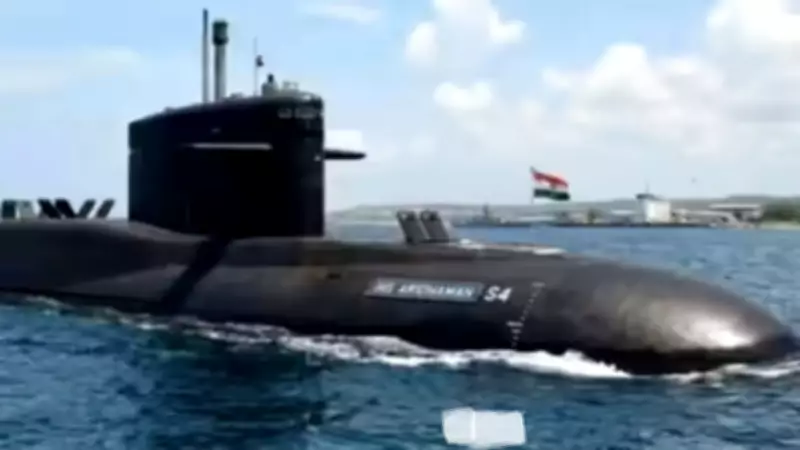
India's Third Nuclear-Powered Submarine INS Aridhaman Commissioned by Defense Minister
India's indigenous nuclear-powered submarine, INS Aridhaman, has been officially commissioned into the Indian Navy by Defense Minister Rajnath Singh. This significant event marks a major advancement in the nation's naval capabilities and strategic defense posture.
Enhanced Capabilities of INS Aridhaman
Built under the Advanced Technology Vessel project at the Ship Building Centre in Visakhapatnam, INS Aridhaman is a 7,000-tonne vessel, making it larger than its predecessors, INS Arihant and INS Arighaat, which weigh 6,000 tonnes each. The submarine features eight vertical launch system tubes, a notable upgrade from the four tubes on earlier models. This allows it to deploy:
- Up to 24 K-15 Sagarika short-range missiles with a range of 750 km
- Eight K-4 intermediate-range missiles capable of reaching 3,500 km
- Potential accommodation for K-5 missiles with an extended range of 6,000 km
Advanced Stealth and Propulsion Systems
INS Aridhaman is powered by an 83 MW Compact Light Water Reactor, an upgraded pressurised water reactor designed with a very low acoustic signature to enhance stealth. It is equipped with a seven-blade propeller, enabling speeds of 12–15 knots on the surface and 24 knots when submerged. Advanced indigenous sonar systems, including USHUS and Panchendriya, along with anechoic tiles, significantly improve its detection capabilities and stealth.

Strategic Importance for India's Nuclear Deterrence
The commissioning of INS Aridhaman strengthens India's sea-based nuclear deterrent, providing a robust "second-strike" capability. With three nuclear-powered ballistic missile submarines now under the Strategic Forces Command, India moves closer to achieving Continuous At-Sea Deterrence. This ensures that at least one nuclear submarine is always on patrol, enhancing national security.
Future Naval Developments and Base Stationing
INS Aridhaman will be stationed at Project Varsha, a high-security naval base with underground pens near Visakhapatnam. In addition to this development, India is set to acquire the Russian Akula-class nuclear-powered attack submarine, Chakra III, expected by 2027–28. Negotiations are also underway with Germany for six advanced diesel-electric submarines under Project-75(I), further expanding the naval fleet.
This commissioning represents a pivotal step in India's defense strategy, bolstering its position as a formidable maritime power with advanced nuclear capabilities.






