

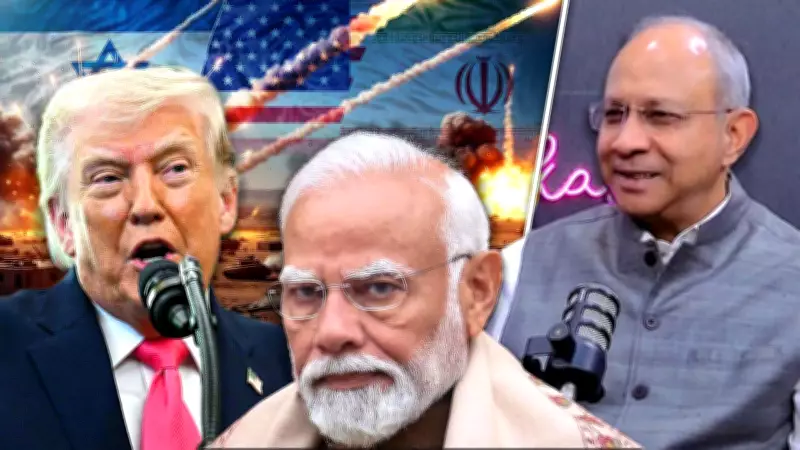
India's Strategic Silence in West Asia Benefits Multiple Nations, Says Former Deputy NSA
Former Deputy National Security Advisor Pankaj Saran has provided detailed insights into India's nuanced diplomatic approach toward the evolving security situation in West Asia and the Gulf region. In a significant analysis, Saran explained that India's deliberate "strategic silence" has proven beneficial not only for the United States and Israel but also for Gulf countries, while simultaneously safeguarding India's own national interests and core values.
Balancing National Interests with Core Values
When questioned about whether India's silence might indicate tacit support for US and Israeli positions in the region, Saran offered a nuanced perspective. "There is partial agreement with that assessment," he acknowledged, emphasizing that India's foreign policy must constantly navigate the delicate balance between pursuing national interests and upholding fundamental values. This balancing act becomes particularly crucial in a region marked by complex geopolitical rivalries and shifting alliances.
Saran highlighted the global criticism directed at US military actions, especially concerning operations in Iran, noting that such international scrutiny creates additional layers of complexity for nations like India that maintain relationships with multiple regional players. "India's foreign policy framework prioritizes maintaining strong, constructive ties across the entire region," Saran explained, "without necessarily aligning completely with any single nation's agenda."

Managing Regional Relationships and Rivalries
The former deputy NSA elaborated on India's careful diplomatic maneuvering, describing how New Delhi maintains relationships with both Gulf nations and Iran while keeping communication channels open. This approach requires sophisticated management of regional rivalries, including the longstanding tensions between Iran and Pakistan that periodically affect broader regional stability.
"India's strategic silence should not be misinterpreted as indifference or lack of position," Saran clarified. "Rather, it represents a calculated diplomatic posture that allows India to protect its substantial interests in the region while avoiding unnecessary entanglement in conflicts that don't directly threaten Indian security or economic priorities."
This diplomatic strategy enables India to continue its energy imports from the region, protect the welfare of millions of Indian expatriates working in Gulf countries, and maintain crucial trade relationships that contribute significantly to India's economic growth and energy security.
Regional Implications and Future Considerations
Saran's analysis suggests that India's approach has created space for continued engagement with all regional stakeholders, even as tensions periodically escalate. By avoiding public alignment with any particular side in regional disputes, India preserves its ability to play constructive roles in conflict resolution when opportunities arise and maintains its reputation as a relatively neutral actor in a polarized geopolitical landscape.
The former security official's comments come at a time when West Asia faces multiple security challenges, including ongoing conflicts, territorial disputes, and great power competition. India's "strategic silence" represents what Saran describes as "a mature foreign policy approach that recognizes the limitations of public positioning while maximizing diplomatic flexibility and protecting national interests across multiple dimensions."






